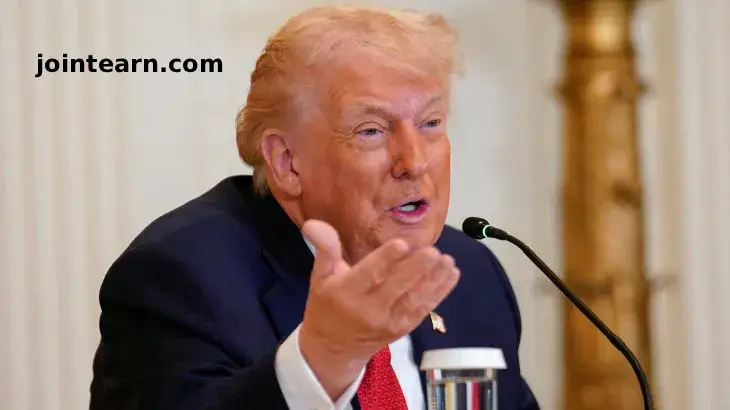
US President Donald Trump has escalated tensions with European allies by threatening to impose tariffs on countries that refuse to support US control over Greenland, describing the Arctic island as essential to American national security. His comments come amid renewed diplomatic efforts by US lawmakers to ease growing strains between Washington, Denmark, and Greenland.
Since returning to the White House in January, Trump has repeatedly stated that the United States must control Greenland — a semi-autonomous Danish territory and NATO ally — arguing that the island’s strategic location and mineral wealth make it indispensable to US defence interests.
Trump Floats Tariffs to Pressure Allies Over Greenland
Speaking on Friday during an unrelated White House event focused on rural healthcare, Trump said he could use economic pressure to advance Washington’s position on Greenland.
“I may put a tariff on countries if they don’t go along with Greenland,” Trump said. “Because we need Greenland for national security.”
The president compared the potential move to previous tariff threats against European allies over pharmaceutical trade disputes, signalling a willingness to use trade leverage to influence geopolitical outcomes.
While Trump has previously refused to rule out the use of force to secure Greenland, this marked the first time he explicitly suggested tariffs as a tool to pressure allies into supporting US control of the territory.
‘Vital for National Security’: Trump Reiterates Strategic Importance
Trump later doubled down on his position, telling reporters that Greenland is crucial to closing what he described as a dangerous gap in US defence.
“We need Greenland for national security very badly,” he said. “If we don’t have it, we have a big hole in national security, especially when it comes to what we’re doing with the Golden Dome.”
The president also said discussions were underway with NATO regarding Greenland’s future, though he provided no further details.
US officials and analysts have long cited Greenland’s importance due to:
- Its strategic Arctic location
- Proximity to Russia and key shipping routes
- Vast reserves of critical minerals
- Its role in missile detection and early-warning systems
Denmark and Greenland Push Back as NATO Allies Reject Claims
European leaders have firmly rejected Trump’s assertions, insisting that only Denmark and Greenland’s people can decide the island’s future.
Greenland’s government has repeatedly stated that it has no interest in joining the United States, while Denmark has reaffirmed its sovereignty over the territory, even as it cooperates closely with Washington through NATO.
Earlier this week, Denmark announced it would increase its military presence in Greenland, coordinating with allies amid rising geopolitical tensions in the Arctic.
Denmark’s Arctic Commander: Focus Is on Russia, Not the US
The head of Denmark’s Joint Arctic Command, Major-General Soren Andersen, downplayed fears of conflict with the United States, saying his primary concern remains Russia, not Washington.
“My focus is not toward the US, not at all,” Andersen told Reuters aboard a Danish warship in Nuuk, Greenland’s capital. “My focus is on Russia.”
He dismissed the idea of military confrontation between NATO allies as “hypothetical” and stressed that Denmark’s defence preparations are routine.
“I don’t see a NATO ally attacking another NATO ally,” Andersen said.
NATO Exercises and Growing Arctic Militarisation
In response to rising tensions, several European nations dispatched small military contingents to Greenland this week ahead of the Arctic Endurance NATO exercise, which is designed to test forces under extreme winter conditions.
Denmark has invited the United States to participate in the drills, though it remains unclear whether Washington will join.
Andersen said NATO allies maintain strong surveillance over the region and currently see no immediate Chinese or Russian naval presence near Greenland, aside from a Russian research vessel operating hundreds of nautical miles away.
However, he warned that Russian activity in the Arctic is expected to increase in the coming years, requiring greater NATO preparedness to defend its northern flank.
US Lawmakers Seek to ‘Lower the Temperature’ in Copenhagen
Amid Trump’s rhetoric, a bipartisan delegation of US lawmakers travelled to Copenhagen on Friday in an effort to calm tensions and reassure Danish and Greenlandic leaders.
The delegation, led by Democratic Senator Chris Coons, met with Danish Prime Minister Mette Frederiksen, Greenlandic Prime Minister Jens-Frederik Nielsen, and senior parliamentarians.
“There’s a lot of rhetoric, but not a lot of reality in the current discussion in Washington,” Coons said, adding that lawmakers aimed to “lower the temperature” when they returned home.
The delegation emphasised that Congress views Greenland as an ally, not property, distancing itself from Trump’s statements.
Disagreements Over Working Group Expose Rift
Earlier in the week, Denmark and Greenland’s foreign ministers met US Vice President JD Vance and Secretary of State Marco Rubio in Washington.
While the meeting produced an agreement to establish a working group, Danish officials and the White House later offered sharply different interpretations of its purpose, highlighting ongoing mistrust between the sides.
Trump Envoy Signals Deal Is Possible
Trump’s special envoy to Greenland, Jeff Landry, said he plans to visit the territory in March and believes a negotiated agreement is possible.
“The president is serious,” Landry told Fox News. “He’s laid the markers down. Now it’s a matter of having Secretary Rubio and Vice President Vance make a deal.”
Al Jazeera’s Alan Fisher, reporting from Washington, said Landry’s visit may prove more revealing than Trump’s tariff threats.
“If the envoy pushes the idea of US control over Greenland, he will hit a red line,” Fisher said, noting strong resistance from Danish officials.
Arctic Tensions Highlight Wider Geopolitical Shift
Trump’s remarks underscore a broader geopolitical struggle in the Arctic, where melting ice has opened new shipping routes and intensified competition over natural resources.
As the US, Russia, and China vie for influence, Greenland has emerged as a critical focal point — but one firmly defended by Denmark and its European allies.
For now, diplomacy continues, even as Trump’s rhetoric raises concerns about the future of US-Europe relations and NATO unity.


Leave a Reply