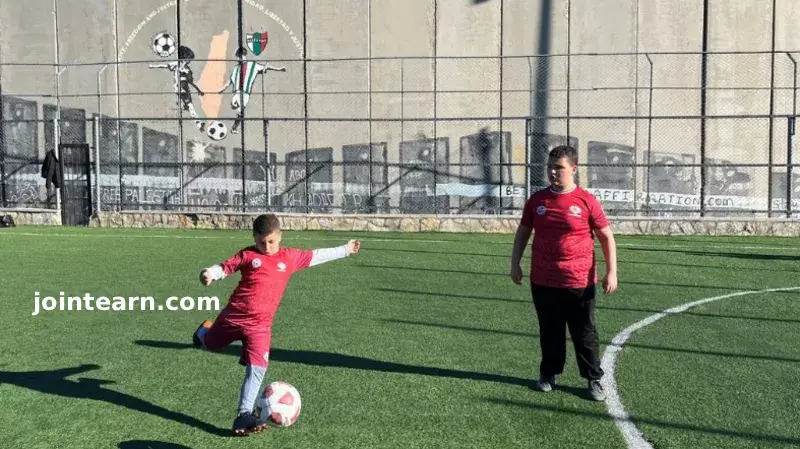
A Palestinian children’s football club in the occupied West Bank is facing the threat of demolition after Israeli authorities claimed the pitch was built without permits. Supporters say the pitch provides a rare sporting opportunity for local youth, but the order has drawn international attention due to the symbolic and human impact of the decision.
The pitch, built on the edge of Bethlehem in 2020, serves over 200 young players from the nearby Aida refugee camp, a densely populated area home to descendants of Palestinian families displaced during the 1948 Arab-Israeli war.
Children’s Voices: “If They Demolish Our Field, They Will Demolish Our Dreams”
On a winter afternoon, children line up to take penalty shots on the artificial turf beneath the shadow of the concrete barrier separating Israel from much of the West Bank. Ten-year-old Naya, wearing a Brazil shirt with Neymar’s name, told the BBC:
“We don’t have anywhere else to play. We are building our dreams here. If they demolish our field, they will demolish our dreams.”
Another player, Mohammed, said:
“I was upset. This is a field I really care for.”
Despite the grassroots efforts to keep the pitch intact, including social media campaigns and petitions with hundreds of thousands of signatures, Israeli authorities issued a demolition order, giving the club the choice of dismantling it themselves or facing forced demolition and subsequent charges.
Legal and Political Context
The pitch sits in a complex administrative zone. While Bethlehem city is under Area A control, Israel asserts civil authority over the surrounding countryside classified as Area C, where the pitch was built.
Under the Oslo Accords of the 1990s, Area C—over 60% of the West Bank—was to remain under Israeli control temporarily, with eventual transfer to Palestinian civil governance. That transfer never occurred, leaving the area under Israeli jurisdiction.
Satellite imagery shows the plot was vacant in 2019, gradually transformed into a football pitch in 2020. Israeli authorities claim it violates planning laws, even though the club says it received verbal permission when construction began.
The Wall and the Wider Conflict
The pitch lies directly adjacent to the Israeli separation wall, a structure built in the early 2000s amid a wave of attacks, which critics say now restricts Palestinian movement, divides communities, and annexes land.
For residents of Aida, the pitch is more than just a field—it’s a space of hope and normalcy in a context marked by restrictions, occupation, and uncertainty. Board member Mohammad Abu Srour said:
“The Israelis don’t want us to have any kind of hope; they don’t want us to have any opportunity. The moment we lose hope and opportunity, we are going to leave.”
Meanwhile, Israel continues to approve construction of new settlements in Area C, considered illegal under international law. In September, Prime Minister Benjamin Netanyahu signed plans for a settlement that could house 20,000 Israelis, cutting through Palestinian land and potentially undermining hopes for a future Palestinian state.
Israeli Authorities Respond
The Israeli military, overseeing civilian affairs in Area C, stated:
“Along the security fence, there is a confiscation order and a prohibition on construction; therefore, the construction in the area was carried out unlawfully.”
The football club has received a short reprieve, but the extension has expired, leaving the pitch’s future uncertain.
International Attention
The case has gained significant attention, highlighting the intersection of politics, occupation, and children’s rights. Supporters hope global awareness might influence Israeli authorities to allow the pitch to remain, providing local youth with a space to play football safely.
For now, as the wider Israeli-Palestinian conflict continues, the fate of this small but symbolic football pitch remains hanging in the balance.
Key Facts About the Aida Youth Football Pitch
- Location: Bethlehem, West Bank
- Established: 2020
- Players Served: Over 200 children
- Threat: Demolition by Israeli authorities
- Legal Status: Built in Area C without formal permits
- Significance: Provides rare sporting and recreational space for Palestinian children
- International Response: Social media campaigns, petitions, and global support


Leave a Reply