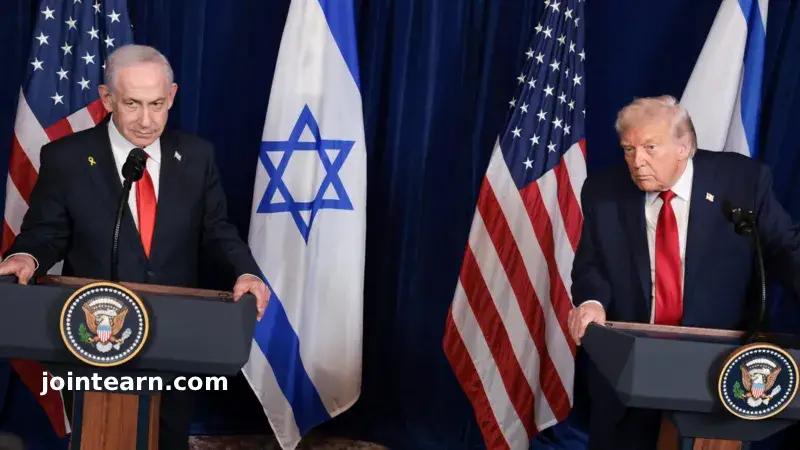
Israel has expressed strong objections to U.S. President Donald Trump’s newly announced “Board of Peace” for Gaza, signaling a growing diplomatic tension between the two allies over the management of the Palestinian territory. Israeli Prime Minister Benjamin Netanyahu convened an emergency meeting with his senior advisers after Washington named key figures to the Gaza Executive Board without prior consultation with Israel.
The development comes as part of Trump’s 20-point plan to resolve the Israel-Hamas conflict, which includes temporary administrative oversight of Gaza and a long-term reconstruction strategy.
Key Members of the Gaza Executive Board
The United States officially announced the first members of the Gaza Executive Board on Saturday. The board includes high-profile international figures such as:
- Mevlüt Çavuşoğlu, Foreign Minister of Turkey
- A senior official from Qatar
- Tony Blair, former Prime Minister of the United Kingdom
- Jared Kushner, senior adviser and son-in-law of Donald Trump
Notably, the appointments excluded Israeli officials in the decision-making process, prompting Netanyahu’s office to declare that the move “was not coordinated with Israel and runs contrary to its policy.”
Structure and Role of the Board of Peace
The Board of Peace is a multi-tiered governance initiative aimed at overseeing Gaza’s administration and reconstruction:
- Gaza Executive Board – Tasked with on-the-ground oversight of Gaza’s infrastructure, humanitarian aid distribution, and operational management. The board will coordinate with the National Committee for the Administration of Gaza (NCAG).
- Founding Executive Board – A smaller, high-level advisory group including Kushner and Blair, focusing on diplomacy, investment, and global fundraising initiatives.
While some members have been confirmed, the exact structure and membership of both boards remain fluid, with additional world leaders reportedly being invited to participate.
Israel and Palestinian Representation
So far, Israel has only one representative on the Gaza Executive Board: Yakir Gabay, an Israeli-born businessman currently based in Cyprus. Remarkably, no Palestinians have been appointed to either board, raising concerns about the legitimacy and inclusiveness of the initiative.
Israel’s far-right National Security Minister Itamar Ben-Gvir criticized the board, posting on X:
“The Gaza Strip does not need any ‘administrative committee’ to oversee its ‘rehabilitation’ – it needs to be cleansed of Hamas terrorists.”
Meanwhile, opposition leader Yair Lapid described the appointments as a “diplomatic failure for Israel,” highlighting the domestic political controversy surrounding the move.
International Reactions and Financial Considerations
The White House stated that the overarching Board of Peace would include world leaders, with President Trump serving as chairman. Countries reportedly invited include the UK, Hungary, Argentina, Jordan, Turkey, India, and Egypt.
So far, only Hungarian Prime Minister Viktor Orban has publicly confirmed participation. Other governments, including the UK and Canada, have approached the invitations cautiously, seeking clarity on the board’s mandate and financial obligations.
Reports indicate that Trump has requested countries to contribute $1 billion (£745 million) to join the initiative. However, a U.S. official clarified that participation could also be on a three-year membership basis without financial contribution, leaving options open for interested countries.
Canada’s Governor Mark Carney expressed support for the plan in principle but emphasized that detailed financial and operational arrangements were still being finalized.
Humanitarian Crisis in Gaza
Amid political maneuvering, the humanitarian situation in Gaza remains critical. The United Nations warns that the crisis is “far from over,” with around 80% of buildings destroyed or damaged during the recent conflict.
Survivors face harsh winter conditions, food shortages, and limited access to healthcare. Olga Cherevko, from the UN aid coordination office, described aid delivery and infrastructure repairs since the ceasefire as a “band-aid” solution rather than a sustainable fix.
Israel has stated that it is facilitating humanitarian assistance while criticizing the UN for inefficient distribution. Israel maintains that certain restrictions are necessary to prevent Hamas from exploiting relief efforts, further complicating aid delivery.
The Road Ahead for Gaza’s Reconstruction
As the Board of Peace begins to take shape, several key challenges remain:
- Diplomatic tensions between Israel, the U.S., and Palestinian stakeholders
- Ensuring inclusive representation for Gaza residents
- Raising sufficient funds and investment to support reconstruction and governance
- Addressing the ongoing humanitarian crisis in a war-torn region
The success of Trump’s initiative will hinge on balancing these factors while gaining the support of both regional actors and the international community.


Leave a Reply