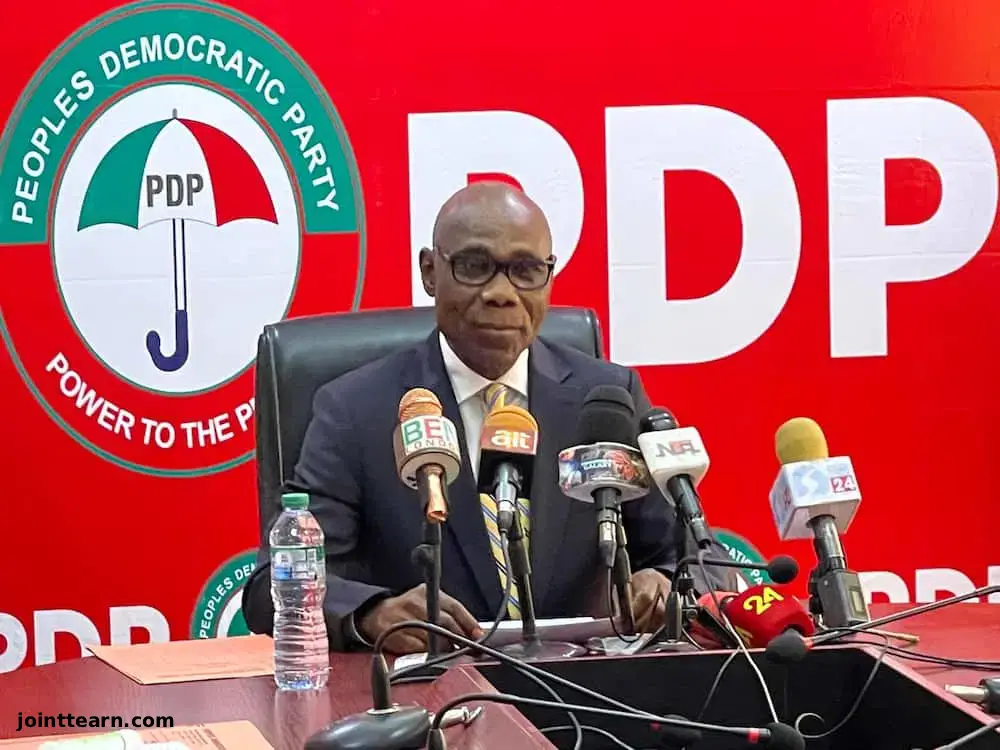
The Peoples Democratic Party (PDP) has described the Federal High Court’s decision halting its planned national convention as a grave assault on Nigeria’s democratic process, vowing to appeal the ruling immediately.
In a statement issued Friday night by the party’s National Publicity Secretary, Debo Ologunagba, the PDP urged its members to continue preparations for the convention despite the setback.
“The Peoples Democratic Party is appalled by the judgment of the Federal High Court, Abuja, presided over by Hon. Justice Kolawole Omotosho. It is an assault on Nigeria’s democratic process,” Ologunagba said.
“However, this judgment does not vitiate our ability to proceed with activities toward our national convention to elect new officers to pilot the affairs of the party for the next four years.”
Ologunagba cited a recent Supreme Court ruling that reaffirmed the supremacy of political parties in managing their internal affairs, saying the PDP remains committed to the rule of law and democratic principles.
“As a law-abiding party, we have directed our lawyers to take immediate steps to appeal the judgment in our unwavering determination to defend and promote multi-party democracy in Nigeria,” he added.
PDP Leaders React
National Chairman Ambassador Umar Iliya Damagum described the court order as the handiwork of “saboteurs” bent on destabilizing the party ahead of the 2027 elections.
Similarly, former Deputy National Chairman Chief Olabode George condemned the ruling, calling it “the joke of the century, an open recipe for anarchy, and a display of judicial brigandage.”
“This judgment will consume this country. The Chief Justice of Nigeria and the National Judicial Council must call this judge to order,” George said.
“What power does he have to order the PDP not to hold its national convention? During all our congresses, INEC officials were present and monitored the process. The judge never cross-checked facts with INEC. Are we still in a democracy?”
He warned that the judiciary was being used to undermine democracy and insisted the PDP had always followed due process since its formation in 1998.
Why the Court Stopped the Convention
In the four-hour ruling, Justice James Omotosho of the Federal High Court, Abuja, held that the PDP had failed to meet key constitutional and procedural conditions required to hold its convention scheduled for November 15–16 in Ibadan, Oyo State.
The court found that the party did not conduct valid state congresses in at least 14 states before fixing the convention dates and failed to properly notify the Independent National Electoral Commission (INEC) as required by law.
The suit — FHC/ABJ/CS/2120/2025 — was filed by three aggrieved members:
- Hon. Austin Nwachukwu (Imo PDP Chairman)
- Hon. Amah Abraham Nnanna (Abia PDP Chairman)
- Turnah Alabh George (PDP Secretary, South-South)
They alleged that the PDP violated its constitution, INEC guidelines, and the 1999 Constitution (as amended) by failing to conduct valid congresses before the planned convention.
Justice Omotosho ruled that notices for the convention, signed only by the National Chairman without the National Secretary’s signature, were invalid. He directed the PDP to “go back and put its house in order” and to issue proper 21-day notices to INEC for congresses and meetings.
The court also restrained INEC from recognizing or publishing any outcome of the Ibadan convention until the PDP complies with all legal and constitutional requirements.
Lamido’s Failed Bid to Halt the Convention
In a related matter, Justice Peter Lifu of the same court rejected an ex-parte application filed by former Jigawa State Governor Sule Lamido, who sought an interim injunction to restrain the PDP and INEC from proceeding with the convention.
Lamido, who was denied a nomination form to contest for National Chairman, filed suit FHC/ABJ/CS/2299/2025, arguing that the process violated his rights.
Justice Lifu, however, declined to grant the order and directed that the defendants be put on notice before any hearing, adjourning the case to November 6.
‘Delay Is Not Denial’ – PDP Leaders See Opportunity
Despite the setback, many within the party see the judgment as a “pause for reflection” rather than a death blow. Some PDP leaders say it could provide an opportunity for reconciliation and internal reform.
Timothy Osadolor, Deputy National Youth Leader, said the delay offers a chance to heal divisions.
“It’s quite unfortunate, but delay is not denial. The leadership must use this period to address unresolved issues, especially in the South East where some congresses are yet to conclude,” he said.
Hon. Austin Nwachukwu, one of the plaintiffs, welcomed the judgment, saying it merely enforced due process.
“The court said the right thing — the PDP must do things properly. That was our only prayer,” he said.
Rt. Hon. Jones Onyereri, a member of the PDP Board of Trustees, echoed similar sentiments:
“You can’t go against your own constitution or INEC guidelines. The court was right. This judgment compels us to do the right thing and follow procedure.”
Mixed Reactions and Next Steps
While some party stalwarts privately admitted that the court’s decision could derail momentum ahead of 2027, others believe it may prevent greater chaos.
A senior PDP chieftain from Kano, who requested anonymity, said the party should obey the ruling and avoid further escalation.
“There’s no time to appeal before the scheduled convention. The best thing is to obey the order and reorganize,” he said, alleging that “some internal saboteurs aligned with the ruling party” were behind the crisis.
The Bigger Picture
The judgment has exposed long-standing internal divisions within the PDP — from disputed congresses in the South East and South South to battles over zoning and leadership positions.
Yet, amid frustration, many members remain optimistic that this court-induced pause could finally push the opposition party to confront its internal contradictions and rebuild unity ahead of the next general elections.
For now, the fate of the PDP’s national convention — and perhaps its political future — hangs between the weight of the law and the test of party loyalty.


Leave a Reply