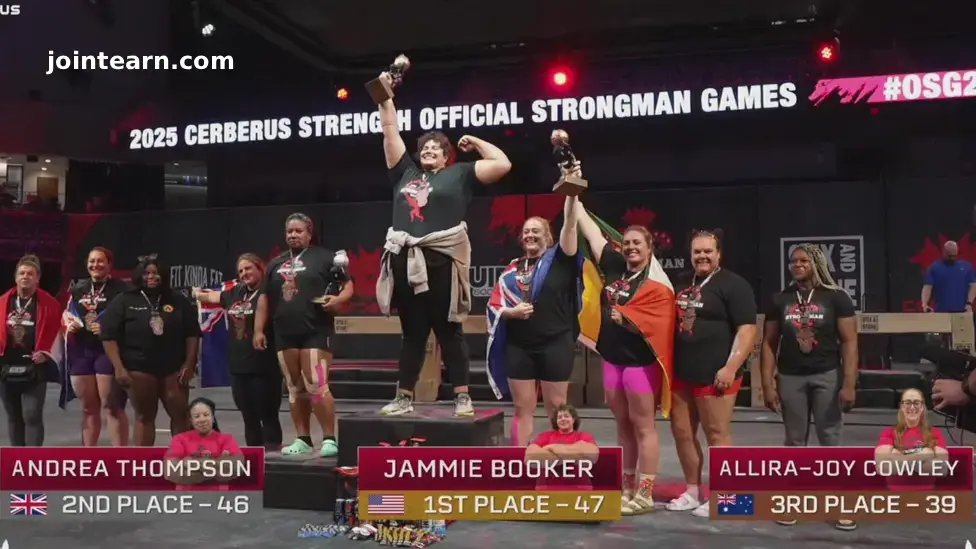
British strength athlete Andrea Thompson has been retrospectively awarded the World’s Strongest Woman title after American competitor Jammie Booker was disqualified for being ineligible to compete in the women’s category.
Thompson, 43, expressed frustration that her moment of victory was “overshadowed” by an athlete who, according to competition rules, should not have been competing.
“I was very frustrated and angry with what she’s done,” Thompson told BBC Sport. “She lied and was very dishonest, and took away a lot of things from a lot of women.”
The disqualification was confirmed by the organisers, Official Strongman, who stated that competitors must participate in the category corresponding to their biological sex at birth. Booker’s records indicated she is biologically male, prompting her removal from the Women’s Open category.
The Controversy
The competition took place in Arlington, Texas, and featured more than 400 athletes from nearly 40 countries. The Official Strongman Games are considered one of the pinnacles of international strength competition, with participants competing across multiple disciplines over three days, including the log press, timber frame carry, and deadlift ladder.
Thompson initially finished second to Booker but was only informed of the disqualification after the event concluded.
“There was nothing at all during the competition—no one had any reason to suspect anything,” Thompson said. “It was about six hours after that the first rumours started going round, and then the organisers contacted me. It’s a massive achievement that’s been overshadowed by some dishonesty.”
Thompson, who previously won the title in 2018, also highlighted the impact on other athletes:
“The lady that came 11th didn’t get the chance to do the third day… to have the top 10 status in the world.”
Rules and Gender Eligibility
Official Strongman clarified that all athletes are assigned to male or female categories based on their sex recorded at birth. The organisation stated that officials were unaware of Booker’s biological sex prior to the competition.
Although Texas has legislation restricting biological males from competing in female collegiate sports, this law does not cover private strength competitions. Thompson suggested that future strongwoman events might introduce sex screening to prevent similar issues.
“I guess it’s going to have to go down that route… but our sport is still quite new. There’s not enough money in it to have these things in place. We rely on the honesty of the athletes.”
Broader Context in Sports
The debate over transgender athletes competing in elite female sports has intensified globally. Several sports federations, including World Aquatics and World Athletics, have introduced rules restricting athletes who have gone through male puberty from competing in female categories.
In May 2025, the Football Association and the England and Wales Cricket Board implemented similar measures following the UK Supreme Court’s ruling that the legal definition of a woman is based on biological sex.
However, the issue remains controversial, with trans rights advocates arguing that these rules could violate human rights and that inclusion should take precedence.
World Athletics has claimed that 50 to 60 athletes who underwent male puberty have been finalists in female track and field championships since 2000.


Leave a Reply