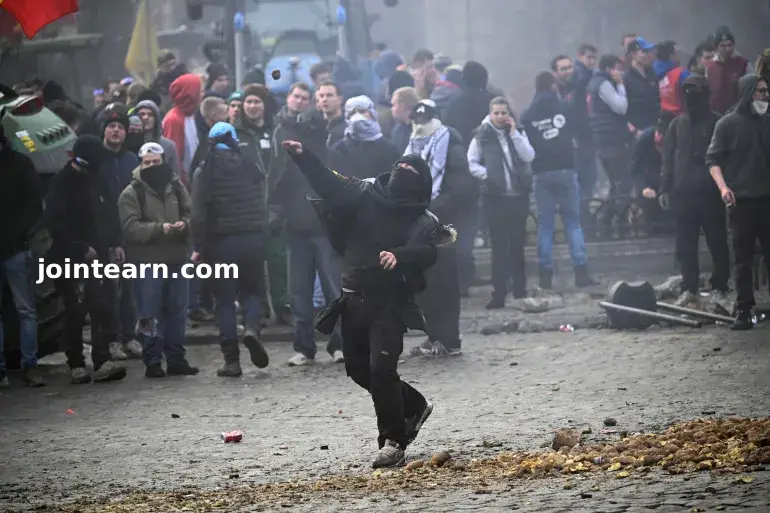
Thousands of European farmers brought the streets of Brussels to a standstill on Thursday, blocking roads with hundreds of tractors in a dramatic protest against the EU-Mercosur trade agreement. Farmers fear the trade pact, which would open European markets to cheaper agricultural products from South America, threatens to devastate local livelihoods.
Tractor Convoys and Chaos in Brussels
The protest saw more than 150 tractors clogging the streets of central Brussels, while an estimated 10,000 demonstrators gathered in the European Quarter, according to farm lobby Copa-Cogeca. Protesters hurled potatoes, eggs, and firecrackers at police, disrupting traffic and creating a tense atmosphere outside the European Parliament.
Authorities responded with tear gas, water cannons, and roadblocks, closing tunnels and key roads to contain the protests. One tractor prominently displayed a sign reading:
“Why import sugar from the other side of the world when we produce the best right here?”
Belgian dairy farmer Maxime Mabille told reporters:
“We’re here to say no to Mercosur. It feels like the European Commission is trying to force the deal through. Europe has become a dictatorship.”
Farmers’ Concerns Over Mercosur Imports
Protesters argue that the agreement would allow an influx of beef, sugar, rice, honey, and soybeans from Brazil and neighboring countries, which face less stringent regulations compared to the EU, particularly regarding pesticides banned in Europe. Farmers warn that local producers will be undercut, threatening jobs and small-scale agricultural economies.
“We’ve been protesting since 2024 in France, Belgium, and elsewhere,” said Florian Poncelet of the Belgian farm union FJA. “We’d like to finally be listened to.”
EU Leaders Split on Trade Deal
The Brussels protest coincided with a tense EU summit, where leaders debated the fate of the Mercosur trade agreement, which has been in negotiation for 25 years. France and Italy have emerged as key opponents, with President Emmanuel Macron declaring the pact “cannot be signed” in its current form. France is coordinating with Poland, Belgium, Austria, and Ireland to block or delay the agreement.
Conversely, Germany and Spain are pushing for approval. German Chancellor Friedrich Merz emphasized the need for urgent decisions to maintain Europe’s credibility in global trade, while Spanish Prime Minister Pedro Sanchez argued the deal strengthens Europe’s geopolitical and geo-economic position.
Significance of the Mercosur Trade Agreement
If ratified, the Mercosur-EU trade pact would create the world’s largest free-trade area, covering 780 million people and a quarter of global GDP. Supporters highlight benefits such as boosting European exports of vehicles, machinery, and wines, and counterbalancing China amid rising US tariffs.
Despite provisional safeguards to cap sensitive imports, opposition from farmers and key EU nations has intensified. European Commission President Ursula von der Leyen plans to travel to Brazil to sign the deal but requires support from at least two-thirds of EU member states.
Brazilian President Luiz Inacio Lula da Silva issued a strict warning, stating that Saturday marks a “now or never” moment and that no further agreements will be made while he is president if the Mercosur deal fails.
Conclusion
The Brussels tractor blockade underscores the deep divisions within the EU over trade policy and the challenge of balancing global economic ambitions with the protection of European farmers. As tensions mount, the coming days will be crucial in determining whether the Mercosur deal moves forward or faces further delays.


Leave a Reply