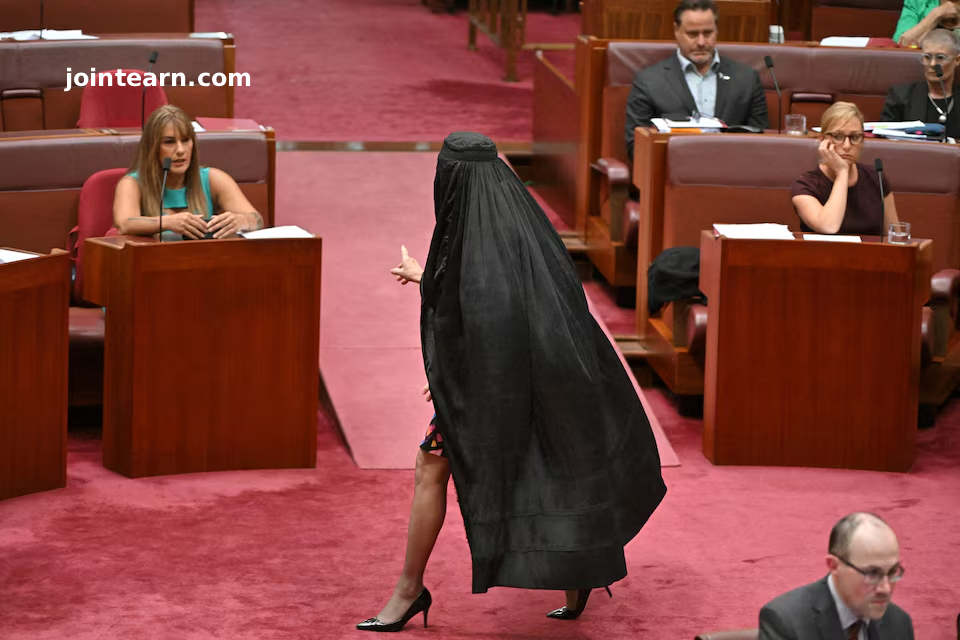
Australia’s Senate has suspended far-right Senator Pauline Hanson for seven sitting days after she wore a burqa to Parliament as a political prop. The stunt, intended to advance her campaign to ban the Muslim garment in public, sparked widespread condemnation from lawmakers and Muslim communities for being offensive and disrespectful.
Context of the Incident
The incident occurred on Monday after Hanson was denied permission to introduce a bill that would ban burqas and other face coverings in public spaces. In response, she wore the garment in the Senate chamber at Parliament House in Canberra, drawing immediate criticism for mocking Islamic practices.
The motion to censure Hanson passed overwhelmingly, 55-5, leading to her suspension.
Political and Social Reactions
Foreign Minister Penny Wong, who leads the centre-left Labor government in the Senate, condemned Hanson’s actions:
“Senator Hanson’s hateful and shallow pageantry tears at our social fabric and makes Australia weaker. It has cruel consequences for many of our most vulnerable.”
Wong emphasized that the stunt mocked and vilified nearly a million Australians who observe Islam and criticized Hanson for showing disrespect to the Parliament.
Hanson’s Defense
Hanson defended her actions, reiterating her stance against the burqa and arguing there is no formal dress code for Parliament. She stated:
“If you can wear a helmet into a bank or any other venue where they ask you to take it off, why is the burqa any different? I’ll stand my ground and continue to express my beliefs. The people will judge me.”
Hanson has a long history of anti-immigration and nationalist campaigning, first gaining prominence in the 1990s due to her opposition to immigration from Asia and asylum seekers. She has repeatedly targeted Islamic clothing, and this marks the second time she has worn a burqa in Parliament, repeating a similar stunt in 2017.
One Nation Party and Rising Influence
The One Nation party, led by Hanson, has expanded its Senate presence to four seats, gaining two additional seats in the May 2025 general election. Recent opinion polls indicate growing support for Hanson, reflecting rising nationalist sentiment and debates over immigration and cultural integration in Australia.
Hanson’s actions and the Senate’s response highlight the tensions in Australian politics over freedom of expression, religious tolerance, and multiculturalism.
Conclusion
The suspension of Senator Pauline Hanson underscores the Parliament’s stance against discriminatory behavior while spotlighting ongoing debates around Islamic dress, nationalism, and political theatrics in Australia. As Hanson continues her campaign, the incident is likely to fuel further discussion about religion, cultural respect, and political conduct in Australian public life.


Leave a Reply