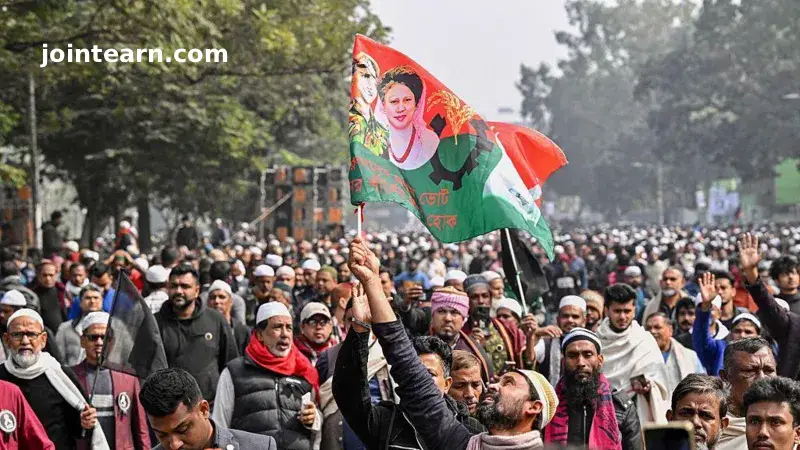
Hundreds of thousands of people gathered in Dhaka, Bangladesh, on Wednesday to pay their final respects to Khaleda Zia, the country’s first female prime minister, who passed away at the age of 80 after a prolonged illness.
The state funeral was a massive display of grief, with mourners lining the streets near the parliament building. Flags depicting Zia’s face were carried by supporters, while the national flag-draped hearse slowly made its way through the capital. Security forces were deployed in large numbers, and flags were flown at half-mast across the city.
Tributes from Citizens
Setara Sultana, an activist and supporter of Zia’s Bangladesh Nationalist Party (BNP), said:
“I have come this far just to say goodbye. I know I won’t be able to see her face, but at least I could see the vehicle carrying her for the last rites.”
Sharmina Siraj, a mother of two, called Zia “an inspiration,” highlighting programs initiated by the former prime minister that improved women’s education and provided stipends to support young girls’ learning.
“It is difficult to imagine women in leadership positions anytime soon,” Siraj told AFP.
International Attendance
Dignitaries from across the region attended the funeral, including:
- India’s External Affairs Minister S. Jaishankar
- Speaker of Pakistan’s National Assembly Sardar Ayaz Sadiq
- Bhutan’s Foreign Minister Lyonpo DN Dhungyel
Earlier in the day, Zia’s body was taken to her son Tarique Rahman’s residence, where he recited the Quran beside her office before the state funeral procession began.
Khaleda Zia’s Political Legacy
Khaleda Zia’s political journey began after the assassination of her husband, President Ziaur Rahman, in 1981, which thrust her into the national spotlight. She went on to lead the Bangladesh Nationalist Party (BNP) and became prime minister for the first time in 1991, returning for a second term in 2001.
Throughout her career, Zia faced significant political challenges, including opposition from military rulers and her long-standing rival, Sheikh Hasina. She was briefly detained during the 2007 military-backed caretaker government and spent years in opposition under Hasina’s rule.
Despite these setbacks, she remained a symbol of resilience and democratic principles. Supporters admired her refusal to compromise on key issues and her commitment to informed decision-making, earning her a reputation as an “uncompromising leader.”
Funeral and National Mourning
Zia’s funeral procession passed through Dhaka streets crowded with supporters, many of whom had traveled from across the country. She will be buried next to her late husband, Ziaur Rahman.
Economist Dr. Debapriya Bhattacharya noted that Zia’s political leadership left a lasting impression:
“She appreciated ideas and valued informed decision-making, making her a leader who inspired confidence among those she worked with.”
Even in her later years, Zia remained politically active. The BNP announced that she had intended to contest three parliamentary constituencies in the February 2026 elections, the first vote since a popular revolution unseated Hasina last year. Her son Tarique Rahman, who recently returned from 17 years in exile in London, is expected to play a central role in the party’s future.
“The country mourns the loss of a guiding presence that shaped its democratic aspirations,” Rahman said following her passing.
Conclusion
Khaleda Zia’s state funeral in Dhaka marked the end of a remarkable political journey—from homemaker to Bangladesh’s first female prime minister. Her leadership, resilience, and dedication to democracy left a lasting imprint on the nation, inspiring both supporters and political observers alike. The massive turnout for her funeral reflected her enduring popularity and the deep respect she commanded across generations in Bangladesh.


Leave a Reply