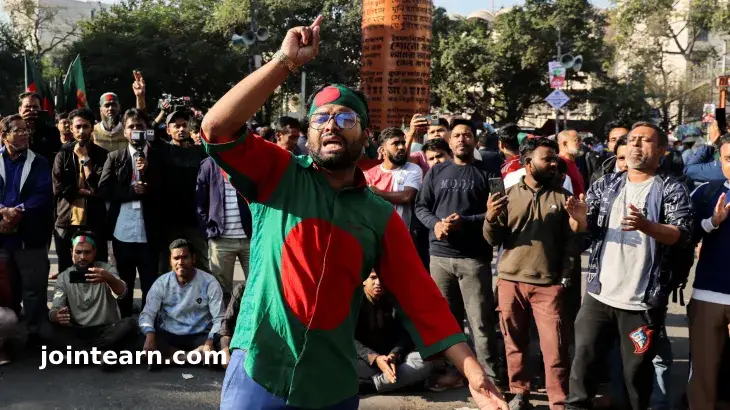
Bangladesh is witnessing a surge of unrest following the killing of Sharif Osman Hadi, a prominent activist and election candidate linked to the 2024 student-led uprising. Security forces have mobilized across Dhaka and major cities after violent demonstrations erupted, raising concerns over stability ahead of the February 2026 national elections.
The unrest began late Thursday when protesters, demanding justice for Hadi, targeted media offices, political buildings, and cultural institutions. On Friday, demonstrations intensified, with protesters blocking highways in Gazipur, north of Dhaka, as calls for accountability echoed nationwide.
Who Was Sharif Osman Hadi?
Hadi, 32, served as the spokesperson for Inquilab Moncho, also known as the Platform for Revolution. He had planned to contest the upcoming election when masked attackers shot him in the head during a campaign event in Dhaka. Initially treated at a local hospital, he was later flown to Singapore for advanced care but died after six days on life support.
Hadi was also known for his outspoken criticism of India and was a key figure in the 2024 student-led uprising that forced Prime Minister Sheikh Hasina to flee the country. His killing has reignited anti-government and anti-India sentiment, particularly among student groups and youth activists.
Nationwide Protests and Security Response
Following Hadi’s death, his body was repatriated to Bangladesh late Friday from Singapore, and a procession was organized to Shahbagh Square in Dhaka. Inquilab Moncho announced that students would continue disciplined protests over the next two days, ensuring the movement remained organized.
Authorities deployed police and paramilitary forces throughout Dhaka and other major cities to curb violence. Despite these measures, several incidents of arson and vandalism were reported, including attacks on Prothom Alo and The Daily Star newspaper offices. Firefighters rescued trapped journalists as security forces secured the areas.
Accusations Against India
The unrest has fueled anti-India sentiment in Bangladesh. Former Lieutenant Colonel Hasinur Rahman, speaking at a protest in Shahbagh, accused India of shielding perpetrators and backing authoritarian governance under Sheikh Hasina. Rahman demanded that India extradite Hasina and others responsible for political violence, asserting that some suspects had fled across the border.
India, however, has rejected these accusations, stating that it is closely monitoring Bangladesh’s internal situation without intervening in domestic affairs. Officials emphasized that the situation is fluid and requires impartial analysis.
Political Tensions Ahead of Elections
Bangladesh’s interim administration, led by Muhammad Yunus since August 2024, faces mounting pressure over delayed reforms. Hasina’s Awami League has been barred from participating in the February 12 elections, intensifying political tensions.
In a televised statement after Hadi’s death, Yunus called for calm, pledged a transparent investigation, and warned that ongoing violence could undermine the credibility of the elections. Saturday was declared a day of state mourning, with flags flown at half-staff and special prayers organized nationwide.
Legacy of Sheikh Hasina and Continued Violence
The legacy of Sheikh Hasina continues to shape the unrest. Protesters torched the home of Sheikh Mujibur Rahman, Bangladesh’s first president and Hasina’s father, which had already been attacked last year. Demonstrations spread to Rajshahi, Chittagong, and other districts, with offices of the Awami League bulldozed and highways blocked.
Anti-India sentiment intensified, especially after Hasina fled to New Delhi in August 2024. In November, Hasina was sentenced to death for crimes against humanity related to the 2024 uprising, in which over 1,400 protesters were killed and thousands injured, according to the United Nations.
Relatives of victims continue to demand justice, emphasizing that the country cannot move forward until those responsible, including Hasina, are held accountable.


Leave a Reply