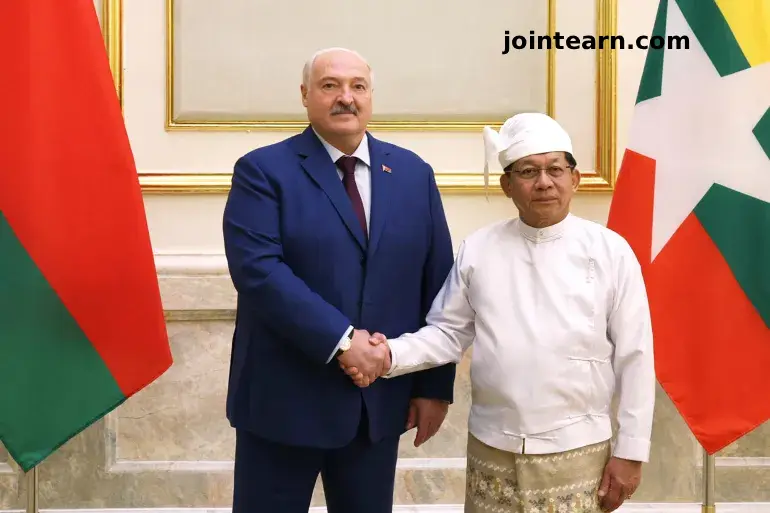
Belarusian President Alexander Lukashenko has arrived in Myanmar for a high-profile goodwill visit, becoming only the second head of state to travel to the country since the military seized power in February 2021. His arrival comes at a politically sensitive moment, with Myanmar’s military government preparing to hold national elections next month—polls that global analysts and democracy advocates have widely dismissed as illegitimate.
A Rare Diplomatic Engagement With an Isolated State
Myanmar’s state media highlighted the visit as a symbol of “trust” between the two governments. Lukashenko was received in Naypyidaw with full ceremonial honours by Senior General Min Aung Hlaing, the leader of the military administration, along with other top officials. The welcome included cultural performances and a formal reception at the Presidential Palace.
This marks the first visit by a Belarusian head of state since diplomatic relations were established 26 years ago. The only other foreign leader to travel to Myanmar following the coup was former Cambodian Prime Minister Hun Sen in 2022.
Support Ahead of Controversial National Elections
The Belarusian president’s trip comes just weeks before the military-led elections scheduled for late December. The polls have been condemned by many local and international observers due to widespread conflict, limited territorial control by the government, and the ongoing detention and dissolution of democratic opposition groups.
During their meeting, Lukashenko and Min Aung Hlaing discussed expanded cooperation and confirmed that Belarus will send an official team to observe the elections, a move analysts say could provide symbolic endorsement of the junta’s political roadmap. Myanmar’s military has repeatedly framed the upcoming polls as a step toward “normalcy,” despite significant instability across the nation.
Military and Economic Cooperation Expands
The two governments agreed to boost collaboration in military technology, trade, and industrial development. The announcement followed the signing of the Myanmar–Belarus Development Cooperation Roadmap 2026–2028 in Yangon.
Belarusian Foreign Minister Maxim Ryzhenkov stated that Myanmar holds “significant potential” in industrial sectors, while Belarus can contribute advanced engineering expertise. He highlighted agricultural mechanisation as a key area of cooperation, emphasizing Belarus’s manufacturing capacity for heavy machinery.
A Deepening Alliance Among Authoritarian States
Belarus, often described as one of Europe’s most authoritarian governments, continues to align closely with Russia and China—two of the few major powers that have maintained ties with Myanmar’s military leadership. Under Lukashenko, who has ruled since 1994, Belarus has increasingly strengthened relationships with countries isolated from Western democracies.
For Myanmar’s military, Belarusian engagement represents rare international recognition at a time when the junta faces global sanctions and diplomatic isolation.
Myanmar’s Ongoing Conflict and Election Challenges
Since the 2021 coup that ousted Aung San Suu Kyi’s National League for Democracy (NLD), Myanmar has been engulfed in escalating conflict. A wave of nationwide protests transformed into a full-scale civil war involving ethnic armed organizations and the anti-junta People’s Defence Force (PDF).
The military’s control has sharply eroded. Recent assessments suggest the junta may hold as little as 21% of the country, while resistance groups dominate vast areas. Even the government-led census conducted in late 2024 reached only 145 of Myanmar’s 330 townships, underscoring the difficulty of organizing nationwide elections.
Despite the instability, the junta has moved forward with pre-election steps, including a mass amnesty that released or dropped charges against 8,665 detainees, many of whom had been jailed for political resistance.
International Condemnation Likely to Continue
Observers widely expect the December polls to deepen Myanmar’s political crisis rather than resolve it. With major opposition parties banned or dismantled, and with violence ongoing across the country, analysts argue that the elections lack the conditions necessary for legitimacy.
Lukashenko’s visit, though symbolic, signals a tightening relationship between two internationally criticized governments—one in Europe and one in Southeast Asia—both seeking to reinforce their global standing amid sweeping condemnation.


Leave a Reply