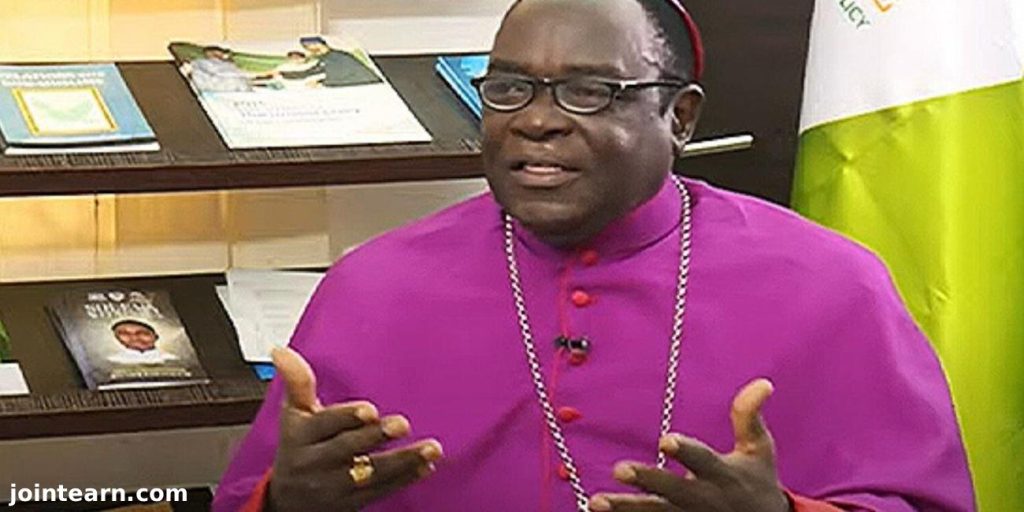
The Catholic Bishop of Sokoto Diocese and Convener of the National Peace Committee (NPC), Most Rev. Matthew Kukah, has reaffirmed that the killing of Christians in Nigeria does not meet the criteria for genocide, emphasising that genocide is determined by intent rather than the number of deaths recorded.
Speaking at the 46th Supreme Convention of the Knights of St. Mulumba (KSM) in Kaduna, Kukah addressed what he described as widespread misinterpretations of his earlier remarks. He referenced a detailed study he presented at the Vatican, saying:
“People say there is genocide in Nigeria. What I presented at the Vatican was a 1,270-page study on genocide in Nigeria and elsewhere. My argument is that it is not accurate to claim there is genocide or martyrdom in Nigeria.”
‘You can kill 10 million people and it still won’t be genocide’
Explaining further, Kukah noted that genocide is defined by a deliberate intention to eliminate a group—not by casualty numbers:
“Genocide is not based on the number of people killed. You can kill 10 million people and it still won’t amount to genocide. The critical determinant is intent.”
Questions martyrdom claims
Kukah also pushed back against broad descriptions of murdered Christians as “martyrs.”
“Because someone is killed in a church, does that automatically make them a martyr? Whether you are killed while stealing someone’s yam or attacked by bandits, does that qualify as martyrdom? We must think more deeply.”
He said he fully aligns with the Vatican Secretary of State, the President of the Catholic Bishops’ Conference of Nigeria, and all Catholic bishops in the country who maintain that Christians are not facing systematic persecution in Nigeria.
Disputes figures on church attacks
Kukah criticised statistics circulating about church burnings:
“They are saying that 1,200 churches are burnt in Nigeria every year, and I ask myself, in which Nigeria? Nobody approached the Catholic Church for accurate data. We do not know where these figures came from.”
He questioned why those spreading such numbers avoid consulting the Catholic Church, saying Catholics do not “indulge in hearsay.”
Christians hold significant influence, he argues
Challenging claims of widespread persecution, Kukah pointed to the influence Christians already hold:
“If you are a Christian in Nigeria and say you are persecuted, my question is: how? At least 80% of educated Nigerians are Christians, and up to 85% of the Nigerian economy is controlled by Christians. With such figures, how can anyone say Christians are being persecuted?”
He added that unity among Christians would help counter marginalisation:
“The main problem is that Christians succumb to bullies. The day we decide to stand together… these things will stop.”
Kukah warns U.S. against escalating tensions
In October, Kukah advised the United States not to redesignate Nigeria as a “Country of Particular Concern” (CPC) for religious freedom violations, arguing that such a move would heighten tensions and enable criminals to exploit religious divides. He said it would undermine efforts by religious leaders and the government to promote interfaith dialogue under President Bola Tinubu.
Instead, he urged global partners to support Nigeria through “vigilance and partnership,” not punishment.
U.S. reinstates CPC designation
Despite these concerns, in November U.S. President Donald Trump officially redesignated Nigeria as a CPC for severe violations of religious freedom. This marks the second time a Trump administration has taken this step—the first being in December 2020. The Biden administration later removed the designation in November 2021.


Leave a Reply