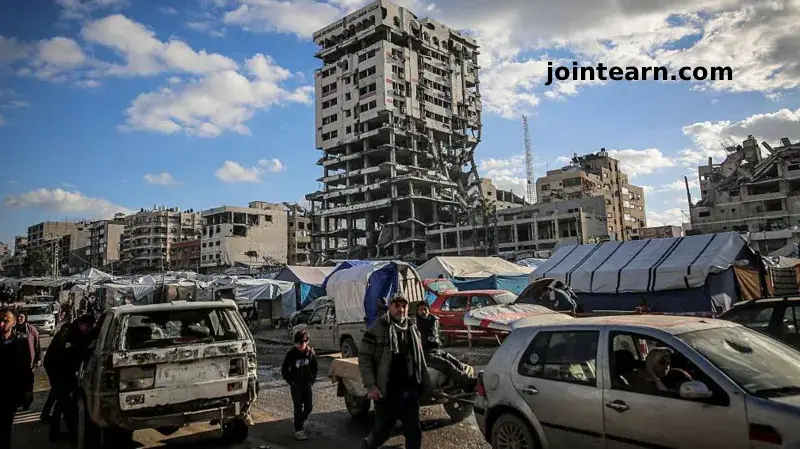
In a major development in Middle East diplomacy, former UK Prime Minister Sir Tony Blair and U.S. Senator Marco Rubio have been appointed as founding members of the newly established “Board of Peace” for Gaza, announced by the Trump administration. This board is a central part of President Donald Trump’s broader 20-point plan aimed at stabilizing Gaza and facilitating post-war reconstruction.
Key Figures Appointed to the Board
The White House confirmed on Friday that Trump himself will serve as chairman of the board, which is designed to temporarily oversee Gaza’s administration and guide reconstruction efforts. In addition to Blair and Rubio, other founding executive board members include:
- Steve Witkoff, Trump’s Middle East envoy
- Jared Kushner, the President’s son-in-law
- Marc Rowan, head of a prominent private equity firm
- Ajay Banga, Chief of the World Bank
- Robert Gabriel, U.S. National Security Advisor
Each member has been assigned portfolios described by the White House as “critical to Gaza’s stabilization and long-term success.” Additional members of the board are expected to be announced in the coming weeks.
President Trump described the board as the “Greatest and Most Prestigious Board ever assembled at any time, any place,” highlighting the administration’s high-profile approach to the conflict.
Tony Blair’s Diplomatic Background
Sir Tony Blair served as UK Prime Minister from 1997 to 2007 and led Britain into the Iraq War in 2003. Following his tenure as Prime Minister, Blair was appointed the Middle East envoy for the Quartet—the UN, US, EU, and Russia—where he focused on economic development in Palestine and efforts to advance a two-state solution.
Blair has previously participated in high-level discussions regarding Gaza’s future, including a White House meeting with Trump in August, which Steve Witkoff described as “very comprehensive.”
While Blair’s involvement has drawn some criticism due to his role in the Iraq War, others note his success in negotiating the 1998 Good Friday Agreement in Northern Ireland as evidence of his strong diplomatic and statecraft skills. UK Health Secretary Wes Streeting commented, “If he can bring those considerable skills there, in both diplomacy and state craft, that can only be a good thing.”
Governance Structure and Ground Operations
The announcement follows the formation of the 15-member National Committee for the Administration of Gaza (NCAG), a technocratic body responsible for day-to-day governance of post-war Gaza. Former Palestinian Authority deputy minister Ali Shaath has been named as head of the NCAG.
In addition, Bulgarian politician and former UN Middle East envoy Nickolay Mladenov will serve as the board’s on-the-ground representative in Gaza, working closely with the NCAG to implement reconstruction and governance initiatives.
Trump’s plan also calls for the deployment of an International Stabilization Force (ISF) to Gaza. The force, led by U.S. Major General Jasper Jeffers, is tasked with:
- Training and supporting vetted Palestinian police forces
- Establishing security and preserving peace
- Creating a durable, terror-free environment
The White House also indicated that a Gaza executive board would be formed to further support governance, including some of the same members as the founding executive board along with additional appointees.
Phase One and Phase Two of the U.S. Peace Plan
Trump’s Middle East peace plan, which came into effect in October 2023, is currently in its second phase. Phase one included:
- A ceasefire agreement between Hamas and Israel
- A hostage-prisoner exchange
- A partial Israeli withdrawal from Gaza
- Increased humanitarian aid
Phase two focuses on reconstruction and full demilitarization of Gaza, including the disarmament of Hamas and other Palestinian groups. Steve Witkoff emphasized that the U.S. expects full compliance from Hamas, warning that “failure to do so will bring serious consequences.”
Despite the ceasefire, tensions remain high. According to Gaza’s Hamas-run health ministry, almost 450 Palestinians have been killed in Israeli strikes since the ceasefire began, while Israel reports three soldier deaths from attacks by Palestinian groups. The United Nations continues to highlight the urgent need for unrestricted humanitarian aid.
Background: The 2023 Gaza Conflict
The recent war in Gaza erupted following a Hamas-led attack on southern Israel on October 7, 2023, which resulted in the deaths of approximately 1,200 Israelis and the taking of 251 hostages. Since then, over 71,260 Palestinians have been killed in Israeli attacks, according to Gaza health authorities.
The creation of the Board of Peace represents one of the most significant U.S.-led international initiatives aimed at rebuilding Gaza, stabilizing the region, and preventing further escalation of violence.


Leave a Reply