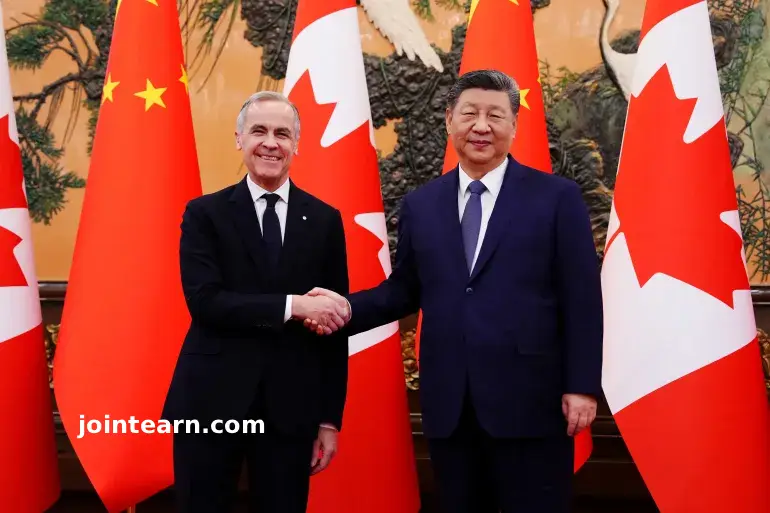
Canada and China have reached a landmark preliminary trade agreement aimed at slashing tariffs on electric vehicles (EVs) and agricultural products, marking a significant reset in bilateral relations after years of diplomatic and trade tensions. The deal was announced during Prime Minister Mark Carney’s official visit to Beijing, the first by a Canadian leader since 2017.
The agreement reflects Ottawa’s effort to diversify trade partnerships, reduce reliance on the United States, and open new markets for Canadian exporters amid escalating US tariffs.
Mark Carney’s Historic Visit to Beijing
Prime Minister Carney met with Chinese President Xi Jinping at the Great Hall of the People, where both leaders pledged to dismantle trade barriers and strengthen economic cooperation. The visit comes at a pivotal moment as Canada seeks to rebuild ties with its second-largest trading partner, following years of strained relations.
“This agreement represents a return to stability and opportunity in Canada–China trade,” Carney said, describing the deal as a foundation for long-term growth, innovation, and clean energy collaboration.
Chinese EVs to Enter Canada at Lower Tariffs
Under the agreement, Canada will allow up to 49,000 Chinese electric vehicles to enter the Canadian market at a reduced tariff rate of 6.1 percent, based on most-favoured-nation terms. This marks a dramatic rollback from the 100 percent tariff imposed in 2024 under former Prime Minister Justin Trudeau, who cited concerns about Chinese state subsidies and unfair competition.
In 2023, China exported more than 41,000 EVs to Canada, highlighting the size of the market now being reopened.
“For Canada to build a competitive electric vehicle sector, we must engage with innovative partners, integrate into global supply chains, and stimulate local demand,” Carney said.
He added that the EV deal is expected to drive significant Chinese investment into Canada’s auto manufacturing sector, supporting job creation and accelerating the country’s transition toward a net-zero emissions economy.
Political Backlash at Home
Not everyone welcomed the announcement. Ontario Premier Doug Ford, whose province is the heart of Canada’s auto industry, warned that the agreement could allow China to gain a foothold without sufficient guarantees of reciprocal investment.
“The federal government is inviting a flood of cheap, made-in-China electric vehicles without clear commitments to Canadian jobs, factories, or supply chains,” Ford said in a post on X.
Canola Tariffs Slashed After Trade Retaliation
The EV deal is paired with major concessions on agriculture, particularly canola, one of Canada’s most valuable exports.
China imposed steep retaliatory tariffs in 2025—up to 84 percent—on Canadian canola seed, oil, and meal after Canada adopted its EV tariffs. Those measures contributed to a 10.4 percent drop in Chinese imports of Canadian goods last year.
Under the new agreement:
- China will reduce tariffs on Canadian canola seed to about 15 percent by March 1
- Anti-discrimination tariffs on canola meal, lobsters, crabs, and peas will be suspended until at least the end of 2026
- The changes are expected to unlock nearly $3 billion in new export orders for Canadian farmers and seafood producers
China represents a $4 billion market for Canadian canola seed alone.
Broader Economic and Energy Cooperation
Beyond trade, the two countries agreed to restart high-level economic and financial dialogues and expand cooperation in:
- Clean and green energy
- Agriculture
- Oil and gas
- Energy storage and grid infrastructure
Carney said Canada plans to double its energy grid capacity over the next 15 years, with opportunities for Chinese investment in projects such as offshore wind.
He also confirmed that Canada intends to produce 50 million tonnes of liquefied natural gas (LNG) annually by 2030, with all exports destined for Asian markets.
China additionally committed to ensuring visa-free travel for Canadians, though details are still forthcoming.
Trade Strategy Amid US Tariffs
The Canada-China rapprochement comes as relations with Washington remain strained. US President Donald Trump has imposed tariffs on Canadian goods and has repeatedly suggested Canada could become the “51st state” of the US.
“Given the current complexities in Canada’s relationship with the US, it’s no surprise Ottawa is seeking more predictable trade partners,” said Even Rogers Pay of Trivium China.
Carney himself described relations with Beijing as increasingly stable:
“In recent months, our engagement with China has been more predictable, and we’re seeing tangible results.”
Implications for Sino-US Rivalry
Analysts say the deal could reshape the geopolitical context of Sino-US rivalry, even if Canada remains firmly anchored to the US-led security framework.
“Canada is a core US ally and deeply embedded in American security and intelligence networks,” said Sun Chenghao of Tsinghua University. “A strategic realignment away from Washington is unlikely.”
However, he noted that Canada’s pragmatic engagement could serve as evidence that economic decoupling from China is not inevitable, even among America’s closest allies.
Key Takeaways
- Canada will allow 49,000 Chinese EVs at sharply reduced tariffs
- China will cut canola tariffs from 84% to around 15%
- The deal could unlock $3 billion in Canadian exports
- Ottawa aims to offset US tariffs by expanding Asian trade
- Analysts say the move could influence broader Sino-US trade dynamics


Leave a Reply