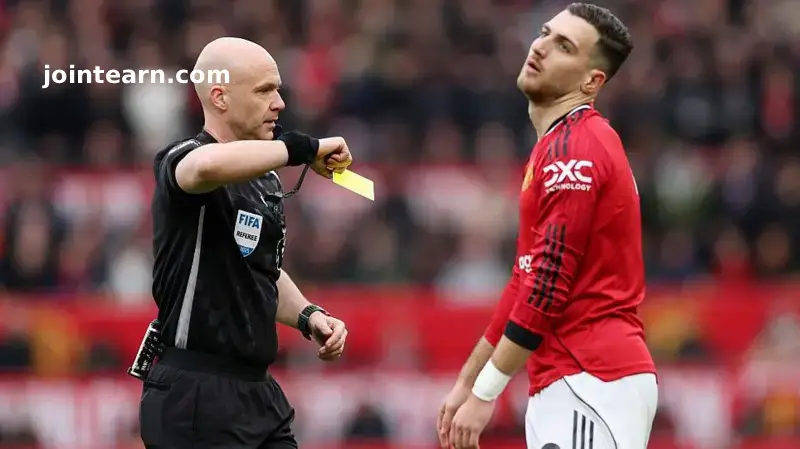
Manchester United were fortunate to avoid playing with 10 men for 80 minutes in their 2-0 victory over Manchester City on Saturday, after Diogo Dalot received only a yellow card for a studs-up challenge that would likely have been punished with a red card in European competitions.
The Controversial Dalot Challenge
The incident occurred early in the game, with the score still 0-0. Dalot, the Portugal international, lunged to intercept the ball against Jeremy Doku near the touchline. While attempting to win possession, Dalot’s studs made contact with Doku’s knee.
Referee Anthony Taylor immediately showed Dalot a yellow card. Video Assistant Referee (VAR) Craig Pawson reviewed the challenge and confirmed the on-field decision, deeming the contact “glancing and not with excessive force.”
However, former players and pundits widely disagreed. Ex-England striker Alan Shearer told BBC Sport:
“For me that was a clear red card. It’s not about whether it was glancing; VAR should have made the decision to upgrade it. Two professionals watching it should have seen it as serious foul play.”
Despite the debate, the Professional Game Match Officials (PGMO) supported the yellow card, arguing that slow-motion replays can exaggerate the severity of contact.
Premier League vs European Standards
PGMO highlighted that in a Champions League or European match, the same challenge would almost certainly result in a red card. UEFA generally has a stricter interpretation of studs-up challenges and serious foul play.
This difference illustrates the Premier League’s approach to officiating, which encourages physicality and fast-paced action while protecting players from overly harsh sanctions.
“The Premier League has more grey areas in what constitutes serious foul play,” said PGMO sources. “Decisions can seem lenient compared to continental standards, but it’s about balancing entertainment and player safety.”
Refereeing Context: VAR and Red Cards
Last season, the Premier League’s Key Match Incidents (KMI) Panel identified seven errors on serious foul play:
- Three red cards missed by VAR
- Two incidents where VAR failed to rescind incorrect red cards
- Two red cards wrongly shown after review
Notably, Dalot’s challenge this season is the first serious foul play decision logged with no error by the KMI Panel, suggesting consistency in the application of VAR rules so far.
Comparison with Pape Matar Sarr Challenge
The Dalot incident mirrors a situation from last April involving Pape Matar Sarr of Tottenham. Sarr made contact with Moises Caicedo’s knee while winning the ball and later scored. VAR sent referee Craig Pawson to the monitor, but the challenge was judged reckless, not excessive, resulting in a yellow card rather than a red.
Similarly, Dalot’s straight-leg contact was considered “glancing,” reinforcing the Premier League’s tendency to favor yellow cards in borderline challenges.
PGMO and Referee Insights
Howard Webb, PGMO chief, explained after the match:
“It would have been incorrect to send Dalot off. There was reckless contact but not excessive force, so a yellow card was correct.”
PGMO emphasizes the importance of referee communication with VAR. If the referee clearly explains the degree of contact and force, VAR is limited in overruling the decision.
Implications for Manchester United vs Manchester City
Manchester United ultimately avoided a man-down scenario that could have drastically changed the game. While Pep Guardiola downplayed Dalot’s escape in post-match comments, insiders believe City could have exploited an early red card to swing momentum.
The incident highlights differences between Premier League and European officiating standards and continues the debate over VAR’s role in serious foul play decisions.


Leave a Reply