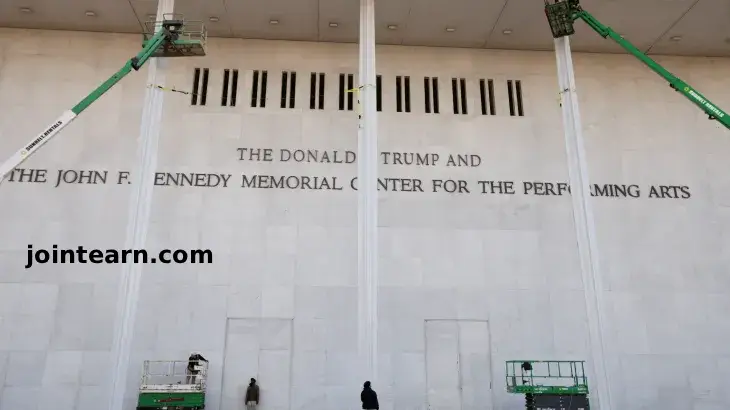
Donald Trump’s name has been controversially added to the John F. Kennedy Center for the Performing Arts in Washington, D.C., one day after his appointed board voted to rename the national arts institution. This unprecedented move marks the first time in U.S. history that a sitting president’s name has been added to a federal cultural landmark.
The newly installed metal lettering on the Kennedy Center now reads: “The Donald J. Trump and the John F. Kennedy Memorial Center for the Performing Arts.” The announcement sparked immediate backlash from the Kennedy family, historians, lawmakers, and cultural observers who argue that the name change violates federal law.
Kennedy Family and Legal Objections
Relatives of former President John F. Kennedy, assassinated in 1963, have strongly criticized the renaming. They argue that only an act of Congress can legally alter the center’s name, which was established as a living memorial to Kennedy in 1964.
Ray Smock, a former House historian, told the Associated Press:
“The Kennedy Center was named by law. To change the name would require a revision of that 1964 law. The board is not a lawmaking entity. Congress makes laws.”
The legislation explicitly prohibits the board of trustees from renaming the center or memorializing any other individual, making the board’s unilateral action legally questionable.
Kerry Kennedy, JFK’s niece, expressed her outrage on social media, vowing to remove Trump’s name herself after his presidency ends:
“Three years and one month from today, I’m going to grab a pickax and pull those letters off that building, but I’m going to need help holding the ladder. Are you in?”
Former Congressman Joe Kennedy III, a grandnephew of JFK, emphasized that the Kennedy Center, like the Lincoln Memorial, is a “living memorial to a fallen president” and cannot be renamed under existing law.
Trump’s Role and Reaction
President Trump claimed he was “surprised” by the renaming, despite having personally purged the previous Kennedy Center board earlier in the year, calling it “too woke.” Trump also appointed himself as chairman of the board, consolidating influence over the institution.
The renaming is part of Trump’s broader effort to reshape cultural institutions, which his administration has accused of promoting left-wing agendas. The addition of his name to a federal landmark has drawn criticism as a politicization of a national institution.
Historical Context
This is the first instance in U.S. history where a sitting president’s name has been added to a federal monument or cultural center. Previously, landmarks such as the Washington Monument, Lincoln Memorial, and the Kennedy Center itself were named posthumously to honor fallen leaders.
The renaming raises questions about the limits of presidential authority over cultural institutions and the protection of historic memorials under federal law.
Public and Media Reaction
The move has prompted widespread debate across social media, news outlets, and among lawmakers. Critics argue it undermines the Kennedy family legacy and sets a troubling precedent for the politicization of national monuments. Supporters of Trump have framed the action as recognition of his leadership, despite the legal and historical objections.
Conclusion
The addition of Donald Trump’s name to the Kennedy Center remains highly controversial, raising legal, historical, and cultural questions. With the Kennedy family vowing to challenge the renaming, the debate is likely to continue throughout the remainder of Trump’s presidency, spotlighting tensions between presidential power and the preservation of national heritage.


Leave a Reply