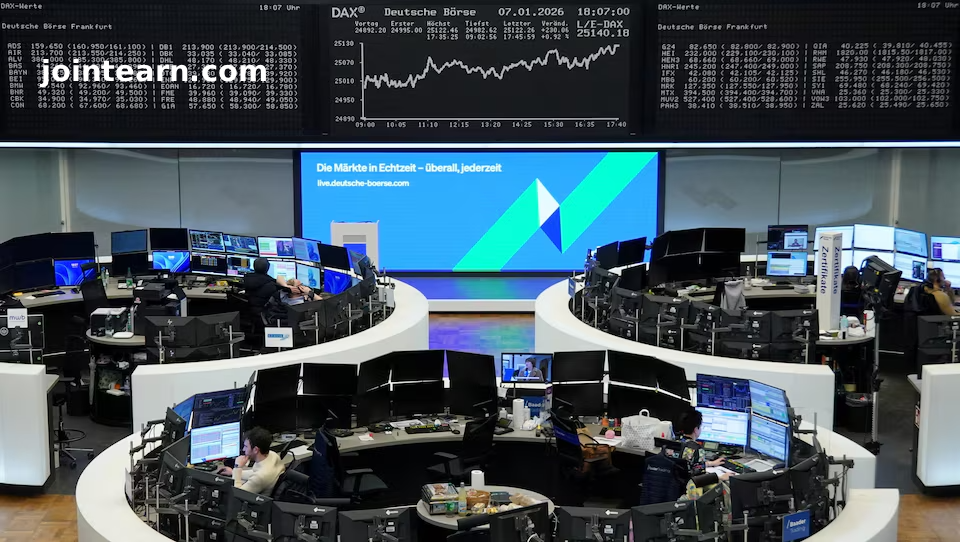
European defence stocks reached all-time highs on Thursday, while oil prices and the U.S. dollar climbed as geopolitical uncertainties—from Venezuela to Greenland—kept investors on edge. Market participants are closely watching global events and U.S. economic indicators, which are expected to influence currency markets, equities, and commodities in the coming days.
Record-Breaking Gains in European Defence Sector
Europe’s STOXX Aerospace and Defence Index (.SXPARO) jumped nearly 2% early in the session, marking its fifth consecutive day of gains. So far in 2026, the index has surged 13% year-to-date and has rallied more than 260% since Russia’s 2022 invasion of Ukraine.
Peter McLean, Head of Multi-Asset Portfolio Solutions at Stonehage Fleming Investment Management, explained, “What investors are realizing is that the threat of geopolitics is not going away. While it is unlikely we see military action in Greenland, there is clearly an impetus to increase defence spending in Europe.”
These record gains reflect broader investor sentiment that geopolitical risk continues to drive demand for defence equities, even amid mixed global economic data.
Oil Prices Rebound on Venezuela Tensions
Crude oil prices rose on Thursday, recovering from earlier losses tied to expectations of increased Venezuelan output. Brent crude futures climbed above $60 per barrel, while U.S. crude gained 0.5% to $56.30 per barrel.
The rebound follows news of the seizure of two Venezuela-linked oil tankers in the Atlantic and statements from U.S. officials emphasizing the need to control Venezuelan oil sales to stabilize its economy and safeguard U.S. interests.
Daniel Hynes, senior commodity strategist at ANZ, said, “The market’s negative reaction to U.S. plans for Venezuela’s oil sales looks misplaced. Continued restrictions could actually be bullish for oil prices in the short term.”
Dollar Strength Amid Euro Weakness and Geopolitical Risks
The U.S. dollar maintained strength, putting the euro on track for its eighth consecutive drop. Mixed U.S. economic data, however, has kept dollar bulls cautious ahead of the non-farm payrolls report scheduled for Friday.
Investors are monitoring global developments, including the U.S. Secretary of State Marco Rubio’s upcoming meeting with Denmark to discuss Greenland, which adds another layer of geopolitical uncertainty affecting currency markets.
Mixed Global Stock Market Performance
Global equities showed uneven performance as markets absorbed the geopolitical news:
- The pan-European STOXX 600 (.STOXX) fell 0.2%.
- Japan’s Nikkei (.N225) declined 1.6% amid rising tensions with China.
- Wall Street futures eased 0.2%.
Charu Chanana, chief investment strategist at Saxo, said, “Geopolitical headlines are in the driver’s seat. Asian markets are taking a breather after a strong start to 2026, while concerns over rare earths and China’s export restrictions are weighing on investor sentiment.”
Focus on U.S. Economic Data and Federal Reserve Outlook
Looking ahead, investors are closely monitoring U.S. labor market data, including weekly initial jobless claims and the non-farm payrolls report. Goldman Sachs forecasts a 70,000 increase in December non-farm payrolls and a slight drop in unemployment to 4.5%, which could provide guidance on the Federal Reserve’s interest rate path.
Previous data, including the JOLTS labor market figures and the ISM services index for December, painted a mixed but generally positive picture of the U.S. economy, leaving markets with expectations of two more Fed cuts in 2026.
Commodities and Safe-Haven Assets
In the commodities space, gold dipped 0.5% to $4,420 per ounce, while silver and platinum fell 2.6% and 3.2% respectively after recent surges. Analysts caution that bond yield direction will remain a key market driver this year.
Stonehage Fleming’s McLean added, “If the 10-year Treasury yield falls below 4% and continues lower, it could be a real positive for markets.”


Leave a Reply