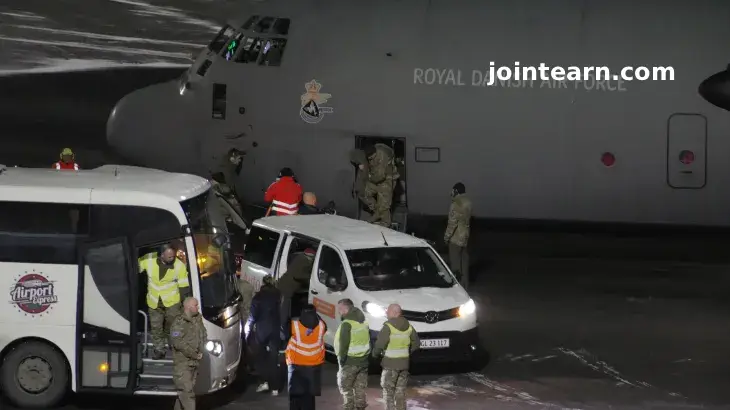
Nuuk, Greenland – January 15, 2026 – European military forces have begun deploying to Greenland in a show of solidarity with Denmark and the island’s autonomous government, as talks with the United States hit an impasse over the future of the Arctic territory. The arrival of troops from France, Germany, Norway, and Sweden comes amid heightened fears that the Trump administration may seek to assert control over Greenland to secure its strategic mineral resources.
“The first French military elements are already en route, with others to follow,” said French President Emmanuel Macron, as French mountain infantry units landed in Greenland’s capital, Nuuk.
European Troops on Greenland
- France: 15 soldiers deployed
- Germany: 13 soldiers deployed
- Norway & Sweden: contributing personnel
The mission has been described as a symbolic recognition of Greenland’s sovereignty, with troops reportedly raising the European Union flag to demonstrate the EU’s ability to rapidly deploy forces to the Arctic if required.
Germany’s Ministry of Defence confirmed a reconnaissance team had also been sent to Greenland on Thursday to support the operation.
“There is a sense of urgency among European nations, particularly following US actions in Venezuela. When President Trump speaks, European countries take it seriously,” reported Al Jazeera’s Natacha Butler from Paris.
Failed US-EU Talks on Greenland
Earlier this week, Denmark and Greenlandic officials met with US Secretary of State Marco Rubio and Vice President JD Vance in Washington, DC, to discuss Greenland’s future and the potential for US intervention.
- Danish Foreign Minister Lars Lokke Rasmussen said talks revealed fundamental disagreement with the US, stating:
“It’s clear that the president has this wish of conquering Greenland.”
- Greenlandic Foreign Minister Vivian Motzfeldt emphasized cooperation but stressed that Greenland does not intend to be “owned” by the United States.
The officials announced the creation of a working group to continue negotiations regarding Greenland’s security and sovereignty.
White House spokeswoman Karoline Leavitt downplayed the European deployments, asserting that they would likely not influence Trump’s decisions regarding Greenland.
Trump’s Stance and Strategic Interests
President Donald Trump reiterated the US strategic interest in Greenland, citing Russian and Chinese activity in the Arctic as justification for potential action.
“If we don’t go in, Russia is going to go in, and China is going to go in. And there’s not a thing Denmark can do about it, but we can do everything about it,” Trump said in the Oval Office.
Analysts in Greenland note that Denmark has two goals:
- Demonstrate serious Arctic defense capabilities
- Act as a deterrent against potential unilateral US action
Al Jazeera’s Rory Challands in Nuuk explained:
“No one expects NATO troops to stop a US invasion, but their presence complicates the scenario and sends a message: Greenland’s security is a multinational concern.”
International Reactions
- Russia: Criticized the escalation, questioning Western references to Russian and Chinese activity as justification. Russian Foreign Ministry spokeswoman Maria Zakharova stated:
“The West’s actions reveal inconsistencies in the so-called rules-based world order.”
- NATO: Moscow accused the alliance of militarizing the Arctic, calling for the region to remain a zone of peace and cooperation.
Impact on Local Communities
Inuit populations, particularly in Ilulissat, are deeply concerned about the potential US takeover of Greenland’s resources.
Karl Sandgreen, head of the Ilulissat Icefjord visitor centre, warned:
“This is my daughter’s and my son’s future, not a future for people thinking only about resources. We are Inuit, and we’ve lived here for thousands of years.”
The deployment of European troops is seen as both a protective and symbolic measure, highlighting Greenland’s strategic importance in the Arctic and its vulnerability amid US-EU tensions.


Leave a Reply