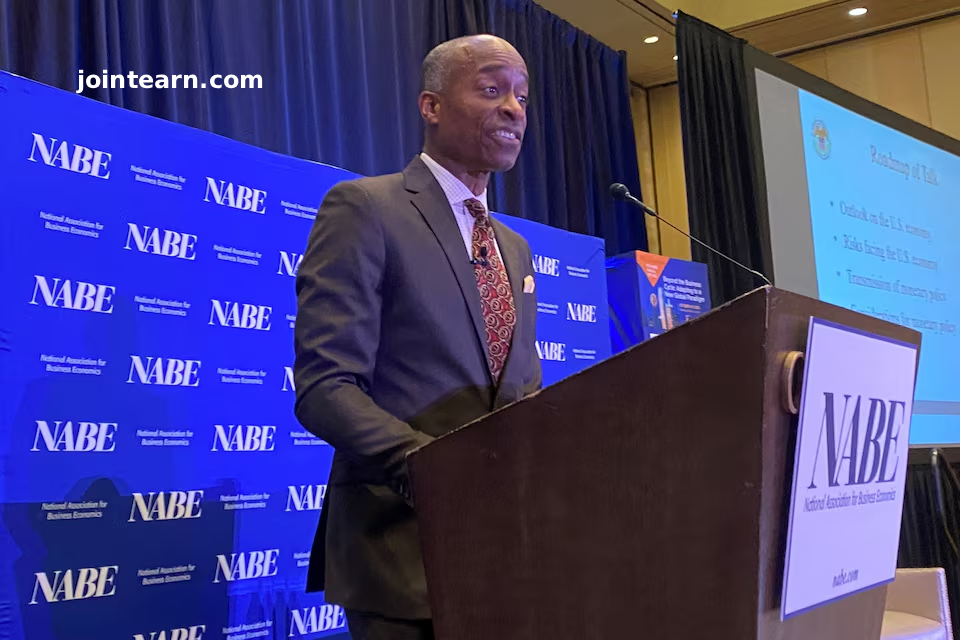
Federal Reserve Vice Chair Philip Jefferson indicated on Friday that the central bank’s current monetary policy stance is “well positioned” to navigate the U.S. economy in 2026. Speaking in Boca Raton, Florida, Jefferson expressed cautious optimism about the outlook for economic growth, inflation, and the labor market, suggesting that the Fed may pause short-term interest rate changes at its upcoming January 27-28 meeting.
Jefferson Highlights Neutral Policy Stance
In his first public remarks on monetary policy since November, Jefferson said the Fed’s recent series of quarter-percentage-point rate cuts, which brought the policy rate to 3.50%-3.75%, has placed monetary policy near a neutral level.
“While I do not want to prejudge the decision that will take place there, in my view, the current policy stance leaves us well positioned to determine the extent and timing of additional adjustments to our policy rate based on incoming data, the evolving outlook, and the balance of risks,” Jefferson said.
His comments echo language from the Fed’s December post-meeting statement, which emphasized the “extent and timing” of future moves—widely interpreted as a signal that the central bank may hold rates steady in the near term.
Economic Outlook and Policy Rationale
Jefferson emphasized that last year’s rate cuts were “the right step” to balance the upside risk of persistent above-target inflation against the downside risk of a weakening labor market. He indicated that the current policy stance positions the economy well moving forward, providing flexibility to respond to incoming economic data.
Looking ahead, Jefferson expects:
- Economic growth near 2% in the near term
- Unemployment to remain steady at 4.4% (December 2025 rate)
- Inflation to gradually return to the Fed’s 2% target, despite recent volatility in core goods prices
Jefferson noted that recent tariff-related increases in goods prices are likely to be a temporary, one-time shift rather than a long-term inflation driver, particularly with inflation expectations remaining anchored.
Market Implications
Financial markets currently assign only a 5% probability to a rate cut at the Fed’s January meeting. Jefferson’s remarks reinforce the expectation that the Fed is likely to pause interest rate adjustments for now while monitoring economic data.
Jefferson’s Voting Record
Jefferson was part of the 9-3 majority that supported the December rate cut. His statements suggest continuity in the Fed’s cautious, data-driven approach to monetary policy, balancing economic growth, employment, and inflation risks.


Leave a Reply