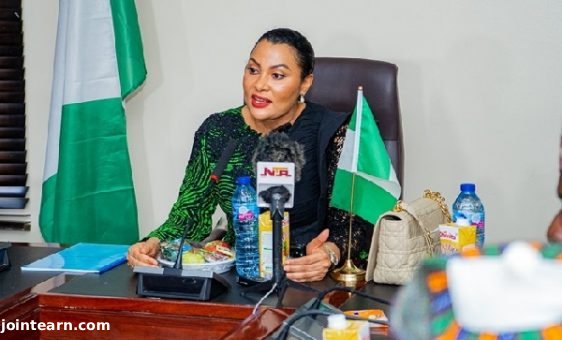
The Federal Government has unveiled a comprehensive Growth Acceleration and Investment Mobilisation Strategy aimed at boosting economic expansion, attracting investments, and creating jobs in 2026, as Nigeria enters the second phase of President Bola Ahmed Tinubu’s reform agenda.
The strategy, anchored by the Federal Ministry of Finance (FMF), is designed to transition the economy from macroeconomic stabilisation to broad-based expansion, with a focus on productivity growth, capital formation, and long-term competitiveness.
Speaking on the initiative, Minister of State for Finance, Dr. Doris Uzoka-Anite, said the strategy would strengthen macroeconomic stability while positioning Nigeria as a preferred destination for foreign direct investment (FDI). She explained that the plan aligns with the administration’s ambition to grow Nigeria into a $1 trillion economy by 2036.
According to her, the transition phase in 2026 will prioritise scaling output, deepening domestic value creation, and building an open, export-oriented economy that also strengthens local supply chains in line with the Nigeria First Policy.
“Our focus is to move decisively from stabilisation to growth. The reforms underway are designed to reduce risk, unlock private capital, and ensure sustainable returns for investors while expanding opportunities for Nigerians,” Uzoka-Anite said.
She noted that the 2026 growth strategy rests on three core pillars critical to investor confidence: macroeconomic predictability, clear sectoral investment pathways, and disciplined policy execution. The government aims to create a stable and transparent economic environment with consistent inflation, exchange rate, and fiscal policies to reduce uncertainty for businesses and investors.
Uzoka-Anite explained that fiscal and monetary coordination between the Ministry of Finance and the Central Bank of Nigeria (CBN) would remain central to disinflation, exchange rate stability, and orderly credit conditions. She added that this coordinated approach is captured in the Disinflation and Growth Acceleration Strategy (DGAS) jointly sponsored by the FMF, CBN, and the Nigeria Revenue Service (NRS).
The strategy adopts a sector-driven growth model that combines export expansion with rising domestic demand. Priority sectors include energy and gas-based industrialisation, agribusiness and food value chains, manufacturing, housing and urban infrastructure, healthcare, digital services, creative industries, logistics, tourism, and solid minerals.
She said regulatory bottlenecks, price controls, and market access restrictions would be dismantled to allow entrepreneurial capital to flourish, while federal ministries, states, and development partners align around a unified investment framework centred on policy clarity and bankable projects.
Uzoka-Anite also highlighted plans to deepen Nigeria’s capital and insurance markets to support long-term investment, expand access to finance, and strengthen investor protection. Development Finance Institutions (DFIs) such as the Bank of Industry (BOI) and Nigerian Export-Import Bank (NEXIM) will play a catalytic role in de-risking investments and mobilising long-term capital.
To ensure inclusive growth, the government will prioritise consumer credit expansion and financial inclusion, targeting households, microenterprises, women- and youth-led businesses, and underserved communities through partnerships with banks, fintechs, and credit guarantee schemes.
On revenue mobilisation, Uzoka-Anite said the government would strengthen non-oil revenue generation through improved compliance, digital revenue systems, and the rollout of the Revenue Optimisation Platform (RevOps) from January 1, 2026. Electronic receipts will become the sole legal proof of payment for all federal services, improving transparency and cash visibility.
She added that engagement with domestic and international investors will intensify in 2026 through structured investment dialogues and the establishment of a central investor desk within the Ministry of Finance to serve as a single interface for investors, DFIs, and market analysts.
Uzoka-Anite concluded that the administration remains committed to difficult but necessary reforms under the Renewed Hope Agenda, stressing that sustained growth, job creation, and inclusive prosperity will remain central to rebuilding trust and improving the lives of Nigerians.


Leave a Reply