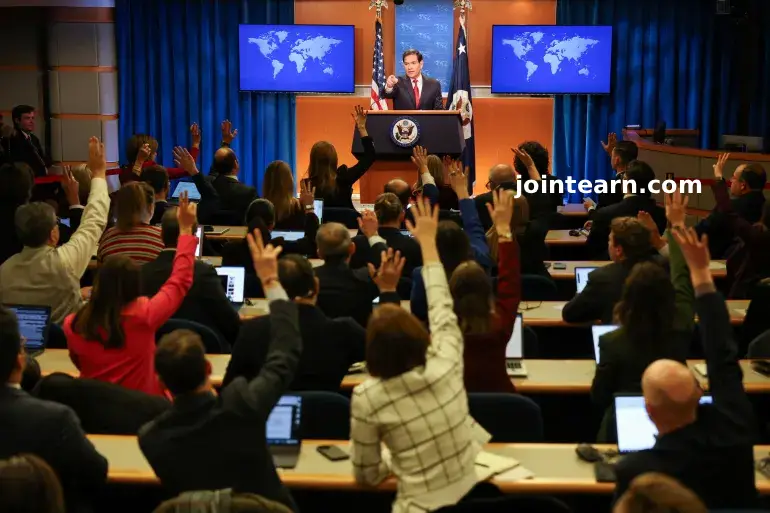
US Secretary of State Marco Rubio outlined the Trump administration’s foreign policy priorities in a comprehensive end-of-year briefing, emphasizing a hardline stance on Venezuela, a cautious approach to the Ukraine conflict, and ongoing US commitments to NATO and global diplomacy.
During the two-hour briefing at the State Department on December 19, 2025, Rubio discussed pressing international issues, defended cuts to foreign aid, and highlighted the administration’s strategic focus on protecting American interests worldwide.
1. Venezuela’s Nicolás Maduro Remains Untrustworthy
Rubio reiterated the Trump administration’s strong stance against Venezuelan President Nicolás Maduro, arguing that further negotiations would be futile.
“He’s never kept any of the deals he’s made in the past, which makes it difficult to consider making one in the future,” Rubio said.
The Secretary of State accused Maduro of supporting narcotics trafficking and terrorism, alleging connections with groups like Hezbollah and the Venezuelan gang Tren de Aragua. While these claims have been questioned by the US intelligence community, the administration has continued to impose pressure on Caracas, including oil blockades.
Rubio also emphasized US collaboration with other Western Hemisphere nations to maintain regional stability, singling out Venezuela as an outlier that undermines cooperation and engages with criminal and terrorist networks.
2. Ukraine Conflict “Not Our War”
Regarding the ongoing war in Ukraine, Rubio described the situation as a conflict on another continent, noting that while the US is involved diplomatically, the conflict is not a primary US priority.
“It’s not our war. It’s a war on another continent,” Rubio said.
The Secretary of State explained that the administration is working to identify what Russia and Ukraine could accept in a peace deal, aiming to facilitate negotiations without directly committing US military forces. Rubio stressed that issues within the Western Hemisphere take precedence over distant conflicts, though Washington remains engaged in the peace process.
3. Advancing Gaza Peace and Humanitarian Efforts
Rubio highlighted the US focus on completing phase one of the Gaza ceasefire, which includes establishing a Palestinian technocratic committee, creating a foreign-led “board of peace,” and deploying an international policing force.
“Peacemaking isn’t just signing a piece of paper; it’s actually complying with it,” Rubio noted.
The US is currently coordinating with Egypt, Qatar, and Turkiye to advance to the next stages of reconstruction and humanitarian support in Gaza. Rubio emphasized the administration’s commitment to long-term peace and stability, despite ongoing challenges and regional violence.
4. Cooperation and Tension with China
While Rubio was previously known as a China hawk, he signaled a more cooperative tone in the briefing. The Secretary of State emphasized the importance of collaborating with China on global challenges, while acknowledging ongoing tensions.
“If there’s a global challenge that China and the US can work together on, we can solve it. There will be points of tension, but our job is to balance these two things,” Rubio said.
The statement reflects a strategic pivot, with Trump’s administration temporarily prioritizing the Americas over the global competition with China, following the recent one-year trade deal that froze tariffs and resolved bilateral disputes.
5. Commitment to NATO and Global Security
Rubio reaffirmed US commitment to NATO and the principles of collective defense outlined in Article Five, despite previous criticisms of European military spending and migration policies.
“We’re committed to the alliance. Our commitment isn’t just rhetorical,” Rubio stated, citing US troops, military investments, and cooperative capabilities.
The Secretary of State emphasized that NATO remains a cornerstone of American security strategy, urging allies to increase defense spending while maintaining alliance cohesion.
Conclusion
Marco Rubio’s year-end briefing underscored the Trump administration’s prioritization of US national interests, regional stability in the Americas, and selective global engagement. From Venezuela to Ukraine, Gaza, China, and NATO, the administration continues to navigate complex geopolitical challenges with a combination of diplomacy, economic leverage, and strategic military positioning.


Leave a Reply