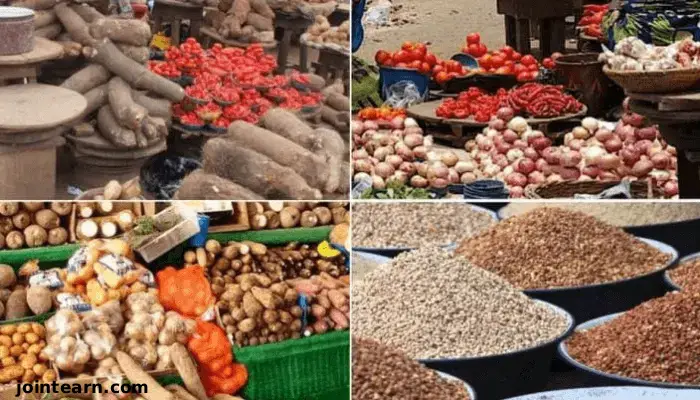
Contrary to public perception that food prices are falling, the National Bureau of Statistics (NBS) has reported that overall food prices increased in October 2025 compared to September. However, the pace of the increase has slowed.
In its October Consumer Price Index (CPI) report, the NBS stated:
- Year-on-Year (YoY) Food Inflation: 13.12% in October 2025, a significant drop of 26.04 percentage points from 39.16% in October 2024. The decline is largely due to adjustments in the inflation base year.
- Month-on-Month (MoM) Food Inflation: -0.37% in October 2025, up by 1.21% from -1.57% in September 2025.
The increase in food prices was largely driven by items such as onions, fruits (oranges, pineapple), shrimp, groundnuts (unshelled), vegetables (ugu, okazi leaves), and meat (goat meat, cow tail, liver).
Regional Variations in Food Inflation
- Highest YoY: Ogun (20.85%), Nasarawa (19.96%), Ekiti (19.7%)
- Lowest YoY: Akwa Ibom (3.98%), Katsina (4.15%), Yobe (4.29%)
- Highest MoM: Bauchi (6.77%), Abuja (5.11%), Niger (4.84%)
- Lowest/Decline MoM: Katsina (-7.72%), Oyo (-5.89%), Taraba (-4.89%)
The NBS also reported on core inflation, which excludes volatile agricultural produce and energy. Core inflation stood at 18.69% YoY in October 2025, down from 28.37% in October 2024.
Headline Inflation Eases
Headline inflation slowed to 16.05% in October 2025, down from 18.02% in September. On a YoY basis, it was 17.82 percentage points lower than October 2024 (33.88%).
Analysts at Afrinvest West Africa Limited noted that the disinflation trend was driven by:
- Moderation in food inflation (13.1% YoY, down from 16.9%)
- Improved harvests
- A stronger Naira
They also highlighted that core inflation fell for the fourth consecutive month to 18.7%, the lowest since February 2023.


Leave a Reply