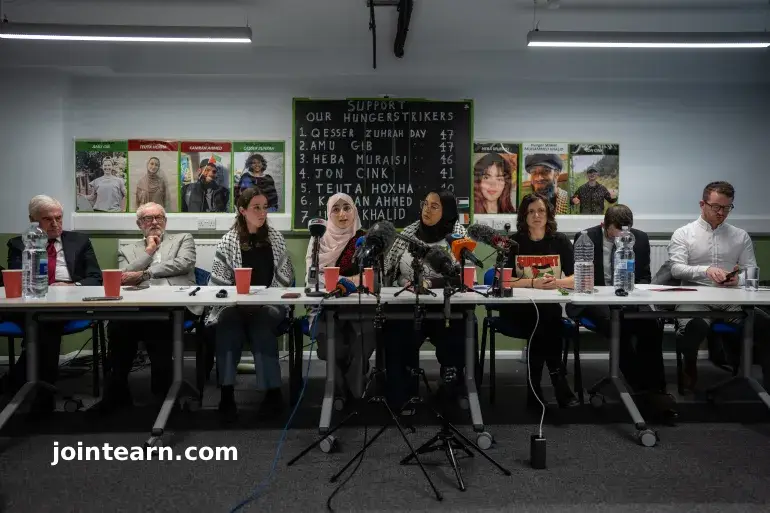
Four prisoners in the United Kingdom affiliated with the banned group Palestine Action have vowed to continue their hunger strike, even as two fellow activists recently paused their protest due to severe health complications.
The protest, organized by Prisoners For Palestine, highlights the ongoing confrontation between jailed activists and the UK government over the group’s designation as a “terrorist organization.” The remaining hunger strikers—Kamran Ahmed, Heba Muraisi, Teuta Hoxha, and Lewie Chiaramello—are determined to persist despite medical warnings and Ahmed, 28, being hospitalized on Saturday for the third time since beginning his refusal of food.
Hunger Strikers’ Demands and Goals
The activists’ protest demands include:
- Immediate bail for all hunger strikers.
- The right to a fair trial.
- De-proscription of Palestine Action, which the UK government outlawed in July.
- An end to alleged censorship of their communication with supporters.
- Closure of all sites operated by Israel’s largest weapons manufacturer, Elbit.
In addition, the remaining four prisoners are asking for:
- An end to non-association orders that prevent them from interacting in prison.
- Access to educational and rehabilitative programs afforded to sentenced prisoners.
- The transfer of Heba Muraisi from a northern England prison to Bronzefield Prison in Surrey, closer to her support network in London.
Prisoners For Palestine emphasized that despite the dangers to their health, the hunger strikers remain committed to these demands.
Health Risks and Hospitalizations
Among the hunger strikers, Lewie Chiaramello, who is diabetic, follows an intermittent hunger strike, refusing food every other day. Prisoners For Palestine reports he suffers from confusion, dizziness, and extreme weakness.
Two other strikers, Qesser Zuhrah and Amu Gib, recently paused their hunger strike due to critical health concerns.
- Qesser Zuhrah, 20, halted her strike after 48 days due to “continuous excruciating abdominal pain” and was denied emergency medical attention for over 18 hours. She lost 13% of her body weight, according to her lawyers, but has signaled her intention to resume the hunger strike in the new year.
- Amu Gib had to resume eating after extreme weakness left them using a wheelchair.
Political Reactions and Government Criticism
MP Zarah Sultana, representing the recently-formed Your Party, has criticized the UK government for its handling of the hunger strikers, accusing officials of “cruelty” and of allowing activists to suffer unnecessarily. She has called for immediate bail for all Palestine Action members and condemned the prolonged neglect of their health and welfare in prison.
Lawyers for the activists have sent a pre-claim letter to the government, warning that they may pursue a High Court case demanding a meeting with Justice Secretary David Lammy to address prison conditions and the welfare of the hunger strikers.
Background: Charges and Allegations
The prisoners face charges related to break-ins at an Elbit factory near Bristol and a Royal Air Force base in Oxfordshire last year, during which two military planes were spray-painted. They deny all allegations, including burglary and violent disorder.
Palestine Action maintains that the UK government is complicit in Israeli military actions in Gaza, framing their hunger strike as a protest against both domestic and international policies affecting Palestinian communities.
Humanitarian Concerns and Ongoing Protest
Prisoners For Palestine and activists warn that the hunger strikers are at a critical point, and the continuation of their protest could lead to life-threatening outcomes. Despite the serious risks, the group remains resolute, asserting that their actions aim to challenge government policies and demand justice for Palestine.
“This is about survival, justice, and political accountability,” Prisoners For Palestine said. “The hunger strike continues until our demands are met, UK complicity ends, and Palestine is free.”


Leave a Reply