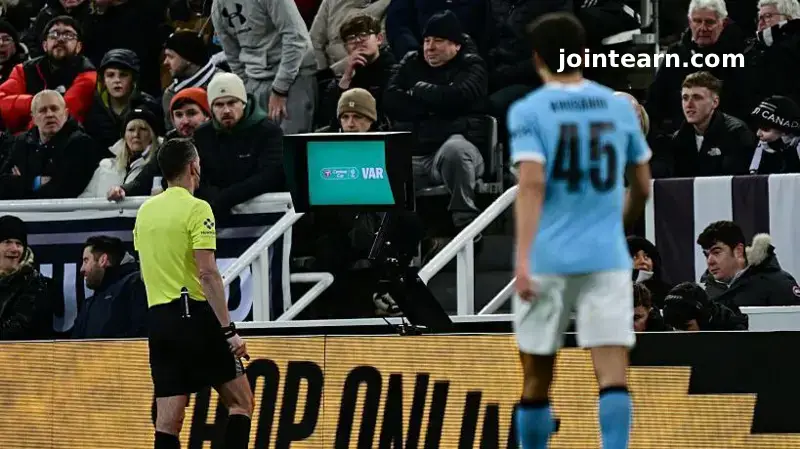
Manchester City’s 2–0 victory over Newcastle United in the first leg of the Carabao Cup semi-final should have put Pep Guardiola’s side firmly in control of the tie. Instead, the match will be remembered for a highly controversial VAR decision that reignited the debate over whether video officiating is damaging the flow and spirit of football.
At a tense St James’ Park, City’s January signing Antoine Semenyo, purchased for £65 million, appeared to score his second goal of the night midway through the second half. However, after a five-and-a-half-minute VAR review, referee Chris Kavanagh disallowed the goal, sparking boos from the home crowd and furious reactions from players, pundits, and fans alike.
What Happened: The Disallowed Semenyo Goal Explained
Semenyo opened the scoring in the 53rd minute, continuing his impressive start to life at Manchester City. Ten minutes later, he thought he had doubled his tally, flicking a cross from Tijjani Reijnders past Newcastle goalkeeper Nick Pope.
The goal was initially given, but VAR intervened to assess a potential offside involving Erling Haaland. Although Haaland did not touch the ball, officials ruled that he interfered with play by obstructing Newcastle defender Malick Thiaw while standing in an offside position.
Complicating matters further, semi-automated offside technology failed, forcing VAR officials to draw offside lines manually. This process took over four minutes, during which frustration grew inside the stadium as fans waited without clarity.
Eventually, Kavanagh was sent to the pitchside monitor to judge whether Haaland’s positioning impacted Thiaw’s ability to defend the shot. After repeated replays, the referee overturned the goal five minutes and 40 seconds after the ball had hit the net.
“The Second Goal Should Have Stood”
Semenyo was clearly disappointed after the match.
“The second goal should have stood,” the forward said, believing Haaland had no meaningful impact on the defender’s ability to stop the shot.
Manchester City captain Bernardo Silva echoed that frustration, particularly in light of past decisions at St James’ Park.
“It should have been 3-0, but we are quite used to this at the moment,” Silva said.
“The last time we came here, we also had a lot of decisions go against us.”
Earlier this season, the Premier League’s Key Match Incidents Panel admitted City were wrongly denied a penalty at the same venue, adding to the sense of injustice felt by Guardiola’s side.
Guardiola Questions VAR Consistency
Pep Guardiola did not hide his irritation, pointing to what he sees as a lack of consistency in VAR decision-making.
“In the Premier League game here, it was 0-0 and there was a penalty on Phil Foden that wasn’t even considered,” Guardiola told Sky Sports.
“Today it’s more than six minutes reviewing, and we’re not even able to discuss it with the referee.”
Despite his frustration, Guardiola insisted the controversy would only motivate his team, saying the decision would make City “stronger”.
Technically Correct, But Is That Enough?
Football analyst Dale Johnson explained that, under the laws of the game, the decision was technically correct. Haaland was offside and in contact with a defender who could theoretically have prevented the goal.
However, Johnson highlighted a deeper issue: perception.
Fans saw a legitimate goal removed due to a marginal and highly subjective interpretation—something that likely would have gone unnoticed without VAR.
Crucially, the length of the review undermined confidence in the process. Had the decision been quick and decisive, the reaction may have been different. Instead, the extended delay made the ruling feel uncertain and manufactured.
“The Game Has Gone”: Pundits React
Former Chelsea striker Chris Sutton was among the strongest critics.
“I think the game has gone,” Sutton said.
“Is Thiaw really stopping that from a yard away? That looked like a sheer guess.”
Former England midfielder Jamie Redknapp agreed that, while the decision followed the letter of the law, it didn’t reflect the spirit of the game.
“If they’d given the goal, nobody would complain,” Redknapp said.
“But by the letter of the law, it’s the right decision.”
Newcastle defender Dan Burn also supported the ruling but criticised the concept of subjective offside, arguing that offside should be clear-cut rather than interpretive.
Meanwhile, ex-City defender Micah Richards described the incident as “anti-goal”, warning that VAR is increasingly re-refereeing matches rather than correcting clear and obvious errors.
Fans Vent Their Anger
Supporters were overwhelmingly critical of VAR’s involvement:
- “Get rid of VAR! It’s a joke,” said one fan.
- “Worst VAR decision I’ve ever seen,” wrote another.
- “If it’s not obvious, it should be a goal,” added a third.
Many fans pointed to the contrast with the FA Cup weekend, where matches were played without VAR and widely praised for their flow and atmosphere.
City Still in Control Despite the Chaos
Despite the controversy, Manchester City eventually secured a second goal deep into stoppage time, with Rayan Cherki finishing clinically to give the visitors a 2–0 advantage ahead of the second leg.
From a footballing perspective, City remain favourites to reach the final. From a wider viewpoint, however, the match has once again fuelled the argument that VAR is eroding trust, momentum, and enjoyment in elite football.
As debates rage on about reforming offside laws and speeding up decisions, one thing is clear: the technology designed to bring clarity is instead becoming the story itself—and for many fans, that is the biggest problem of all.


Leave a Reply