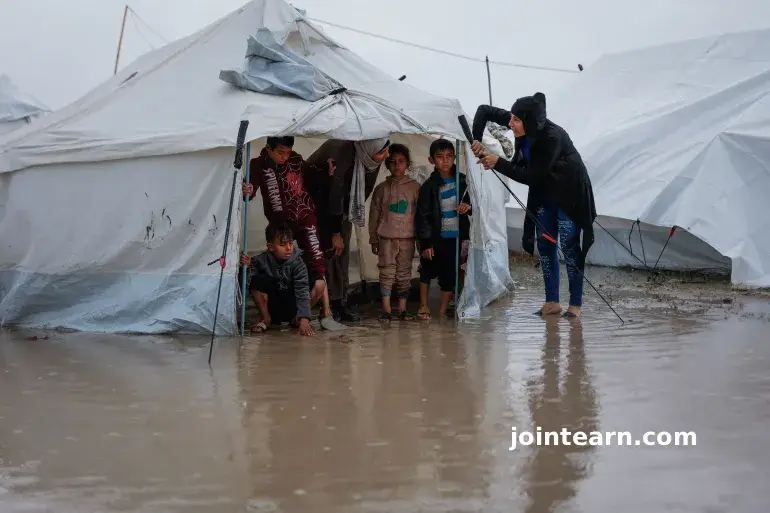
Gaza City, December 12, 2025 – Heavy rainfall and strong winds from Storm Byron have hit Gaza’s displacement camps, leaving tens of thousands of Palestinians struggling to survive in makeshift tents and plastic shelters. For the 1.5 million displaced, the storm adds to a long list of hardships caused by years of conflict, bombardment, and deprivation.
Makeshift Camps Vulnerable to Flooding
In Gaza City and surrounding areas, rows of tents made from tarpaulins, salvaged plastic, and blankets tied to wooden poles sag under the rain. Muddy paths and collapsed drainage channels turn streets into flowing water hazards, while families try to salvage their soaked belongings.
Hani Ziara, a father sheltering in western Gaza City, said, “When the wind starts, we all hold the poles to keep the tent from falling.” Despite his efforts, floodwaters from the night’s rain soaked his children, leaving them exposed to the cold.
Limited Resources Make Storm Preparation Impossible
Residents face the storm with minimal supplies, little food, and scarce clean water. Stockpiling, storing fuel, or cooking ahead—typical storm-preparation steps—are luxuries they cannot afford.
Mervit, a mother of five near Gaza’s port, described the situation: “Our tent was flooded with rainwater. Everything we had was flushed out. We barely have enough food for tonight. We can’t save what we don’t have.”
Solidarity Becomes a Survival Strategy
In the absence of formal support, community solidarity is key. Neighbors help reinforce tents, young men scavenge for wood and metal to shore up shelters, and women organize collective cooking. Volunteers dig drainage channels, patch holes, and move the most vulnerable to safer spots.
Despite the exhaustion, these informal networks are crucial for survival in camps that lack functional infrastructure or adequate shelter materials.
Psychological Toll of Displacement
Beyond the physical danger, the storm is a heavy psychological burden. Families are already traumatized by years of conflict, and yet another crisis—this time natural—feels overwhelming.
Wissam Naser, a displaced resident, said, “Our tents were destroyed. We are exhausted. Every day there is a new fear: hunger, cold, disease, now the storm.”
Waiting on Endurance, Not Preparedness
With no alternative, residents prepare as best they can—holding down tent walls, moving blankets to the driest corners, and praying for merciful weather. Storm Byron serves as a stark reminder of Gaza’s fragile humanitarian situation, where survival depends more on endurance than preparation.


Leave a Reply