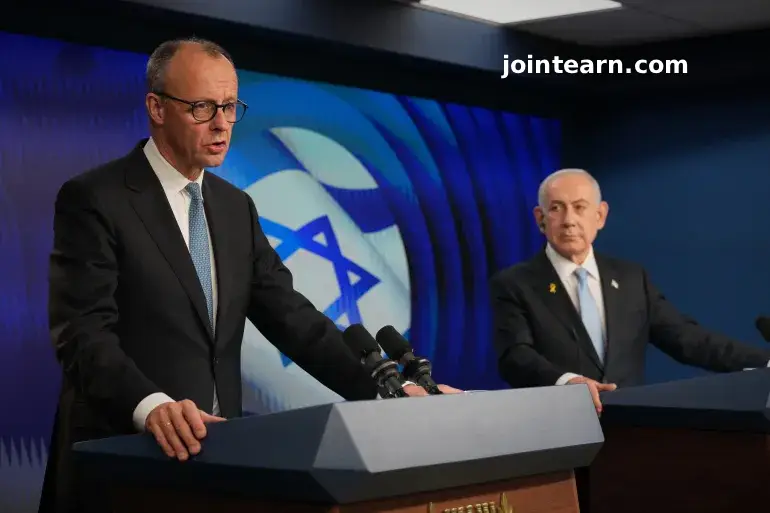
German Chancellor Friedrich Merz reaffirmed Germany’s support for Israel during his inaugural visit to the country, even as the Israeli war on Gaza continues to draw international scrutiny. During a joint press conference in Jerusalem on Sunday, Merz emphasized Germany’s commitment to Israel’s security while also voicing support for a future Palestinian state. Israeli Prime Minister Benjamin Netanyahu, however, reiterated his opposition to a two-state solution and defended ongoing Israeli military operations in Gaza.
Merz Supports Palestinian State in Principle
Addressing reporters, Merz said Germany believes that a Palestinian state alongside Israel offers the best prospects for lasting peace in the Middle East. “Our conviction is that the prospective establishment of a Palestinian state alongside Israel presumably offers the best prospect for this future,” he stated.
However, he clarified that Germany would not formally recognize a Palestinian state “in the foreseeable future,” stressing that recognition should follow peace negotiations, not precede them. This stance contrasts with countries like France, Spain, and the United Kingdom, which have already moved toward formal recognition.
Netanyahu countered that the Israeli public opposes a two-state solution and described the prospect of Palestinian statehood as a threat to Israel’s existence. He also outlined the progress of Trump’s Gaza plan, indicating that further discussions with U.S. leadership, including President Donald Trump, would follow later in December.
Diplomatic Strains Over Gaza
Germany’s traditionally strong support for Israel has been tested by the ongoing war in Gaza. In August 2025, in response to escalating civilian casualties, Berlin temporarily restricted arms exports to Israel, signaling public concern over the humanitarian impact of the conflict. These restrictions were lifted two weeks later, and Merz maintained that the measures had not altered Germany’s “very basic attitude towards Israel,” emphasizing continued military and political support.
Despite these tensions, Merz highlighted the importance of Germany’s historical responsibility to Israel, reflecting the enduring impact of the Holocaust on German foreign policy. Prior to meeting Netanyahu, Merz visited Yad Vashem, the Holocaust memorial in Jerusalem, and stated: “Germany must stand up for the existence and security of Israel.”
High-Value Arms Deal and Military Cooperation
During the visit, it was noted that Germany recently signed a $4.5 billion deal for an Israeli-made missile defense system, reportedly the largest arms export in Israeli history. Netanyahu framed the agreement as a milestone in bilateral relations: “Not only does Germany work in the defense of Israel, but Israel, the Jewish state, 80 years after the Holocaust, works for the defense of Germany,” he said.
While the deal underscores Berlin’s unwavering support, it has provoked domestic and international controversy. Activists in Berlin staged protests against Israel’s military operations in Gaza and the continuation of German arms exports. Critics also questioned the propriety of Merz meeting a leader, Netanyahu, who faces an ICC arrest warrant for alleged war crimes in Gaza.
No Reciprocal Visit Planned
Despite close diplomatic ties, no visit by Netanyahu to Germany is currently planned. Merz indicated that an invitation could be considered in the future, but stressed it was not a priority at present. Earlier in 2025, Merz had promised that Netanyahu would not face arrest on German soil if such a visit were arranged, reflecting Berlin’s careful approach to balancing legal obligations with diplomatic priorities.
Germany-Israel Relations Remain Strong
Reporting from the occupied West Bank, Al Jazeera’s Nour Odeh noted that Germany’s relationship with Israel remains resilient, despite strains over Gaza. Germany’s resumption of arms exports and the signing of high-value defense agreements highlight Berlin’s commitment to Israel’s security, while maintaining its role as a stabilizing partner in the European Union.
Odeh explained that Germany has occasionally voiced criticism of Israeli actions but continues to act as a “brick wall” in the EU against sanctions or punitive measures. Israel, in turn, understands that German criticism is largely symbolic and does not significantly influence policy outcomes.
Looking Ahead
Chancellor Merz’s visit underscores the complexities of Middle East diplomacy, particularly for Germany, which seeks to uphold its historical responsibility toward Israel while navigating regional tensions and humanitarian concerns in Gaza. The balance between support for Israel, acknowledgment of Palestinian rights, and the handling of international law remains a central challenge for Berlin’s foreign policy.


Leave a Reply