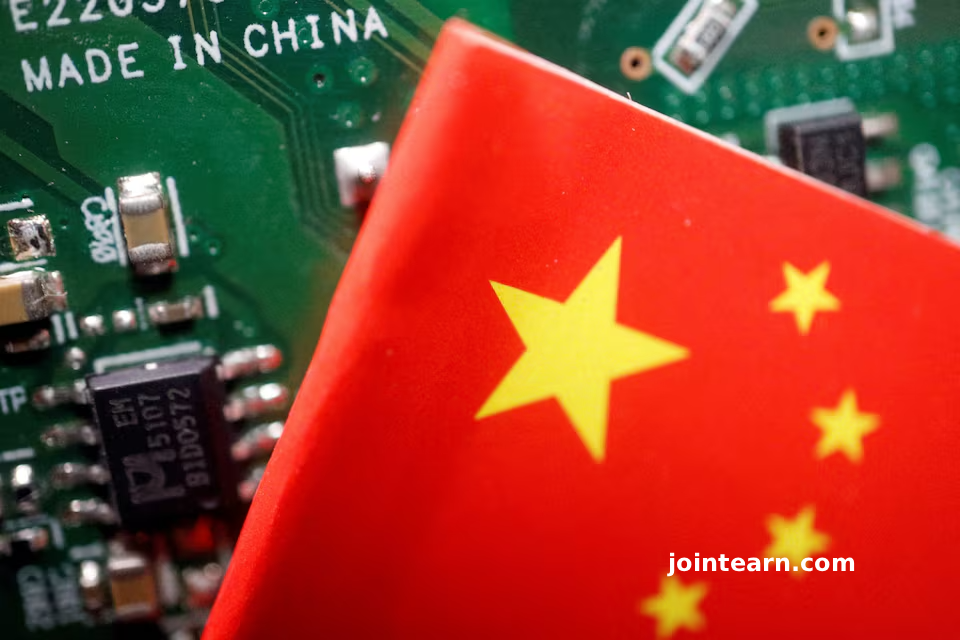
Global investors are increasingly turning their attention to Chinese artificial intelligence (AI) companies, betting on the next big breakthrough in AI technology, as concerns rise over a speculative bubble in U.S.-listed AI stocks. This shift comes amid Beijing’s push for technological self-reliance, which has accelerated the growth and listing of Chinese AI and semiconductor companies, attracting significant foreign investment.
Surge in Chinese AI Investment
Chinese tech firms such as Moore Threads—dubbed “China’s Nvidia”—and MetaX Integrated Circuits have recently debuted on Chinese exchanges, generating massive investor interest. Moore Threads and MetaX recorded spectacular market entries, with MetaX surging 700% on its Shanghai market debut, and Moore Threads rising 400% in its initial week.
The rush to invest in Chinese AI is partly driven by the perception that China is rapidly closing the technological gap with the United States, particularly in AI chip manufacturing and large language model development.
Gemma Cairns-Smith, Investment Specialist at U.K.-based asset manager Ruffer, said:
“While the U.S. remains the leader in frontier AI, China is rapidly narrowing the gap. The competitive landscape is shifting.”
Ruffer is gaining exposure to AI opportunities through major Chinese tech firms, including Alibaba, which operates an AI chip division, owns the large language model Qwen, and invests heavily in cloud infrastructure.
ETFs Fueling Chinese Tech Investments
Exchange-traded funds (ETFs) focused on Chinese technology are seeing unprecedented growth. KraneShares’ KWEB ETF, which invests in offshore-listed Chinese stocks such as Tencent, Alibaba, and Baidu, has jumped by two-thirds this year, reaching nearly $9 billion in assets under management.
Similarly, Rayliant Global Advisors, in partnership with China Asset Management Co., launched a Nasdaq-listed ETF (CNQQ.O) that targets Chinese stocks with transformative technologies, including AI chipmakers Cambricon and Montage Technology.
Brendan Ahern, Chief Investment Officer at KraneShares, highlighted the rapid ascent of Chinese AI chipmakers as evidence of the scale and speed of innovation in China’s AI and semiconductor industries.
China’s AI Drive and Tech Independence
China’s government has actively promoted AI independence, encouraging domestic companies to innovate amid a tense Sino-U.S. tech war. Restrictions on technology exports from the U.S. have prompted China to invest heavily in semiconductor manufacturing, AI development, and hard technology, further attracting global investors seeking growth opportunities outside the U.S.
UBS Global Wealth Management has rated China tech as “most attractive”, citing geographical diversification, policy backing, technological self-reliance, and rapid AI monetization as key factors.
Jason Hsu, founder of Rayliant, noted:
“U.S. tech curbs have forced China to pump money into hard technology and invent from scratch. For investors, the prudent strategy is to capture AI opportunities while managing uncertainty through diversification.”
Caution Amid Rapid Gains
Despite impressive gains, some analysts urge caution. Kamil Dimmich, partner at North of South Capital, warned that current Chinese AI chip companies are largely driven by hype, with limited valuation support, particularly compared to U.S. players such as Nvidia and OpenAI.
Carol Fong, CEO of CGS International Securities, emphasized selective investment:
“Investors should focus on companies benefiting from China’s self-reliance push in AI and semiconductors, while maintaining exposure to global leaders to balance risk.”
Outlook for Global AI Investment
The global AI race is now a geopolitics-driven, high-stakes competition, with the U.S. leading in innovation and China excelling in engineering, manufacturing, and power supply. With the continued growth of Chinese AI firms and supportive government policies, analysts expect further foreign investment inflows, particularly in sectors like robotics, AI chips, and cloud infrastructure.
Investors are encouraged to diversify portfolios across regions and technologies, balancing high-growth Chinese AI stocks with established U.S. tech giants to mitigate risk in a highly dynamic market.


Leave a Reply