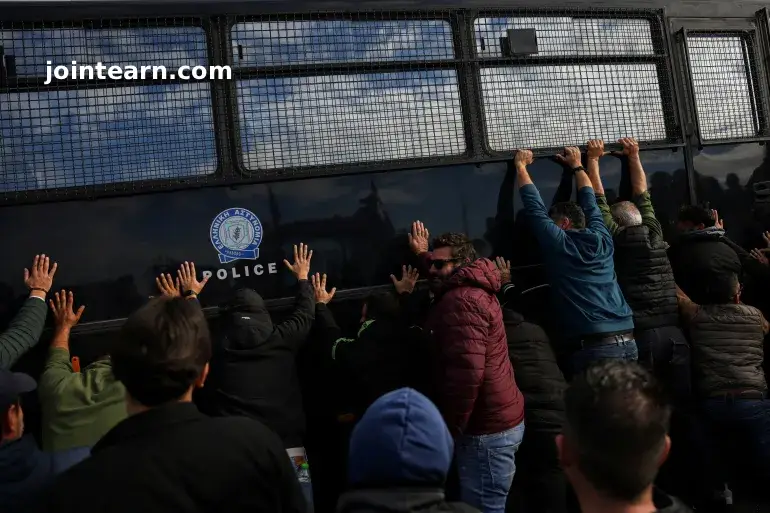
Massive Protests Erupt as Farmers Demand EU Subsidies
Hundreds of Greek farmers clashed with police on Sunday, blocking major highways in central and northern Greece amid growing frustration over delayed European Union (EU) agricultural subsidies. The protests, which involved hundreds of tractors, mainly targeted the Athens-Thessaloniki national highway near Larissa, a key transport artery in the country.
Police reportedly used tear gas to disperse the protesters, making three arrests, but demonstrators succeeded in blocking the highway for hours. The farmers have vowed to continue protests in the coming week until their demands are addressed.
“We will stay here until the government gives solutions,” said Costas Tzelas, a local farm trade unionist, highlighting the anger among rural communities dependent on EU funding.
Background: Delayed Subsidies Amid Fraud Investigation
The payment delays come amid ongoing investigations into a subsidy fraud scandal, in which some farmers allegedly falsified ownership of land and livestock to claim EU Common Agricultural Policy (CAP) subsidies. Authorities estimate the fraudulent claims totaled over €30 million ($35 million).
Deputy Minister of Rural Development and Food Christos Kellas told the ERT public broadcaster that affected farmers had received reduced payments, amounting to €100 million ($116 million) less than expected. Kellas stressed that once the investigations and appeals are complete, farmers legitimately entitled to subsidies will receive the full amount.
Government Response and Investigations
The scandal has prompted a broad government response. The Greek parliament is investigating OPEKEPE, the agency responsible for distributing roughly €2.5 billion ($2.9 billion) in EU aid annually to hundreds of thousands of farmers. The controversy has already forced the resignation of a minister in Prime Minister Kyriakos Mitsotakis’ conservative government, highlighting the political sensitivity of the issue.
Livestock Farmers Demand Compensation
The protests also reflect ongoing concerns among livestock farmers, who have lost more than 400,000 sheep and goats due to a recent sheep pox outbreak. Farmers demanded permission to vaccinate their flocks, but authorities resisted, arguing there is insufficient evidence that vaccination is effective in controlling the disease.
The combination of delayed subsidies, disease-related livestock losses, and the subsidy fraud investigation has intensified pressure on the Greek government to provide immediate relief and financial support.
Impact on Greek Agriculture
The protests and subsidy delays underscore the vulnerability of Greece’s agricultural sector, particularly small and medium-scale farmers dependent on EU funding. The OPEKEPE scandal has not only caused financial strain but also eroded trust in the government’s ability to manage agricultural aid effectively.
Analysts warn that continued delays in subsidies could have broader implications for food production, rural employment, and Greece’s compliance with EU agricultural policies.


Leave a Reply