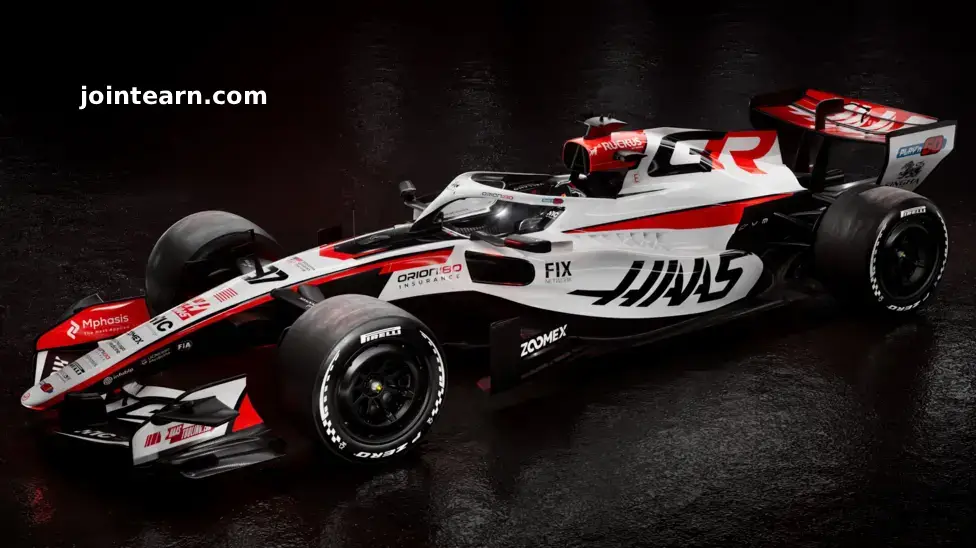
Haas has become the first Formula 1 team to reveal images of its 2026 car, the VF26, ahead of a season set to feature the sport’s most significant rule overhaul in decades. Digital renders released on Monday showcase the car’s new aerodynamic design, highlighting narrower wings, revised engine-cover fins, and a chassis built to fully comply with the F1 2026 regulations.
The VF26 marks a major step forward for Haas, the smallest team on the grid, as they prepare to face both technical and strategic challenges in a season where energy management and sustainable power units play a central role.
Key Features of the Haas VF26
The Haas VF26 incorporates several of the mandatory 2026 regulation changes:
- Narrower front wing and engine-cover fin to optimize airflow.
- Smaller and slimmer chassis, designed according to new aerodynamic philosophies.
- Revised livery reflecting Haas’ strengthened partnership with Toyota, featuring the Japanese automaker’s corporate white and red colours.
The changes aim to enhance efficiency while adapting to the new power-unit regulations, which emphasize energy recovery and sustainable fuels.
Power Units and Energy Management Challenges
The 2026 regulations keep the 1.6-litre V6 turbo hybrid engines, but significantly increase the role of electrical components, now providing up to 50% of total power. Drivers will face a complex energy management challenge, balancing battery depletion and regeneration multiple times per lap.
Haas team principal Ayao Komatsu highlighted the difficulty:
“The question will be for everyone, what’s possible for drivers to manage around a single lap, and over multiple laps in a race scenario. That’s going to be a lot of our focus in Barcelona. Energy management is the huge one.”
Komatsu also stressed that aerodynamic development remains a priority, noting that the first few races will be crucial to establishing performance benchmarks and identifying any missed design targets.
Haas Driver Line-Up for 2026
- Oliver Bearman (UK) returns for his second season with Haas, partnering Esteban Ocon (France). Bearman expressed his excitement about the new regulations:
“These changes are the biggest in the history of Formula 1. There’s a huge amount of excitement, but we won’t know where we truly stand until qualifying in Australia. Reliability and adaptation will be key in the opening races.”
- Ocon will provide experience and feedback to help Haas optimize both the VF26’s aerodynamics and energy strategies.
The team finished eighth in the 2025 Constructors’ Championship, with Bearman securing a best result of fourth in Mexico City. With the new VF26, Haas aims to make strides up the grid despite the challenge of competing against larger teams.
F1 2026: Testing and Race Schedule
Haas will reveal more updates as part of the staggered team car launches over the next three weeks, ahead of the first public pre-season test in Bahrain from 11-13 February, followed by a second test from 18-20 February.
A private test in Barcelona later this month will allow teams to refine energy management and aero concepts without independent media access. The season begins with the Australian Grand Prix in Melbourne on 6-8 March.
Expectations for a Dynamic Season
Komatsu anticipates significant variation between teams, driven by differences in power units and aerodynamic interpretations. Mercedes, Ferrari, Red Bull, Audi, and Honda will supply multiple teams with engines, creating a complex landscape where pecking order may shift rapidly in the first races.
“Even the biggest teams won’t be fully equipped to tackle this,” said Komatsu. “I expect the first four races to establish early trends, but it’s going to be a very dynamic season.”
Haas enters 2026 embracing both risk and opportunity, with a smaller team mindset and the potential to surprise if they manage energy, reliability, and aerodynamics effectively.


Leave a Reply