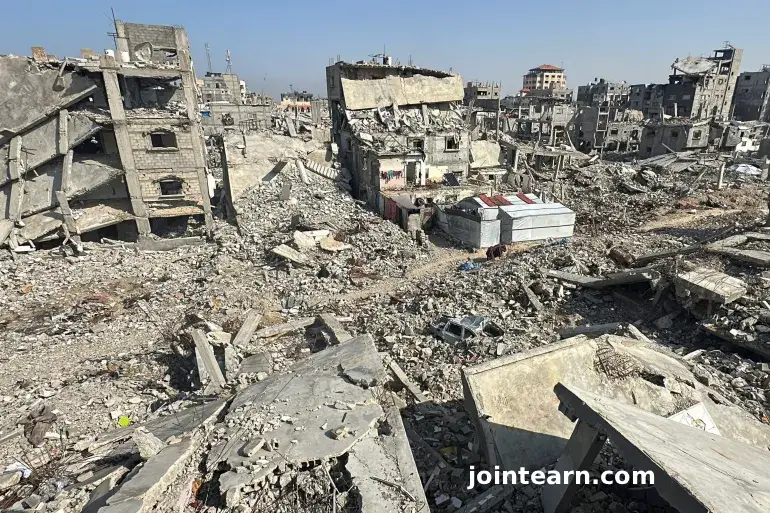
Hamas and other Palestinian factions in Gaza have strongly opposed a recent United Nations Security Council (UNSC) resolution that proposes the establishment of an international governing board and stabilization force to oversee the Israeli-besieged Gaza Strip.
The resolution, spearheaded by the United States and supported by several Arab states, has been met with widespread criticism in Gaza, with local factions arguing that it imposes external control over Palestinian affairs and threatens the people’s right to self-determination.
UN Resolution Sparks Outrage Among Palestinian Factions
In a joint statement issued on Tuesday, Hamas and allied Palestinian groups condemned the resolution, describing it as a framework “that paves the way for field arrangements imposed outside the Palestinian national will.”
The factions warned that the proposed international military force could evolve into a form of “imposed guardianship or administration,” effectively restricting Palestinians from governing their own affairs. They argued that the resolution entrenches a reality that undermines the long-standing struggle for independence and self-governance in Gaza.
“The plan represents a form of deep international partnership in the war of extermination waged by the Israeli occupation against our people,” the statement read, highlighting Palestinian fears of foreign intervention dictating local governance.
Concerns Over Ignored Issues
Hamas and other factions also criticized the resolution for failing to address systemic issues fueling the conflict, including:
- Daily attacks by Israeli soldiers and settlers in the occupied West Bank
- The ongoing Israeli occupation and apartheid system
- The absence of a clear roadmap toward Palestinian statehood
Local residents expressed skepticism about the UN plan despite the ongoing ceasefire announced on 10 October 2025. While the ceasefire brought temporary relief from bombings and shortages, many Palestinians questioned the UN resolution’s long-term implications.
“I completely reject this decision,” said Moamen Abdul-Malek, a Gaza City resident. “Our people are capable of ruling ourselves. We don’t need forces from Arab or foreign countries to govern us. We are the people of this country, and we will bear responsibility for it.”
Mixed Reactions From Gaza Residents
Other residents echoed similar concerns. Mohammed Hamdan, whose home in Gaza City was destroyed during Israel’s two-year war, warned that the resolution could strip Palestinians of the right to armed resistance, which he described as legitimate under international law for occupied peoples.
Sanaa Mahmoud Kaheel also expressed uncertainty regarding the involvement of international forces, saying that their presence could complicate governance and create instability.
“They initially said the Palestinian Authority would take control of the Gaza Strip, and we were enthusiastic about that. But things will be unclear with the international forces, and we do not know what might happen tomorrow or the day after tomorrow with them being in Gaza,” she said.
Experts have voiced concerns about the resolution’s failure to guarantee Palestinian statehood. Mohamad Elmasry, professor at the Doha Institute for Graduate Studies, described the resolution as lacking a “meaningful path forward” toward an independent Palestinian state.
Israeli and Palestinian Authority Reactions
The UNSC resolution has also provoked strong reactions in Israel. While Prime Minister Benjamin Netanyahu’s office thanked former U.S. President Donald Trump—who is expected to lead the so-called “board of peace”—Israeli politicians voiced anger at the potential for future Palestinian sovereignty.
Israeli National Security Minister Itamar Ben-Gvir made extreme statements, claiming that if the resolution advances Palestinian statehood, key Palestinian Authority officials should face severe consequences.
Meanwhile, the Palestinian Authority, which governs parts of the West Bank, welcomed the resolution and confirmed its readiness to implement the plan, highlighting a division between Gaza factions and the West Bank leadership.
Ongoing Violence in Gaza
Despite diplomatic developments, Gaza continues to experience violence. On 18 November 2025, Israeli airstrikes targeted areas beyond the so-called “yellow line” east of Khan Younis, while raids and demolition operations continued near Gaza City.
According to Gaza’s Health Ministry, nearly 70,000 Palestinians have been killed and more than 170,000 wounded since the war began in October 2023, underscoring the devastating humanitarian impact of the ongoing conflict.
Conclusion
The UNSC resolution aimed at stabilizing Gaza has drawn sharp criticism from Hamas, allied Palestinian factions, and local residents, who argue that it undermines Palestinian self-determination and fails to address root causes of the conflict. As Gaza remains in crisis, the international community faces pressure to consider solutions that respect Palestinian sovereignty while promoting lasting peace.


Leave a Reply