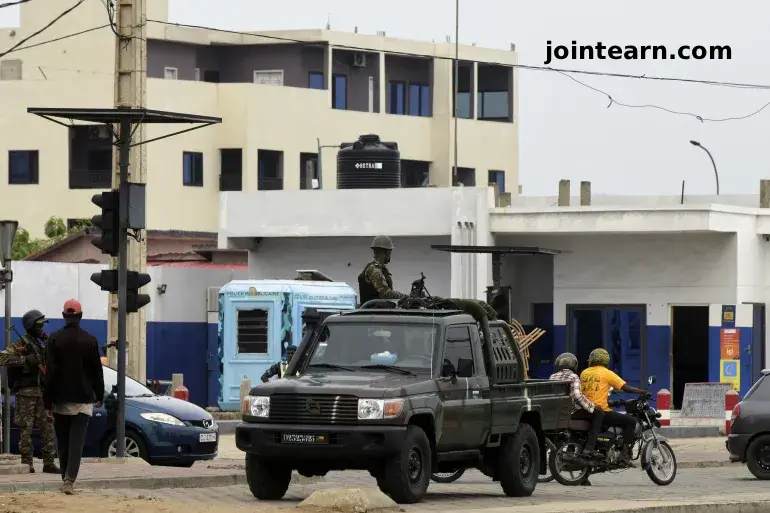
When soldiers appeared on Beninese television on December 7, 2025, announcing they had seized power, many across West Africa feared the region was witnessing yet another successful coup. Since 2020, military takeovers have become distressingly familiar, with governments falling one after another across the Sahel and coastal West Africa.
But this time, the story unfolded differently.
Within hours of reports of gunfire and panic in Cotonou, Benin’s economic capital, it became clear that the coup attempt had failed. President Patrice Talon remained in power, loyalist forces held their ground, and crucially, regional intervention—led by ECOWAS and backed by Nigeria—helped turn the tide.
The outcome has sparked a broader debate: Has ECOWAS reasserted itself as a serious West African powerbroker after years of perceived irrelevance?
A Coup Attempt That Didn’t Follow the Script
Initial confusion reigned as a small group of soldiers claimed victory while government officials insisted the plot had collapsed. By nightfall, the facts were undeniable: the coup had been thwarted.
What made the difference was swift regional coordination, particularly support from Nigeria, Benin’s powerful eastern neighbour. Analysts say this rapid response marked a sharp departure from ECOWAS’s recent pattern of issuing condemnations without decisive action.
Political analyst Ryan Cummings told Al Jazeera that the Benin episode forced ECOWAS to confront its declining credibility.
“After years of embarrassment, ECOWAS wanted to remind the region that it still has the capacity to act—when conditions allow,” he said. “Losing Benin, one of West Africa’s most stable democracies, would have been catastrophic.”
Why Benin Became a Red Line for ECOWAS
Between 2020 and 2025, nine coup attempts succeeded in overthrowing governments in Mali, Burkina Faso, Niger, Guinea, and most recently Guinea-Bissau. In those cases, ECOWAS appeared powerless, even when its own observers were present, as in Bissau last month.
Benin, however, presented a different scenario.
According to analysts, the coup plotters made two fatal mistakes:
- They failed to detain President Talon, allowing him to appeal directly to regional leaders for help.
- They lacked unified military backing, wrongly assuming other units would defect.
In a country where military rule ended in 1990 and where 73 percent of citizens believe democracy is the best form of government, loyalty within the armed forces remained strong. That internal division created a narrow window for external intervention without triggering a full-scale war.
ECOWAS Acts with Unusual Speed
For the first time in nearly a decade, ECOWAS activated its standby force, deploying troops from Nigeria, Ghana, Ivory Coast, and Sierra Leone. Nigeria authorised air operations against rebel positions in Cotonou, while France provided intelligence support.
By the end of the day, Nigerian jets had dislodged the remaining rebel forces. At least 14 suspects were arrested, and authorities later revealed that the coup leader, Colonel Pascal Tigri, had fled to neighbouring Togo.
For ECOWAS, the mission was about more than Benin—it was about survival.
Strategic Stakes: Why Nigeria Couldn’t Sit This Out
Security analysts argue that Nigeria had compelling reasons to act decisively.
A military takeover in Benin could have:
- Opened the door for Benin to join the Alliance of Sahel States (AES)—the bloc formed by Mali, Burkina Faso, and Niger after leaving ECOWAS
- Provided the landlocked AES states with access to Cotonou’s strategic port
- Worsened security threats along Nigeria’s southern flank
Armed group JNIM launched its first attack on Nigerian soil in October, adding pressure on Abuja, which is already battling Boko Haram and armed banditry.
“Nigeria could not afford another unstable neighbour,” Cummings said. “Security failures elsewhere have already spilled across borders.”
President Bola Ahmed Tinubu, a former ECOWAS chair, later praised Nigerian forces for defending constitutional order, while governors across Nigeria hailed the operation as proof of renewed regional leadership.
A Revival—or a One-Off Success?
Despite the apparent victory, analysts caution against declaring ECOWAS fully restored.
Kabiru Adamu, head of Beacon Security, warned that the bloc still struggles with its core mission: preventing democratic erosion before coups occur.
In Benin itself, critics point out that President Talon has increasingly restricted opposition participation, barring key challengers in multiple elections. With elections scheduled for April 2026 and the main opposition candidate again excluded, some fear the conditions that breed coups remain unaddressed.
“ECOWAS intervened militarily, but it stayed silent as democratic norms eroded,” Adamu said. “That contradiction undermines its credibility.”
Regional Tensions and the France Factor
Another challenge lies in ECOWAS’s strained relationship with the AES states, which accuse France of manipulating regional politics. As Paris grows closer to Abuja, some Sahel governments view interventions like Benin’s as foreign-driven rather than African-led.
Analysts warn that unless ECOWAS clearly defines its independence and democratic principles, such perceptions could push breakaway states further away.
A Critical Turning Point for ECOWAS
Following the Benin incident, ECOWAS declared a state of emergency, acknowledging the need for introspection.
“Recent events show the urgent need to invest in democracy and collective security,” said ECOWAS Commission President Omar Touray, citing electoral manipulation and geopolitical rivalries as growing coup risks.
Whether Benin marks a true revival or merely a rare success will depend on what ECOWAS does next:
proactive democratic oversight, consistent accountability, and credible regional leadership.
For now, Benin has given the bloc a moment of redemption—but the deeper crisis facing West Africa remains unresolved


Leave a Reply