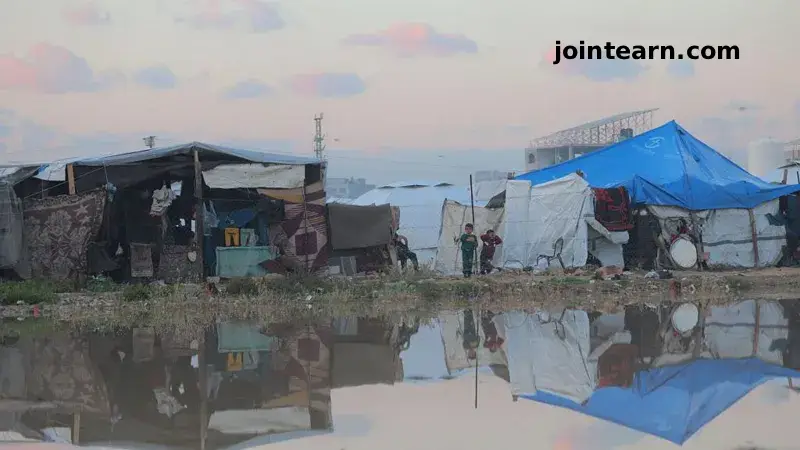
Severe winter rains have intensified the already dire conditions for displaced Palestinians in the Gaza Strip, UN agencies have warned. With hundreds of thousands living in tents and makeshift shelters, humanitarian organizations say urgent action is needed to prevent further loss of life and widespread suffering.
Rains Flood Refugee Camps
According to UNICEF spokesman Jonathan Crickx, recent rainfall has been “horrendous,” with water levels reaching up to 15cm (6 inches) in some areas. The heavy rains, combined with strong winds, have caused widespread flooding, damaged shelters, and destroyed the belongings of tens of thousands of families.
“When I drove this morning, I could see many people trying with buckets to remove water from their shelters,” Crickx told the BBC.
The UN estimates that almost 55,000 families have been affected by the rainfall, with many forced to relocate multiple times during the two years of war between Israel and Hamas.
Casualties and Building Collapses
Gaza’s Hamas-run health ministry reported that a two-week-old baby named Mohammed Abu al-Khair died of hypothermia, and at least 11 other people died when war-damaged buildings collapsed. A spokesman for the Civil Defence agency, Mahmoud Bassal, placed the death toll at 17, including four children.
Strong winds and rain have caused 17 residential buildings to collapse completely and partially damaged another 90 buildings, leaving many residents without shelter. Video footage has shown first responders recovering bodies from rubble, highlighting the ongoing danger faced by displaced families.
Children at Risk
UNICEF expressed deep concern for children living in wet and cold conditions, noting temperatures of 7–8°C (45–46°F) at night. Children and families in tents, often with limited clothing, are at risk of hypothermia and illness.
“With temperatures this low and constant rain, children are extremely vulnerable,” Crickx said.
UN agencies have been delivering tents, blankets, and winter clothing, but the aid remains insufficient for the scale of the crisis. To date, about 250,000 winter clothing kits, 600,000 blankets, and 7,000 tents have been provided, yet thousands of people continue to suffer.
Humanitarian Response and Aid Delivery
The International Committee of the Red Cross (ICRC) has called for increased and sustained humanitarian assistance to address urgent needs, including food, shelter, and repair of critical infrastructure.
Israel’s military body Cogat, which controls Gaza’s border crossings, stated that 600–800 lorries of humanitarian supplies enter Gaza daily. Since the start of the ceasefire, nearly 310,000 tents and tarpaulins have been delivered, along with over 1,800 lorry loads of blankets and clothing.
The UN reports that 67,800 tents, 372,500 tarpaulins, and 318,100 bedding items have been collected at crossings over the same period. Despite this, agencies warn that many displaced families remain in life-threatening conditions.
Context: Ceasefire and Reconstruction Efforts
The current Gaza ceasefire, now nine weeks in effect, includes plans for reconstruction, post-war governance, and disarmament of Hamas. Israel’s prime minister confirmed last week that the second phase of the ceasefire is nearly complete, pending the return of a dead Israeli hostage held by Hamas.
The ongoing humanitarian crisis follows the Hamas-led attack on southern Israel on 7 October 2023, which resulted in roughly 1,200 deaths and 251 hostages. Since then, Gaza has experienced heavy Israeli attacks, with more than 70,600 people killed, according to Gaza’s health ministry.
Voices from the Ground
Ahmed al-Hosari, a relative of one of the victims, pleaded with the international community:
“We call on the world to solve our problems and rebuild the territory so that people can have homes instead of being displaced and living in the streets.”
UN agencies warn that without rapid, coordinated assistance, the humanitarian situation could worsen, especially for children and families already displaced multiple times.


Leave a Reply