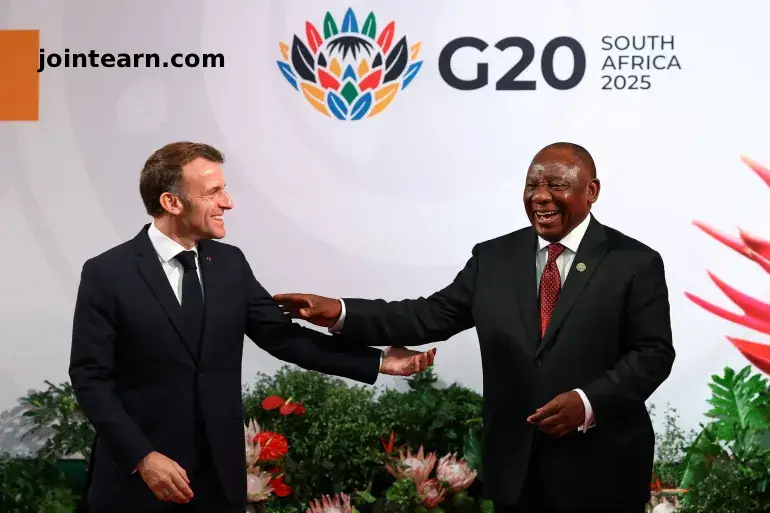
Johannesburg, South Africa – November 22, 2025: Africa hosted its first-ever G20 summit, where world leaders agreed on a declaration focusing on climate action, debt relief, and conflict resolution in developing nations. The summit marked a historic step for the Global South, despite the United States boycotting the event under President Donald Trump.
G20 Declaration Highlights: Peace and Development
The summit’s final declaration pledged to support peace efforts in Sudan, the Democratic Republic of the Congo, the occupied Palestinian territories, and Ukraine. Leaders emphasized that global crises—such as climate change and natural disasters—disproportionately affect vulnerable populations, aggravating poverty and inequality.
“We are committed to strengthen the implementation of the G20 common framework for debt treatments in a predictable, timely, orderly, and coordinated manner,” the declaration stated.
The declaration also highlighted the potential of critical minerals to drive value addition and broad-based development, rather than being exported solely as raw materials.
South Africa’s Role as Host
President Cyril Ramaphosa stressed the importance of balancing the priorities of leading economies with those of the Global South, ensuring Africa’s development agenda finds a place at the G20 table.
The summit was held near the iconic Soweto township, symbolically connecting the gathering to South Africa’s post-apartheid legacy.
US Boycott and International Response
President Trump’s boycott stemmed from claims that South Africa pursued racist anti-white policies against the Afrikaner minority, and his administration opposed the summit’s focus on climate change, equity, and inclusion.
US Secretary of State Marco Rubio previously skipped a G20 foreign ministers’ meeting, calling the agenda a misuse of taxpayer money.
Other leaders, including French President Emmanuel Macron, expressed regret over the absence but emphasized the need to move forward on global challenges.
“Our duty is to be present, engage, and work all together because we have so many challenges,” Macron said.
The G20: Global Economic Power with Consensus Challenges
The G20 consists of 21 members: 19 nations, the European Union, and the African Union. Formed in 1999, it represents roughly 85% of the global economy, 75% of international trade, and over half the world’s population.
The bloc operates on consensus, which can be challenging given the diverse interests of members such as the US, Russia, China, India, Japan, France, Germany, the UK, Indonesia, Saudi Arabia, and South Africa.


Leave a Reply