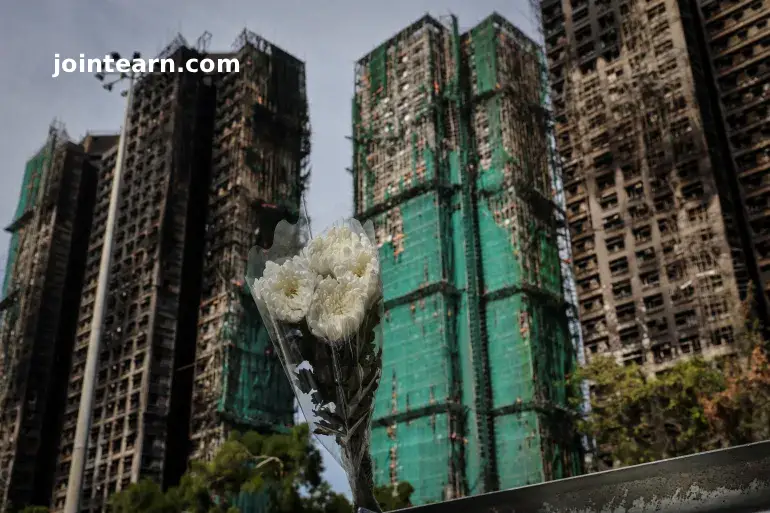
Hong Kong is confronting one of the gravest urban disasters in its recent history after a massive blaze swept through the Wang Fuk Court housing estate in Tai Po, killing at least 159 people and leaving thousands displaced. As residents mourn and search for answers, the tragedy has reopened deep social wounds — particularly the mistrust and unresolved divisions that have lingered since the 2019 antigovernment protests.
A Catastrophic Fire That Shook the Entire City
The fire began on November 26 and rapidly spread across seven of the estate’s eight towers. According to early official reports, many residents were trapped inside their homes when alarms failed to operate correctly. Firefighters battled the blaze for more than 40 hours before finally extinguishing it on November 28.
With the death toll climbing steadily, Wang Fuk Court is expected to become Hong Kong’s worst residential fire since 1948, when a massive blaze claimed 176 lives. For many Hong Kong residents, the scale of the disaster feels almost unimaginable.
“This is a bustling district, not a remote area,” said Issie, an educator living in Tai Po. “People never expected something like this could happen. We assumed the government had systems in place to prevent this.”
Community Mobilization Echoes the Spirit of 2019
Almost immediately after the fire, Hong Kongers mobilized in ways reminiscent of the 2019 protest movement. Individuals, NGOs, religious organizations, and community groups delivered water, clothing, and basic necessities to more than 4,000 displaced residents. Online volunteers set up databases compiling emergency resources and temporary housing options.
A petition demanding “four key accountability measures” garnered more than 10,000 signatures before being removed — a symbolic callback to the 2019 protest slogan “five demands, not one less.”
Handwritten notes of condolence soon covered walls near the estate, creating scenes strikingly similar to the “Lennon Walls” that became iconic during the protests.
A Hong Kong governance scholar told Al Jazeera that such grassroots coordination reflects a deep cultural instinct:
“Mobilization is part of Hong Kong’s DNA. People stepped up because they couldn’t understand how a major renovation project meant to improve safety could end in disaster.”
Frustration Over the Government’s Early Response
For many residents, the fire revealed gaps in governmental preparedness and communication — issues that echo the grievances of 2019.
Athena Tong, a visiting research fellow at the University of Tokyo, said the public’s swift response reflected a lack of confidence in official actions.
“People felt ordinary citizens had to respond quickly because they did not trust the government to act effectively,” Tong said.
Authorities initially suggested that bamboo scaffolding — long used in Hong Kong construction — contributed to the fire’s rapid spread. However, investigators later found that low-quality mesh and Styrofoam materials were the primary accelerants. This fueled further skepticism about official accountability.
2019’s Unresolved Tensions Resurface
Many observers say the renewed mistrust stems from the fact that the core issues raised in 2019 — identity, autonomy, and political accountability — were never fully addressed.
The 2019 protests began over an extradition bill proposal but expanded into a broad movement questioning Hong Kong’s future under the “one country, two systems” framework. Concerns ranged from the selection of the city’s leader to fears that Beijing’s promises of autonomy were weakening.
When national security legislation was introduced in 2020, large-scale protests became nearly impossible. But the frustrations remained beneath the surface.
Issie said the reaction to the Wang Fuk Court fire feels eerily familiar.
“Whenever people express criticism or try to fill gaps left by the government, the response seems defensive,” she said. “This wasn’t the case years ago.”
Government Warnings of ‘Foreign Interference’ Stir Old Fears
In the days following the fire, a government spokesperson accused “foreign forces” and “anti-China groups” of circulating misinformation to undermine rescue operations — language closely mirroring the rhetoric used during the 2019 protests.
The Office for Safeguarding National Security also alleged that “external hostile forces” were attempting to manipulate the tragedy to create social unrest, according to reports from the state-run Global Times.
Local police have arrested at least 15 people for suspected manslaughter related to the fire and three more on suspicion of sedition or incitement, including a community volunteer, former district councillor Kenneth Cheung, and a university student accused of distributing leaflets.
Authorities Defend Their Actions Amid Public Scrutiny
Ronny Tong, a member of Hong Kong’s Executive Council, told Al Jazeera that the public has limited information about the sedition cases but emphasized that security-related arrests typically rely on more than simple criticism.
“The law is the law,” he said. “If someone may be violating it, especially at a sensitive time, the police have to proceed with caution. Courts will review any overreach.”
He added that the government’s decision to centralize relief operations — shifting responsibility away from volunteers — was meant to improve coordination.
Officials have promised temporary housing, financial subsidies of HK$100,000 (about US$12,847), and a long-term rebuilding plan for the damaged towers.
Chief Executive John Lee also announced plans for an independent investigation into the fire and a review of Hong Kong’s construction and building system, though few details have been released.
Calls for Accountability Continue as Hong Kong Heals
Despite widespread public anger, no government official has resigned. Analysts note that residents are still grappling with both the scale of the loss and longstanding concerns about transparency.
Tong said the priority is to rebuild and provide long-term support:
“We can rebuild homes, even if we can’t replace the loved ones who were lost. The community must focus on helping the survivors move forward.”
For many Hong Kongers, however, the broader recovery will depend not just on rebuilding the towers of Wang Fuk Court, but on addressing the deeper trust gaps that have lingered since 2019 — gaps that the tragedy has brought painfully back into view.


Leave a Reply