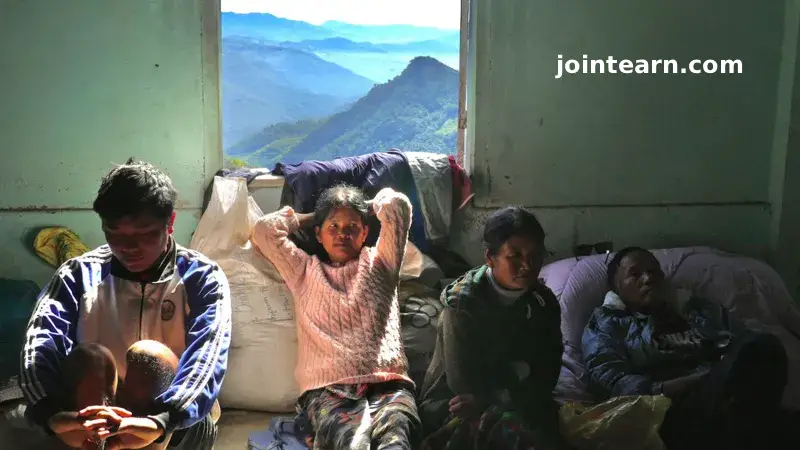
As Myanmar’s military rulers prepare to stage a nationwide election later this month, civilians in rebel‑held regions are facing a devastating escalation of air strikes, ground offensives, and forced displacement. For thousands of families, survival—not voting—has become the priority, as many flee across borders to escape bombing campaigns and what they describe as a fraudulent election enforced through fear.
Air Strikes Force Civilians to Flee Chin State
Late one night in November, Iang Za Kim was jolted awake by explosions in a nearby village in K‑Haimual, Chin State. Soon after, she heard fighter jets roaring overhead. When she stepped outside, she saw smoke rising in the distance.
Terrified that her own village would be next, she fled into the surrounding jungle with only a few belongings—food and clothes hastily gathered in the dark. Recounting the events weeks later, her voice trembles as she describes the fear and uncertainty of that night.
She is among thousands of civilians displaced in recent weeks as Myanmar’s military launched one of its fiercest offensives in more than three years, combining air strikes with ground assaults to recapture territory ahead of elections scheduled to begin on 28 December.
Refugees Cross Into India to Escape Violence
Many families from Chin State have fled internally, while others, including Iang, crossed the border into India’s Mizoram state, seeking safety. They are currently sheltering in makeshift conditions, including a rundown badminton court in Vaphai village, with their few possessions packed into plastic sacks.
Local Indian villagers have stepped in to provide food and basic supplies, but conditions remain harsh. Among the displaced is Ral Uk Thang, an 80‑year‑old who survived days in jungle shelters before reaching safety.
“We are afraid of our own government,” he says. “The military is extremely cruel. They have arrested people, tortured them, and burned down homes in our villages.”
Fear of Forced Voting and Repression
For many civilians, the air strikes are only part of the reason for fleeing. Iang says she also ran to avoid being forced to participate in the junta‑run election.
“If we are caught and refuse to vote, they will put us in jail and torture us,” she says. “We ran away so we don’t have to vote.”
Myanmar’s military government tightly restricts foreign journalists and has imposed severe laws criminalising dissent, making it dangerous for civilians to speak openly. Since the February 2021 coup, the junta has been accused of widespread human rights abuses as it attempts to crush armed resistance across the country.
Civilian Targets and Verified Bombings
Human rights groups report that civilians and civilian infrastructure are increasingly being targeted. Last week, junta air strikes hit a hospital in Rakhine State, killing at least 30 people and injuring more than 70, according to rebel groups.
The Chin Human Rights Organisation says that since mid‑September, at least three schools and six churches in Chin State have been struck by air attacks, killing 12 people, including six children.
The BBC has independently verified the bombing of a school in Vanha village on 13 October, where two students—aged seven and 12—were killed during lessons and more than a dozen others injured.
Myanmar’s military government did not respond to requests for comment on these allegations.
Displacement Repeated Again and Again
For families like Bawi Nei Lian’s, displacement has become a grim cycle. His home in Falam town was destroyed in an air strike shortly after the coup in 2021. After rebuilding his life in K‑Haimual village, he is now homeless once again.
“We left to stay alive,” he says. “But what the military claims—that this election is free and fair—is absolutely false. When the main political party is not allowed to contest, how can there be democracy?”
The National League for Democracy (NLD), led by Aung San Suu Kyi, which won overwhelming victories before the coup, has been barred from the election. Suu Kyi and many senior party figures remain imprisoned.
Rebels Condemn the Election as a “Dictatorship Tool”
Rebel groups have dismissed the upcoming vote as illegitimate. At a base belonging to the Chin National Front (CNF)—the most prominent resistance group in the region—Vice Chairman Sui Khar says the election is designed solely to entrench military rule.
“This election is not about the people’s choice,” he says. “It is only to prolong military dictatorship. The military barely controls much of Chin State, so how can they hold an election here?”
He describes intense fighting, with hundreds of junta soldiers advancing from multiple directions, supported by air strikes, artillery, and drones. In just one month, nearly 50 rebel fighters have been injured.
Young Fighters and the Human Cost of War
Inside the CNF base hospital, the consequences of the latest offensive are stark. Injured fighters—many of them teenagers—lie recovering from surgeries and amputations.
Abel, just 18, lost his right leg and suffered severe hand injuries during a recent battle. Nearby, Si Si Maung, 19, recounts stepping on a landmine before being attacked from the air.
“I’ve lost a leg,” he says, “but even if I have to give my life, I’m willing to sacrifice it so future generations can have a better life.”
Many of these fighters were schoolchildren when the coup occurred. Now barely adults, they have abandoned their dreams to resist the junta’s rule.
A Future Clouded by Uncertainty
Despite the suffering, some displaced civilians cling to hope that the military may retreat after the election. Others, like Ral Uk Thang, are less optimistic.
“I don’t think I will live to see democracy restored in Myanmar,” he says. “But I hope my children and grandchildren will see it one day.”
As Myanmar’s military presses ahead with elections under the shadow of air strikes, mass displacement, and armed conflict, civilians in rebel‑held areas continue to pay the highest price—caught between bombs from the sky and a political process they overwhelmingly reject.


Leave a Reply