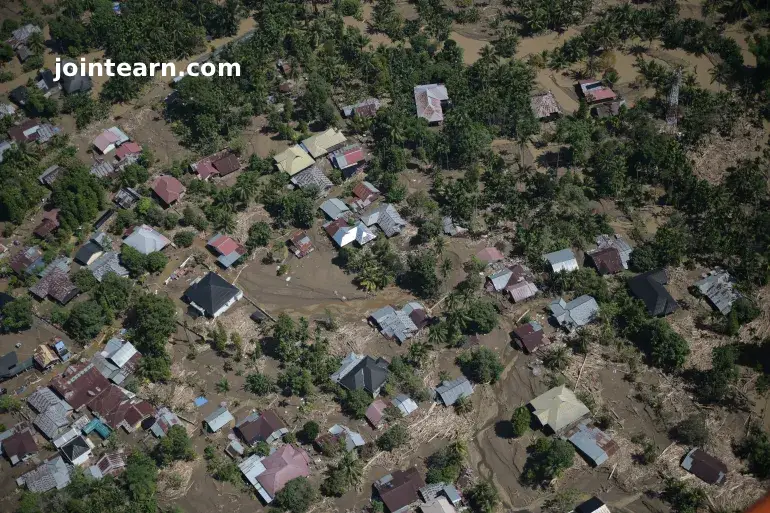
The Indonesian government has filed lawsuits seeking over $200 million in damages against six companies accused of contributing to environmental destruction in flood-prone areas of Sumatra. The legal action follows last year’s deadly floods, which claimed more than 1,000 lives and devastated communities across the northwestern part of the island.
Environmentalists, however, have criticized the lawsuits as insufficient, arguing that government policies granting companies permits to clear large tracts of land played a significant role in the disaster.
Floods and Environmental Damage
Last year’s floods swept mud, debris, and logs into villages, particularly in North Sumatra, West Sumatra, and Aceh, highlighting the dangers of deforestation and land degradation. Environmental experts have linked these practices to the intensity of the flooding, which compounded the effects of the climate crisis.
The Ministry of Environment announced that it is seeking 4.8 trillion rupiah ($283.8 million) in total damages, representing both fines for environmental harm and the estimated cost of recovery efforts. The lawsuits were formally filed in Jakarta and Medan, the capital of North Sumatra.
“We firmly uphold the principle of polluter pays,” said Environment Minister Hanif Faisol Nurofiq.
“Any corporation that profits by damaging the ecosystem must be held fully responsible for restoring it.”
The ministry, however, has provided limited details on the nature of the environmental damage or the identities of the accused companies, listing them only by initials.
Broader Investigations Underway
In addition to the lawsuits, the ministry is conducting environmental audits on over 100 companies operating in flood-prone provinces. The goal is to identify potential criminal suspects responsible for environmental degradation once the audits are completed.
A separate government task force, comprising the military, police, Attorney General’s Office, and relevant ministries, has identified 12 companies suspected of contributing to flash floods and landslides across Sumatra, according to reports from The Indonesia Business Post.
Environmental Groups Criticize Government Policy
Greenpeace Indonesia has criticized the government’s approach, arguing that the lawsuits place the blame solely on corporations while overlooking the role of government-issued permits.
“Besides the impact of the climate crisis, the flooding was also caused by land degradation, including deforestation, carried out by corporations,” said Arie Rompas, Greenpeace Indonesia’s forest campaigner.
“Those companies were granted permits by the government.”
Mining, plantation expansion, and fires have led to the clearing of vast areas of Indonesian rainforest in recent decades. In 2024 alone, more than 240,000 hectares of primary forest were lost, according to analysis from The TreeMap’s Nusantara Atlas project.
Government Measures and Policy Review
The government has begun taking steps to address environmental mismanagement. Forestry Minister Raja Juli Antoni announced that 22 forestry permits covering over 100,000 hectares in Sumatra will be revoked. Although he did not directly link the move to last year’s floods, Antoni noted that the disaster presents an opportunity to re-evaluate national policies.
“The pendulum between the economy and ecology seems to have swung too far towards the economy and needs to be pulled back to the centre,” Antoni said.
Environmentalists argue that comprehensive policy reform is necessary, beyond punishing individual companies, to prevent future disasters and protect Indonesia’s fragile rainforest ecosystems.
The Human and Ecological Cost
The floods in Sumatra stand as a stark reminder of the interconnectedness of deforestation, climate change, and human vulnerability. With over 1,000 lives lost and thousands of families displaced, the disaster has reignited debates about balancing economic development with ecological preservation in Indonesia.
The lawsuits and ongoing audits signal a step toward accountability, but experts warn that preventative measures, stricter regulations, and sustainable land-use policies are essential to avoid similar catastrophes in the future.


Leave a Reply