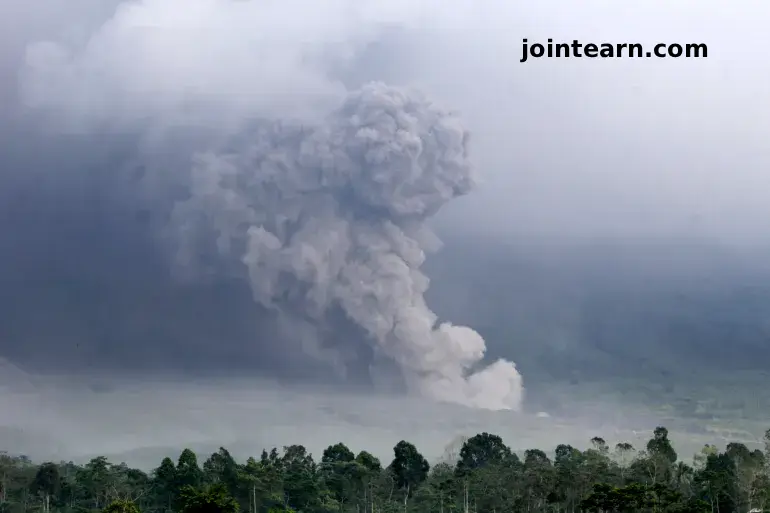
Indonesia’s Mount Semeru, the tallest volcano on Java island, erupted on Wednesday, unleashing fast-moving pyroclastic flows and sending plumes of ash soaring as high as 5.6 kilometers (3.48 miles) into the sky. In response to the eruption, the Indonesian volcanology agency raised the alert level to the highest, urging residents to maintain a safe distance of at least 2.5 kilometers (1.55 miles) from the volcano’s slopes.
Details of the Semeru Eruption
The eruption began around 4:00 PM local time (09:00 GMT), according to Mukdas Sofian, an officer at the volcano’s monitoring post. He reported that pyroclastic flows were still active, with some traveling as far as 7 kilometers (4.3 miles) from the summit.
“Pyroclastic flows are ongoing, and the eruption continues at the time of this report,” Sofian said, emphasizing the risks to nearby villages, transportation routes, and aviation.
Mount Semeru: A Volcanic Giant in the Pacific Ring of Fire
Mount Semeru, also known as Mahameru, stands at 3,676 meters (12,060 feet), making it Java’s highest peak. The volcano is located in a densely populated region of Indonesia and forms part of the Pacific Ring of Fire, a seismically active arc famous for frequent volcanic eruptions and earthquakes.
Semeru has a long history of eruptions. Over the past 200 years, it has erupted numerous times, including a deadly 2021 eruption that killed 62 people and buried nearby villages under hot ash. Due to its frequent volcanic activity, Semeru is closely monitored to protect communities, manage aviation safety, and mitigate the impact on infrastructure.
Widespread Impacts of the Eruption
The eruption of Mount Semeru has significant consequences for both local residents and broader transportation networks:
- Aviation: Ash clouds can disrupt flights across Java and nearby regions.
- Local communities: Villagers are at risk from pyroclastic flows, falling ash, and lava. Authorities urge evacuation from high-risk zones.
- Environment: Thick ashfall can affect air quality, farmland, and water sources.
Indonesia is home to nearly 130 active volcanoes, more than any other country, making volcanic monitoring a critical part of disaster preparedness. Semeru’s eruption underscores the ongoing risks posed by living in volcanic regions and highlights the importance of timely alerts and evacuation protocols.
Historical Context
Semeru’s history is marked by both frequent eruptions and devastating human impact. The 2021 eruption, one of the deadliest in recent memory, serves as a reminder of the volcano’s destructive potential. Scientists continue to study Semeru to understand its patterns and improve early warning systems for nearby populations.


Leave a Reply