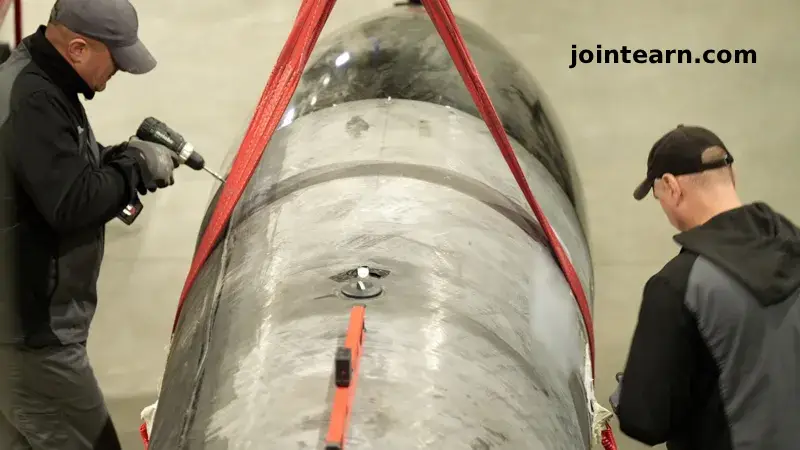
At a hidden location deep inside Ukraine, far from public view and under intense security, the country is quietly accelerating one of the most important efforts of its war strategy: the rapid expansion of its domestic arms industry. At the heart of this push is the Flamingo, a newly developed Ukrainian cruise missile designed for long‑range strikes deep inside Russian territory.
Blindfolded and Cut Off: Extreme Secrecy Around Missile Production
To reach the factory, journalists were blindfolded and ordered to switch off their phones, underscoring the extraordinary secrecy surrounding Ukraine’s weapons production. Inside the facility, filming restrictions were strict: no structural features such as windows or pillars could be shown, and workers’ faces were kept hidden to protect their identities.
This secrecy is not optional. According to officials, two factories linked to Fire Point, the company producing the Flamingo missile, have already been struck by Russian attacks. Dispersing production and concealing locations have become essential for survival.
Ukraine Now Produces the Majority of Its Frontline Weapons
Despite repeated attacks on infrastructure, Ukraine has significantly scaled up its arms manufacturing. President Volodymyr Zelensky says Ukraine now produces more than 50% of the weapons used on the front line, with nearly all of its long‑range weapons domestically made.
At the start of Russia’s full‑scale invasion in February 2022, Ukraine relied heavily on Soviet‑era stockpiles and Western military aid. While that support helped modernise its armed forces, Ukraine has since emerged as a global leader in unmanned systems, including drones, robotics, and now cruise missiles.
The Flamingo Missile: Ukraine’s New Long‑Range Weapon
The Flamingo is a long‑range Ukrainian cruise missile capable of striking targets up to 3,000 kilometres (1,900 miles) away. That range is comparable to the US‑made Tomahawk missile, a weapon Western governments have been reluctant to supply to Ukraine.
Visually, the Flamingo resembles the German V‑1 rocket from World War Two: a large jet engine mounted on top of a long cylindrical body roughly the length of a London bus. Early prototypes were painted pink, inspiring the missile’s name, but the final version is black.
“It’s black,” says Iryna Terekh, Fire Point’s chief technical officer, “because it eats Russian oil.”
Although Fire Point will not confirm specific targets, the missile has already been used in combat, contributing to Ukraine’s growing long‑range strike capability.
Targeting Russia’s War Economy
Deep‑strike weapons like the Flamingo play a central role in Ukraine’s strategy. With Russian forces advancing along a front line stretching more than 1,000 kilometres, Ukraine is increasingly focused on attacking Russia’s war economy rather than engaging solely at the front.
Ukraine’s commander‑in‑chief, General Oleksandr Syrskyi, says Ukrainian long‑range strikes have cost Russia’s economy more than $21.5 billion this year alone.
According to Ruslan, an officer in Ukraine’s Special Operations Forces, hundreds of strikes have targeted oil refineries, weapons factories, and ammunition depots deep inside Russian territory.
“The goal is simple,” he says. “To reduce the enemy’s military capabilities and their economic potential.”
Racing to Match Russia’s Scale
Russia continues to launch an average of around 200 drones per day, often targeting civilian infrastructure and causing widespread power outages. Ukraine’s response has been roughly half that number, but production is accelerating rapidly.
“I’d like to launch as many drones as Russia does,” Ruslan admits. “But we’re scaling up very quickly.”
While Ukraine cannot match Russia’s industrial scale, it is focusing on efficiency, innovation, and cost‑effectiveness.
Fire Point: From Startup to Major Weapons Producer
Fire Point did not exist before the full‑scale invasion. Today, the company produces around 200 drones per day. Its FP1 and FP2 long‑range drones—each roughly the size of a small aircraft—have reportedly carried out 60% of Ukraine’s long‑range strikes.
Each drone costs about $50,000, significantly cheaper than Russia’s Shahed drones, which cost roughly three times as much. Russia, however, is still producing nearly 3,000 Shahed drones per month.
“There is no ‘wonder weapon,’” says Denys Shtilerman, Fire Point’s chief designer and co‑founder. “The real game changer is our will to win.”
Reducing Dependence on Foreign Suppliers
Ukraine still relies on Western intelligence, funding, and targeting support, but manufacturers like Fire Point are striving for maximum self‑sufficiency. The company deliberately sources as many components as possible from within Ukraine.
“We follow the principle that no one can influence the weapons we build,” Ms Terekh explains.
Fire Point avoids components from China and the United States, citing concerns over political uncertainty. Regarding the US, Terekh says shifting policies could one day restrict access to critical parts, potentially grounding Ukraine’s own weapons.
Lessons for Europe
Until late last year, the US had supplied nearly $70 billion in military aid to Ukraine. That support was later reduced, placing more pressure on European allies to fill the gap—something they have struggled to do.
Concerns over future security guarantees loom large in ongoing peace discussions. Ms Terekh dismisses current negotiations as “capitulation talks,” arguing that domestic weapons production is Ukraine’s only real security guarantee.
She also hopes Europe is paying attention.
“We are a bloody example,” she says. “If any other country had faced what Ukraine has faced, they would already have been conquered.”
Conclusion: A War Built on Innovation and Resolve
Inside Ukraine’s secret missile factories, the country is betting its future on innovation, resilience, and domestic production. The Flamingo missile symbolizes more than just military capability—it represents Ukraine’s determination to survive, adapt, and fight on its own terms, even under constant attack.


Leave a Reply