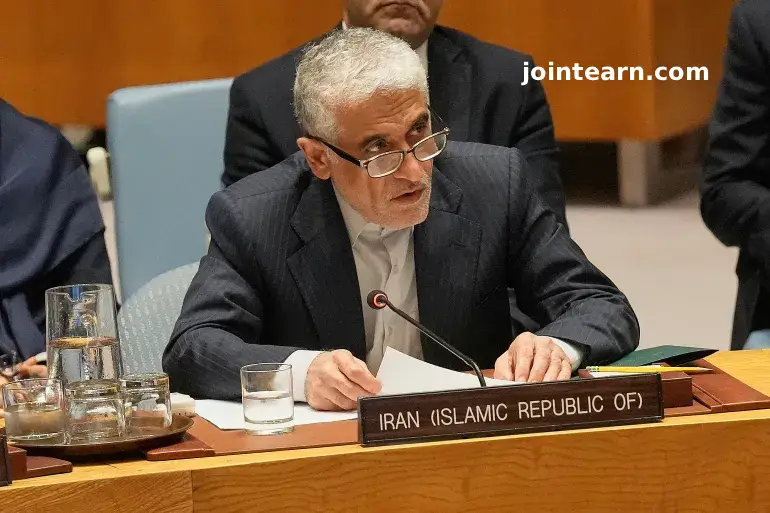
Iran’s United Nations ambassador, Amir Saeed Iravani, has formally called on the UN Secretary-General and the UN Security Council (UNSC) to condemn “unlawful threats” issued by US President Donald Trump amid widespread protests in the Islamic Republic. The letter, sent on Friday, comes hours after Trump warned that the US was “locked and loaded” to intervene if Iranian authorities continued to violently suppress demonstrators.
UN Letter Condemns US Threats
In the letter, Iravani described Trump’s statements as provocative and reckless, framing them as a serious violation of the UN Charter and international law. He stressed that any attempt to incite unrest or use domestic protests as a pretext for foreign military intervention violates Iran’s sovereignty, political independence, and territorial integrity.
“Iran reiterates its inherent right to defend its sovereignty and will exercise its rights in a decisive and proportionate manner,” the letter read, according to Iran’s IRNA state news agency. Iravani further warned that the United States bears full responsibility for any consequences arising from such threats, including the potential escalation of tensions.
Protests Sweep Across Iran
Iranian protests continue to spread across the country, including major gatherings in Qom, Marvdasht, Yasuj, Mashhad, Hamedan, and neighborhoods of Tehran such as Tehranpars and Khak Sefid. The unrest was sparked by shopkeepers striking in Tehran on Sunday over rising prices and economic stagnation.
At least nine people have been killed and 44 arrested amid the demonstrations. In Qom, one individual died after a grenade exploded in his hand, which authorities said was part of a plot to incite unrest.
Trump escalated tensions in a post on Truth Social, stating that if Iran “violently kills peaceful protesters… the United States of America will come to their rescue.” In response, Ali Larijani, Secretary of the Supreme National Security Council, condemned US interference as equivalent to “chaos across the entire region and the destruction of American interests.”
Economic Crisis Fuels Unrest
Iran’s protests occur against a backdrop of deep economic crises, including a collapsing currency, high inflation, and the effects of prolonged drought. Tehran, a city of over 10 million, has seen these crises exacerbate social unrest, with citizens frustrated over rising costs and stagnant wages.
Despite tensions, some Iranian officials have taken a conciliatory tone. President Masoud Pezeshkian acknowledged governmental faults in the situation and pledged to implement solutions to address the protesters’ concerns. Observers note this response contrasts sharply with past crackdowns on dissent.
Military Tensions Between Iran, US, and Israel
The US-Iran relationship has been strained by recent military escalations. In June 2025, the United States bombed three Iranian nuclear sites during a 12-day confrontation between Israel and Iran, which Trump later described as a “very successful attack.”
Last week, speaking alongside Israeli Prime Minister Benjamin Netanyahu, Trump reiterated US threats, warning that the US would “knock the hell out of” Iran if it advanced its nuclear or ballistic weapons programs. Pezeshkian, in turn, promised a severe response to any such aggression, highlighting the ongoing volatility in the region.
Regional and International Implications
Analysts warn that US threats and potential interventions in Iran could destabilize the broader Middle East, particularly amid ongoing protests and economic collapse. The UNSC and international observers face mounting pressure to respond to Iran’s call for protection of its sovereignty and adherence to international law.
The situation underscores a complex interplay of domestic unrest, foreign threats, and geopolitical tensions, with potential ramifications for both regional security and global diplomacy.


Leave a Reply