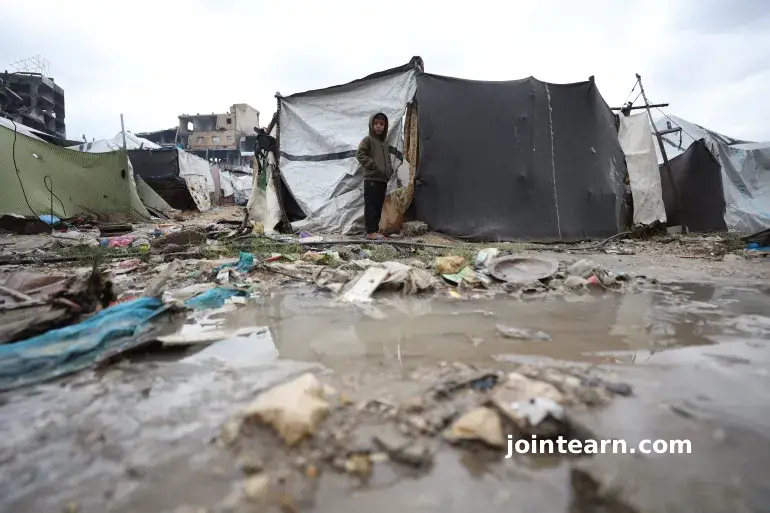
The Israeli military has intensified operations in Gaza, expanding its so-called “yellow line” in the eastern parts of the enclave while continuing air and artillery strikes in southern Gaza. These moves are forcing Palestinians into increasingly confined areas, raising fears of widespread displacement and civilian casualties.
Expansion of the “Yellow Line”
Over the past 24 hours, Israeli forces have extended their presence in eastern Gaza, particularly in Tuffah, Shujayea, and Zeitoun neighborhoods of Gaza City. According to Al Jazeera correspondents on the ground, this expansion is putting pressure on displaced families who have already sought shelter in densely populated areas.
Al Jazeera reporter Hani Mahmoud described the situation:
“The ongoing Israeli attacks on the ground, the expansion of the ‘yellow line,’ are meant to eat up more of the territory across the eastern part, really shrinking the total area where people are sheltering. Everyone is cramped here, with populations in some neighborhoods doubling or tripling.”
The military push is also moving closer to Salah al-Din Street, a key artery in Gaza City, heightening the threat to civilians in the area.
Casualties and Destruction
Since the ceasefire mediated by the United States on October 10, 2025, Israeli attacks have resulted in:
- At least 414 Palestinians killed
- 1,145 injured in daily ceasefire violations
Intense artillery bombardment and helicopter strikes continue south of the enclave near Rafah and Khan Younis. On Sunday, at least three Palestinians were killed in separate attacks in Khan Younis, while a five-storey building in the Maghazi camp collapsed, leaving five injured as civil defense teams searched for those trapped under rubble.
Al Jazeera noted that Israel now physically occupies more than 50% of the Gaza Strip, with civilians increasingly squeezed into smaller, overcrowded areas.
Rafah Crossing: Lifeline or One-Way Exit?
Amid the intensified military campaign, expectations have grown around the possible reopening of the Rafah crossing. For many in Gaza, the crossing could provide a vital lifeline, enabling the sick and wounded to access medical care and reuniting families separated by the war.
However, fears persist that the crossing could become a one-way exit, potentially leading to permanent displacement. Mahmoud reported:
“Until this moment, there’s nothing on the ground other than headlines about Rafah. The Israeli military is reportedly pushing for it to be just a one-way exit, which could raise fears of permanent expulsion.”
The uncertainty leaves Gazans cautious and wary, even in the face of potential humanitarian relief.
Humanitarian Impact
The Ministry of Health in Gaza reports devastating figures since the start of the conflict in October 2023:
- 71,386 Palestinians killed
- 171,264 injured
Since the ceasefire, at least 420 people have been killed, highlighting ongoing violations. Despite the massive accumulation of international humanitarian aid at Gaza crossings, the Israeli military continues to block or restrict access, contradicting claims that aid is sufficient.
Winter conditions and scarce resources have exacerbated the suffering, leaving Palestinians struggling for basic necessities, shelter, and medical care.
Context and Ongoing Conflict
The expansion beyond the “yellow line” demonstrates Israel’s intent to control larger parts of Gaza, putting civilians at severe risk and further limiting the ability of humanitarian organizations to operate safely.
With intense military operations ongoing and the Rafah crossing potentially serving as a one-way exit, international observers warn of a prolonged humanitarian crisis that could escalate if hostilities continue unchecked.
Key Takeaways
- Israeli forces have expanded the “yellow line” in eastern Gaza, squeezing civilians into smaller areas.
- Airstrikes and artillery attacks continue south near Rafah and Khan Younis.
- At least 414 Palestinians killed and 1,145 injured since ceasefire on October 10, 2025.
- Rafah crossing may open but concerns exist over it being a one-way exit.
- Gaza faces severe winter conditions, shortages of basic needs, and restricted humanitarian aid.
- The conflict has left over 71,000 dead and 171,000 injured since October 2023.


Leave a Reply