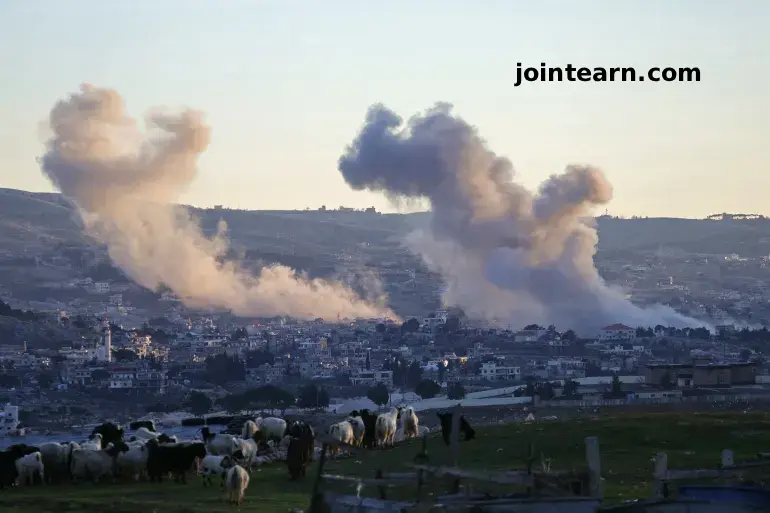
Beirut, January 16, 2026 — Israeli air and drone strikes have killed at least two people in Lebanon, according to the country’s Ministry of Public Health, while United Nations peacekeepers reported that a drone dropped a grenade near their troops, raising serious concerns over escalating violations of a fragile ceasefire with Hezbollah.
The latest incidents underscore growing instability along Lebanon’s southern border, where hostilities have persisted despite a ceasefire agreement that came into force in late 2024.
Fatal Israeli Attacks in Southern Lebanon
In a statement issued on Friday, Lebanon’s Ministry of Public Health confirmed that an Israeli strike targeting a vehicle in the southern village of Mansuri killed one person. A second person was reported killed overnight in the town of Mayfadun, also in southern Lebanon.
Israel claimed the individual killed in Mayfadun was a member of Hezbollah, alleging that he was involved in efforts to rebuild the group’s military infrastructure. Lebanese officials have not confirmed this claim and continue to describe the strikes as unlawful violations of Lebanese sovereignty.
In addition to the southern attacks, the Israeli military carried out multiple air strikes in eastern Lebanon’s Bekaa Valley, north of the Litani River. Residents in some areas reported receiving evacuation warnings ahead of the strikes, which targeted locations Israel says are linked to Hezbollah activity.
UN Peacekeepers Targeted by Drone Incident
Separately, the United Nations Interim Force in Lebanon (UNIFIL) reported a dangerous incident involving its peacekeepers. According to UNIFIL, a drone dropped a grenade near one of its patrols in southern Lebanon, prompting the mission to immediately request a halt to Israeli fire in the area.
It remains unclear whether the grenade detonated. UNIFIL said the incident placed both peacekeepers and civilians at serious risk and constituted a violation of UN Security Council Resolution 1701, which governs the cessation of hostilities between Israel and Hezbollah.
UNIFIL was first deployed in 1978 and its mandate was significantly expanded following the 2006 Israel-Hezbollah war. The force currently consists of more than 10,000 peacekeepers tasked with monitoring ceasefire violations and supporting the Lebanese army’s presence south of the Litani River.
The UN Security Council has approved a plan to end UNIFIL’s mandate by December 31, 2026, followed by a gradual drawdown of forces over the following year.
Ceasefire Under Increasing Strain
Despite the ceasefire agreement reached in November 2024, Israel has continued to carry out frequent strikes inside Lebanese territory, resulting in hundreds of casualties over the past year. Israeli forces also remain stationed on five strategic hills in southern Lebanon, further fuelling tensions.
Lebanese authorities say the ongoing attacks are part of a broader campaign by Israel — supported by the United States — to pressure Lebanon into disarming Hezbollah. Beirut has warned that further escalation could destabilize the entire country, which is already grappling with severe economic and political crises.
International and Regional Concerns
The continued violations have raised alarm among international observers, particularly following the reported drone incident involving UN peacekeepers. Any threat to UN forces risks undermining the international framework established to prevent renewed large-scale conflict along the Israel-Lebanon border.
Lebanon’s leaders fear that Israel could intensify strikes across the country to force faster action against Hezbollah’s arsenal, potentially dragging the region into another devastating war.
As ceasefire breaches mount and diplomatic pressure grows, the situation in southern Lebanon remains volatile, with civilians once again bearing the brunt of renewed hostilities.


Leave a Reply