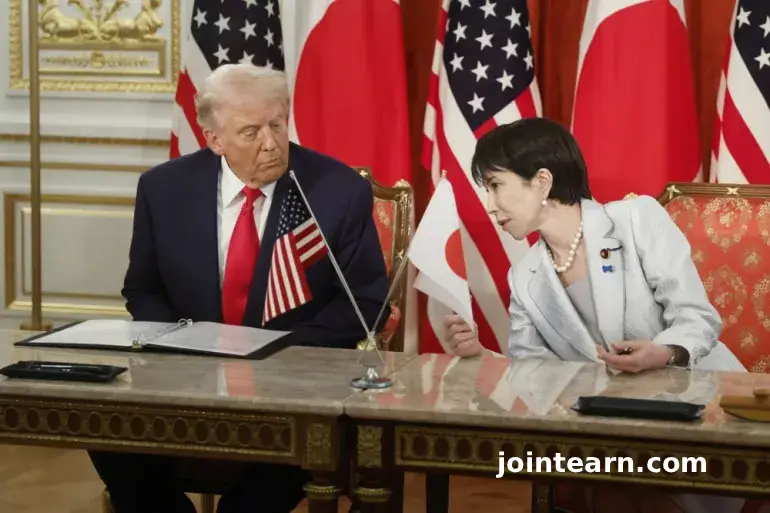
Japan has officially denied a report claiming that U.S. President Donald Trump advised Japanese Prime Minister Sanae Takaichi not to provoke China regarding Taiwan. The alleged advice was reportedly given following a phone call between Trump and Chinese President Xi Jinping, which touched on Taiwan’s status and broader U.S.–China relations.
At a news briefing on Thursday, Japan’s top government spokesperson Minoru Kihara dismissed the Wall Street Journal report, stating, “There is no such fact,” while declining to provide further details about the diplomatic exchange.
Background: Takaichi’s Taiwan Comments Ignite Beijing’s Anger
The diplomatic tensions between Asia’s two largest economies began earlier this month after PM Takaichi suggested that Japan might consider military intervention if Taiwan were attacked. China, which claims Taiwan as part of its territory, reacted strongly to the statement, condemning the remarks as “seriously erroneous.”
Following Takaichi’s comments, Beijing reportedly raised the issue during a phone call between President Xi and President Trump. According to the Wall Street Journal, Trump then allegedly arranged a call with Takaichi, advising caution to avoid provoking China. Japanese officials have since denied this report.
Takaichi herself confirmed that during her conversation with Trump, the two discussed his call with Xi as well as broader bilateral relations. “President Trump said we are very close friends, and he offered that I should feel free to call him anytime,” she stated.
Escalation of China-Japan Diplomatic Row
Beijing’s response to Takaichi’s initial Taiwan comments has been multifaceted:
- Diplomatic warnings: The Chinese government summoned Japan’s ambassador and warned its citizens against traveling to Japan.
- Travel advisories: The Chinese embassy in Tokyo issued additional warnings, claiming an uptick in crimes targeting Chinese nationals—a claim Japan’s Foreign Ministry has refuted. Japanese police data showed that overall violent crime, including murders, had decreased compared to 2024.
- Economic measures: Reports indicate China may ban Japanese seafood imports again, continuing the economic fallout from the dispute.
Chinese Foreign Ministry spokesperson Guo Jiakun reiterated that Beijing will not accept Takaichi’s comments and criticized Japan’s attempts to downplay the issue. “The Japanese side’s attempt to downplay, dodge, and cover up Prime Minister Takaichi’s seriously erroneous remarks by not raising them again is self-deception. China will never accept this,” Guo stated.
U.S.–Japan Relations and Regional Security Concerns
Trump’s public silence regarding Japan’s escalating dispute with China has caused unease in Tokyo. Some Japanese officials fear that the former president may prioritize U.S.–China trade relations over Taiwan’s security, which could embolden Beijing and increase tensions in East Asia.
Kazuhiro Maejima, a professor of U.S. politics at Sophia University, commented, “For Trump, what matters most is U.S.–China relations. Japan has always been treated as a tool or a card to manage that relationship.”
While Washington’s envoy to Tokyo affirmed U.S. support for Japan in the face of Chinese “coercion,” some Japanese lawmakers expressed disappointment, wishing for more explicit backing from the U.S. on security matters.
Summary of Key Points
- Japan denies that Trump advised PM Takaichi not to provoke China on Taiwan.
- PM Takaichi had suggested Japan might intervene militarily if Taiwan were attacked, angering Beijing.
- China has issued travel advisories and is considering banning Japanese seafood imports.
- U.S. support remains ambiguous, raising concerns in Tokyo about regional security.
- The situation underscores the fragile balance of East Asian geopolitics amid U.S.–China–Japan interactions.


Leave a Reply