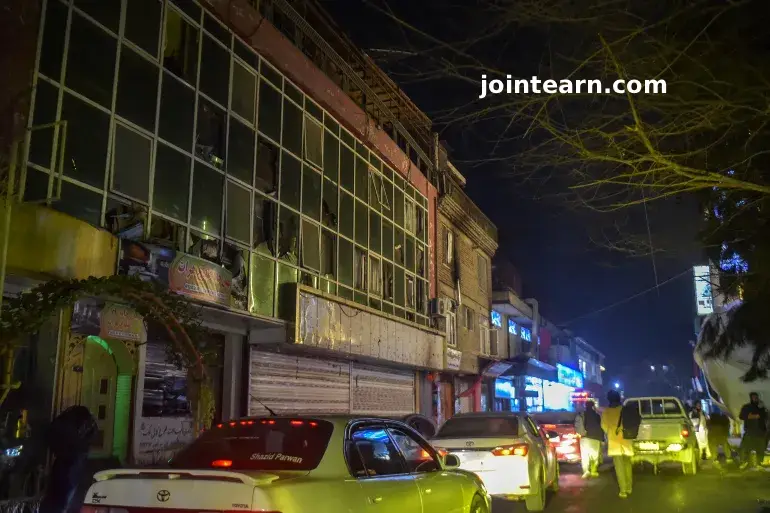
A deadly explosion ripped through a hotel restaurant in central Kabul, killing at least seven people, including a Chinese national, and injuring several others in one of the Afghan capital’s most heavily guarded neighbourhoods. The attack, later claimed by the ISIL (ISIS) affiliate in Afghanistan, has raised fresh concerns about security in the city despite a decline in large-scale violence in recent years.
The blast struck a Chinese-run restaurant inside a hotel in the Shahr-e-Naw district, an area known for housing foreign embassies, offices, shopping centres, and international organisations. Shahr-e-Naw is widely considered among the safest parts of Kabul, making the attack particularly alarming.
Explosion Hits Chinese-Run Restaurant in Secure Kabul District
According to Kabul police spokesperson Khalid Zadran, the explosion occurred on Monday near the restaurant’s kitchen area. The force of the blast shattered windows, tore through the building’s facade, and sent debris spilling onto nearby streets.
“One Chinese citizen and six Afghan nationals were killed, and several others were wounded,” Zadran said, adding that a child was among the injured.
The restaurant primarily served the Chinese Muslim community in Kabul and was jointly operated by:
- A Chinese Muslim businessman, Abdul Majid
- His wife
- An Afghan partner, Abdul Jabbar Mahmood
Authorities identified the Chinese victim as Ayub, though further details about the victims have not yet been released.
ISIL Claims Responsibility for Suicide Bombing
The Afghan branch of ISIL later claimed responsibility for the attack, stating that it was carried out by a suicide bomber. In a statement released via its Amaq news agency, ISIL said it had deliberately targeted Chinese citizens in Afghanistan.
The group cited what it described as “crimes by the Chinese government against Uighurs”, referring to Beijing’s policies in the Xinjiang region. Human rights organisations have long accused China of mass detention, forced labour, and cultural repression against the Uighur population—allegations that China strongly denies.
The statement underscores ISIL’s continued effort to internationalise its attacks and frame violence in Afghanistan within broader global grievances.
Hospitals Receive Casualties as Rescue Efforts Continue
The Italian humanitarian organisation Emergency, which operates a surgical hospital in Kabul, confirmed receiving a large number of victims following the explosion.
“Twenty people were received at EMERGENCY’s Surgical Centre in Kabul following the explosion,” the NGO said in a statement.
“Seven of them were dead on arrival. The figures are still provisional.”
Emergency added that four women and one child were among those injured, highlighting the civilian toll of the attack.
Videos Show Widespread Damage in Shahr-e-Naw
Videos shared on social media showed:
- Thick smoke rising from the damaged building
- A large hole blown through the restaurant’s exterior
- Shattered glass scattered across the road
- Motorists and pedestrians cautiously passing the blast site
Security forces quickly sealed off the area as investigators examined the scene and searched for additional threats.
Renewed Security Concerns Despite Drop in Attacks
Large-scale bombings in Kabul have become less frequent since the Taliban returned to power following the US withdrawal in 2021. Taliban authorities have repeatedly claimed they have restored security across the country.
However, ISIL affiliates remain active, continuing to carry out sporadic but deadly attacks, particularly targeting:
- Religious minorities
- Foreign nationals
- Diplomatic or symbolic locations
Analysts say the attack highlights the persistent challenge ISIL poses to the Taliban’s claims of stability, especially in urban centres.
China–Afghanistan Relations in Focus
China has maintained a diplomatic presence in Afghanistan and has pursued economic interests in the country, particularly in mining and infrastructure projects. Beijing has also engaged with Taliban authorities, calling for stability and security for Chinese nationals.
The targeting of a Chinese-run business may further complicate:
- China’s security calculations in Afghanistan
- Taliban efforts to reassure foreign investors
- Regional counterterrorism cooperation
Key Facts at a Glance
- Location: Shahr-e-Naw, central Kabul
- Casualties: 7 killed, several injured
- Victims: 1 Chinese national, 6 Afghans
- Claimed by: ISIL (ISIS) Afghanistan affiliate
- Type of attack: Suicide bombing
- Target: Chinese-run hotel restaurant
Conclusion: A Stark Reminder of Ongoing Threats
The Kabul hotel restaurant bombing serves as a stark reminder that, despite reduced violence overall, Afghanistan remains vulnerable to militant attacks, particularly from ISIL-linked groups seeking to undermine stability and attract global attention.
As investigations continue, the attack has once again placed the spotlight on security for civilians and foreign nationals in Afghanistan—and the fragile calm that still defines life in the capital.


Leave a Reply