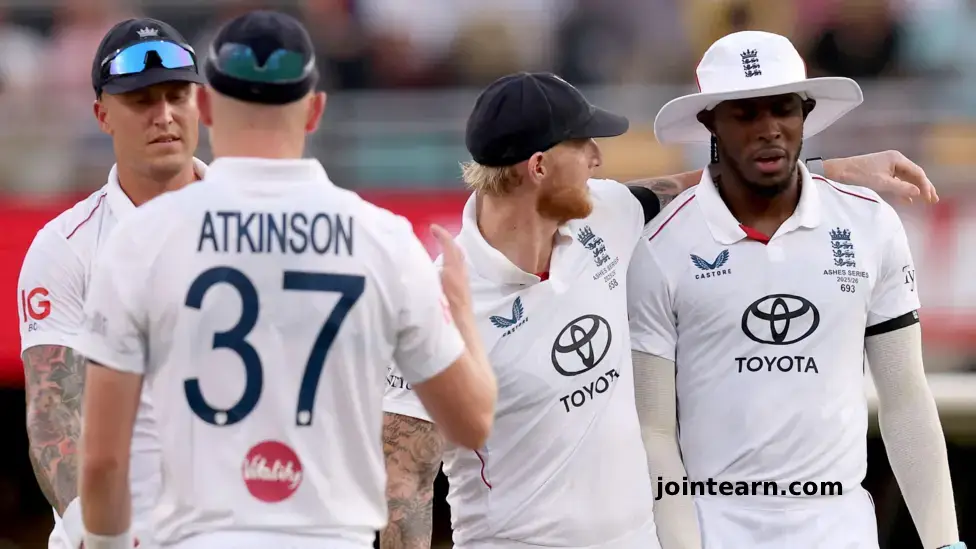
England’s crushing Ashes defeat has sparked familiar criticism, mostly aimed at their struggling batting lineup. Words like reckless, brainless, and unwilling to learn have dominated the headlines, but there’s another, more subtle issue threatening England’s campaign: their fast bowling attack.
In the second Test of the series, a bowling unit built for high-stakes moments faltered dramatically. Stuart Broad, one of England’s greatest ever bowlers, called the team’s first-innings bowling in Brisbane “the worst performance since 2008.” A lackluster start combined with a strangely flat finish allowed Australia to amass a par score with ease, then surpass it comfortably.
Broad isn’t exaggerating. Beyond that one innings, England’s bowling stats in 2025 are alarming. This year, Ben Stokes’ side has recorded its worst bowling average in 23 years and ranks as the sixth worst calendar year in 140 years of Test cricket.
Could England’s so-called “best-laid plans” be unraveling under the pressure?
A Statistical Overview: 2025’s Bowling Woes
Some of these poor numbers are explainable. England has faced seven consecutive Tests against India and Australia, with the Indian series played on exceptionally flat pitches in the UK. Their only other Test of the year, a four-day match against Zimbabwe, was similarly slow, allowing spinner Shoaib Bashir to dominate with nine wickets at Trent Bridge.
An all-pace attack initially looked promising during the Ashes opener in Perth, where England bowled Australia out for just 135. But subsequent performances, particularly the first innings in Brisbane with the game on the line, were disheartening.
Broad told the Sky Cricket podcast:
“I have not seen a whole group get it wrong and bowl short and wide… I have seen it on a really flat one but not on a pitch with uneven bounce and nip.”
The data backs him up. Australia scored 81 runs off the back foot in the first 20 overs at the Gabba—the highest on record for any team in a match’s first 20 overs. Brydon Carse conceded 95 runs in his first 12 overs, while Stokes gave away 64 runs in 11. England’s consistency in hitting the ideal 7-8m length plummeted from 31% in Perth to just 17% at Brisbane.
Leadership and Strategy: The Missing Link
One major factor behind the collapse is leadership—or the lack thereof. England went into Brisbane with a fast-bowling unit featuring Jofra Archer, Gus Atkinson, Brydon Carse, and a fully fit Ben Stokes. The plan was to leverage pace and bounce over experience, ignoring historical data showing bowlers under 83mph often outperformed faster bowlers in Australian conditions.
Injuries and selection decisions compounded the problem. Chris Woakes’ shoulder injury eliminated a senior tactical option, while Sam Cook was overlooked despite potential. Meanwhile, veteran James Anderson, now retired from regular Test cricket, has not been able to guide the attack directly.
Former England bowler Steven Finn argued that this is still the best attacking option available:
“They’re not one-dimensional… Archer is Archer, Atkinson gets steep bounce, Carse angles the ball in—these are their strengths.”
Yet, even Finn acknowledges that pace alone cannot compensate for a lack of on-field tactical leadership.
Individual Performances: Bright Spots Amid Chaos
Despite the collective failures, there are individual standouts. Archer has been England’s most effective bowler this series, producing false shots and ranking highest on CricViz’s Expected Average model, even surpassing Australia’s Mitchell Starc.
However, pace alone hasn’t delivered consistent results. Starc has maintained 72% of his deliveries on a good length or fuller, compared to Archer’s 45%. England must improve their bowling lengths to create more opportunities for wickets rather than just unsettling batters.
The Real Problem: Inexperience in Leadership Roles
Broad has pointed out a deeper structural problem: England’s bowlers are not “tacticians of the game.”
“There were a lot of times Archer was at mid-on, Atkinson deep cover, and Carse bowling… They would not say a word. Stokes has to make all of the decisions while bowling and captaining. It’s a lot to take on.”
Without Woakes’ 62-Test experience and Mark Wood now returning home, the attack is left with a dearth of senior leadership. Shoaib Bashir, with just 19 Test caps, is now the most experienced bowler in the touring frontline. The absence of seasoned tacticians has put immense pressure on Stokes and exposed a vulnerability that statistics alone cannot measure.
Conclusion: England’s Bowling Crisis Could Be Bigger Than the Batting Collapse
While England’s batting failures often dominate headlines, their fast bowling crisis in the 2025 Ashes is a more worrying structural issue. Lack of experience, limited tactical leadership, and inconsistency in execution have turned what should be a threatening pace attack into a liability. Without strategic guidance and better on-field decision-making, even their fastest bowlers may struggle to achieve their potential.
In the end, England’s Ashes problem is no longer just about runs—it’s about leadership, planning, and execution on the field.


Leave a Reply