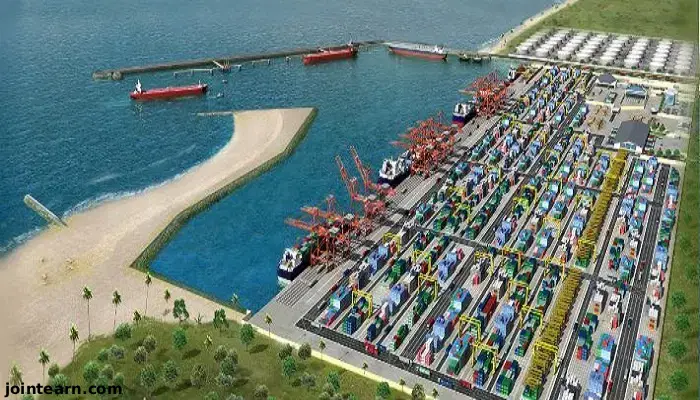
Lekki Deep Seaport has announced that it now operates at nearly 50 percent of its trade capacity, with steady month-on-month growth in container throughput since September 2025.
Recent data from Nigeria’s Trade by Top 10 Ports of Operation report shows that Lekki Deep Seaport handled an estimated N13.46 trillion in total trade value—including imports and exports—between the first and third quarters of 2025. This makes it the country’s second-largest port by trade value, ahead of Tin Can Island Port at N9.31 trillion and Onne Port at N6.76 trillion.
Speaking during an end-of-year media tour of the port, Managing Director and CEO of Lekki Port LFTZ Enterprise Limited, Mr. Wang Qiang, said the port’s near-half capacity operation reflects growing confidence from shipping lines and cargo owners. He attributed the growth to consistent increases in the number of twenty-foot equivalent units (TEUs) handled monthly.
The trade breakdown shows Lekki Port recorded N7.39 trillion in imports and N6.07 trillion in exports. Imports rose steadily each quarter, from N1.70 trillion in Q1, to N2.51 trillion in Q2, and N3.18 trillion in Q3. Exports also increased, from N303.6 billion in Q1 to N2.41 trillion in Q2, and N3.36 trillion in Q3.
Qiang emphasized that efficient multimodal connectivity is essential to sustaining growth. Barge operations, he noted, now account for about 10 percent of cargo movement. He also highlighted the ongoing Lagos–Calabar Coastal Road project, which is expected to ease congestion and improve port access. However, he stressed that rail connectivity remains critical given the growing industrial activity along the Lekki corridor.
“I believe the train option is something the government is concerned about, and with the level of industrial activities in this region, we expect it will be provided,” Qiang said. He also urged the government to adopt a simplified tax framework to support ease of doing business, citing Germany and other countries that allow a 30-day window for VAT remittance after goods are cleared.
Captain Jedrzej Mierzewski, CEO of Lekki Freeport Terminal (LFT), added that after just two years of operations, LFT has become the second-largest terminal in Nigeria. “We are the fastest-growing terminal in the country, combining modern infrastructure, operational excellence, and a clear ambition to become a leading transshipment hub for West Africa. Our growth supports the Nigerian economy by strengthening trade connectivity and helping to reduce the cost of foreign trade through efficient, reliable, and competitive port services,” he said.


Leave a Reply