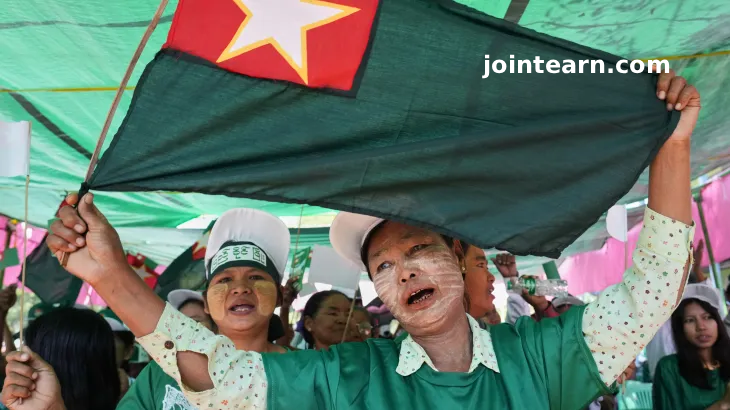
Myanmar’s military-backed political party, the Union Solidarity and Development Party (USDP), has strengthened its lead after the second round of voting in the country’s three-phase general election, according to official election body figures. Critics warn that the election is neither free nor fair and accuse the military of attempting to legitimize its rule following the 2021 coup.
USDP Dominates Second Round of Voting
State broadcaster MRTV, citing the Union Election Commission, reported that the USDP won 86 of 100 contested seats in the second round, held on Sunday, January 11. When combined with results from the first round on December 28, the USDP is on track to secure 182 of the 330 lower-house seats, giving it a majority in parliament.
The final phase of voting is scheduled for January 25, though ongoing armed conflicts prevent 65 townships from participating. Final results for both national and regional legislatures are expected to be announced by late January.
Election Held Amid Civil War and Conflict
Since the military seized power from Aung San Suu Kyi’s elected government in February 2021, Myanmar has been embroiled in civil war and armed resistance. The three-phase election schedule reflects the security situation, as thousands of citizens remain displaced, and many areas are too dangerous for voting.
During the first two rounds, the military government reported attacks on polling stations and government offices by armed groups opposing the junta. Despite these challenges, Major-General Zaw Min Tun, the military’s spokesperson, confirmed that parliament will convene in March, with a new government assuming duties in April.
International Concerns and Human Rights Criticism
Human rights groups, opposition parties, and international observers have widely criticized the polls, stating that the elections are designed to entrench military control rather than reflect the will of the people.
The election also unfolds against the backdrop of international legal scrutiny. The International Court of Justice (ICJ) is currently hearing a case brought by The Gambia, which accuses Myanmar of committing genocide against its Rohingya minority.
Political Landscape and Party Dynamics
Over 4,800 candidates from 57 political parties are contesting seats across national and regional legislatures. However, only six parties are competing nationwide, with the remainder participating in selected townships.
One such party, the People’s Pioneer Party, faces a potential legal challenge that could lead to its dissolution. Party officials, including Chairwoman Thet Thet Khine, were investigated for holding meetings with foreign embassy representatives in Yangon without prior approval from the election commission.
Restrictive Election Laws and Crackdown on Dissent
A new Election Protection Law imposes severe penalties for public criticism of the polls. Authorities have recently charged over 330 individuals for leafleting or online activity deemed critical of the elections, raising concerns about freedom of speech and political repression.
Looking Ahead
As Myanmar prepares for the final phase of voting, the USDP’s projected majority will likely consolidate the military’s control over the government. However, ongoing civil conflict, widespread displacement, and international legal pressure over the Rohingya genocide case continue to challenge the legitimacy and stability of the election process.
The outcome of Myanmar’s elections will not only determine domestic political control but also influence international relations, human rights monitoring, and regional stability in Southeast Asia.


Leave a Reply