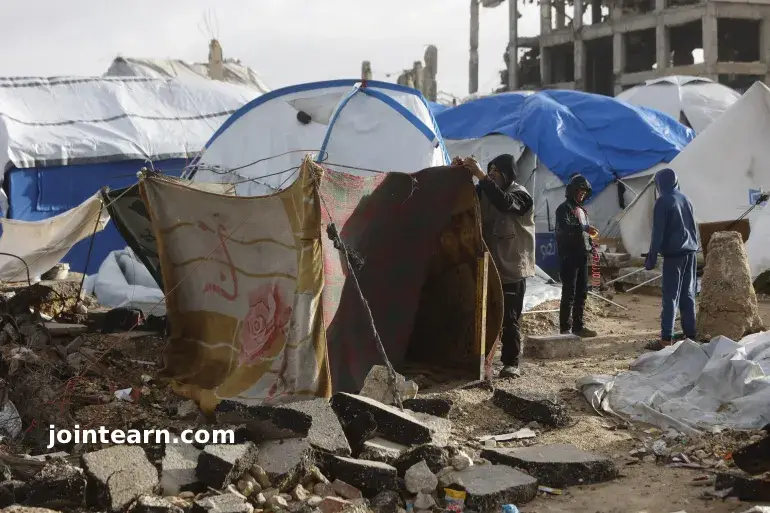
A powerful new winter storm is forecast to hit the Gaza Strip, threatening to worsen an already catastrophic humanitarian situation for hundreds of thousands of displaced Palestinians living in fragile tent camps that offer little to no protection from cold, rain, and strong winds.
After more than two years of Israel’s war on Gaza, nearly the entire population of the besieged enclave – close to two million people – has been forced from their homes. With residential neighbourhoods reduced to rubble, families have been left to survive in makeshift shelters that are rapidly collapsing under the weight of extreme winter conditions.
Majority of Displacement Tents Now Unusable
According to Gaza’s Government Media Office, the scale of destruction caused by recent storms is staggering. Of the approximately 135,000 tents erected in displacement camps across Gaza, 127,000 have been rendered unusable due to heavy rain, flooding, and high winds over the past week alone.
“The reality on the ground tells a very painful and grim story,” said Al Jazeera correspondent Tareq Abu Azzoum, reporting from Gaza City. “Hundreds of thousands of displaced families are still living in torn tents and roofless homes, fully exposed to the rain, cold, and freezing night temperatures.”
These shelters, often constructed from thin plastic sheets and salvaged fabric, were never designed to withstand winter storms. As temperatures drop and winds intensify, many tents have collapsed entirely, leaving families sleeping in the open.
Aid Restrictions Worsen Winter Emergency
Humanitarian workers and local officials say the crisis is being directly exacerbated by Israeli restrictions on aid and construction materials.
Israel has continued to block the entry of prefabricated mobile housing units, durable shelter materials, and sufficient quantities of fuel needed for heating. According to Abu Azzoum, there has also been no “free flow of essential humanitarian aid” despite repeated international warnings.
Under a United States-brokered ceasefire that came into effect on October 10, aid deliveries into Gaza were meant to increase dramatically. The agreement stipulated that at least 600 aid trucks per day would be allowed to enter the territory to address urgent civilian needs.
However, Gaza’s Government Media Office reports that since the ceasefire, only an average of 145 trucks per day have been permitted to enter – less than a quarter of what was promised.
Families Forced to Improvise to Survive
With formal assistance scarce, displaced Palestinians have resorted to desperate coping mechanisms to stay alive.
“Families are reinforcing their tents with plastic sheets, keeping all their clothes on through the night, and burning scraps inside the tents for warmth,” Abu Azzoum said. “Fuel is unaffordable, heating mechanisms are unavailable, and people are risking fires or toxic smoke just to keep warm.”
Winter conditions in Palestine can be severe even in normal circumstances. But this year, the cold has arrived on top of months of displacement, hunger, physical exhaustion, and psychological trauma, pushing already vulnerable communities to the brink.
Death Toll from Cold and Building Collapses Rising
The harsh weather has also caused previously damaged buildings to collapse, killing at least 25 people since mid-December, according to Gaza’s Ministry of Health.
Even more alarming is the rise in deaths linked directly to cold exposure. The Government Media Office reported last week that at least 24 people have died from the cold, including 21 children.
“All the victims were displaced Palestinians living in forced displacement camps,” the office said, underscoring the lethal consequences of inadequate shelter.
“The elderly, the sick, and children are among those most affected,” Abu Azzoum added, noting that these groups lack the physical resilience to withstand prolonged exposure to freezing temperatures.
Hospitals Overwhelmed by Cold-Related Illnesses
Gaza’s Civil Defence has warned that hospitals across the territory are seeing a surge in patients suffering from cold-related illnesses, particularly infants and young children.
A spokesperson said emergency services have received hundreds of distress calls as families seek help during freezing nights. Many children are arriving at medical facilities with hypothermia, respiratory infections, and complications linked to prolonged exposure to damp and cold conditions.
Medical staff, already operating under severe shortages of supplies, fuel, and electricity, are struggling to cope with the growing caseload.
Meteorological Warnings Add to Fears
The Palestinian Meteorological Department has issued fresh warnings of frost and freezing conditions as a polar air mass moves across large parts of Palestine. According to the Palestinian news agency Wafa, temperatures are expected to drop further on Tuesday night and Wednesday morning, increasing the risk to displaced families with no adequate shelter.
Humanitarian agencies fear the coming storm could further destroy remaining tents, displace families yet again, and push mortality numbers higher unless urgent action is taken.
A Preventable Humanitarian Disaster
Aid groups and local authorities stress that the suffering unfolding in Gaza this winter is not inevitable. With sufficient access for aid, shelter materials, heating fuel, and medical supplies, thousands of lives could be protected.
Instead, hundreds of thousands of Palestinians remain trapped between harsh winter storms and man-made restrictions, enduring a humanitarian catastrophe that deepens with every passing day.
As Gaza braces for another storm, families already stripped of homes, safety, and stability face the cold with little more than plastic sheets, borrowed blankets, and the hope that help will arrive before it is too late.


Leave a Reply