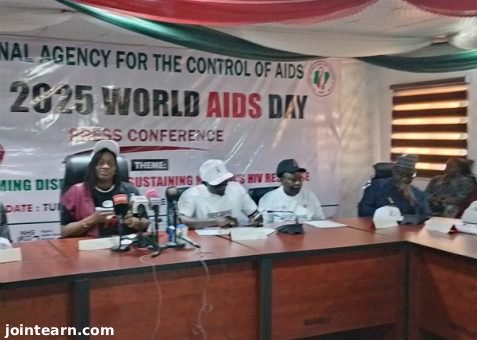
Nigeria has achieved two of the three global HIV targets for 2030, with 87% of people living with HIV diagnosed, 98% of those diagnosed receiving treatment, and 95% of those on treatment achieving viral suppression, the National Agency for the Control of AIDS (NACA) has announced.
According to the agency, these outcomes place Nigeria firmly on course to eliminate AIDS as a public health threat by 2030. The country has also recorded a 46% reduction in new HIV infections over the past decade and its highest-ever retention rate among people receiving treatment.
NACA’s Director General, Dr. Temitope Ilori, disclosed this on Tuesday in Abuja during a World AIDS Day briefing. She noted that the progress comes despite economic challenges, fluctuating donor funding, service gaps in remote areas, and Nigeria’s disproportionately high burden of paediatric HIV.
“Today, I stand before you to report that Nigeria remains firmly on track to end AIDS as a public health threat by 2030. We will not stop until that goal is achieved,” she said.
Ilori explained that 87% of Nigerians living with HIV know their status, 98% of them are on life-saving treatment, and 95% of those on treatment have suppressed viral loads, meaning they cannot transmit the virus.
She added that more Nigerians are now enrolled and retained in HIV care than ever before, with improvements also seen in early infant diagnosis and paediatric treatment—although these areas still need increased focus.
Ilori praised the role of civil society and community-based organisations in extending testing, treatment and prevention services to key populations and young people. In 2024 alone, 204,201 individuals from key populations accessed antiretroviral therapy with strong viral suppression results.
She also highlighted improved domestic financing, with several states boosting their HIV budgets and strengthening HIV Trust Funds. She credited President Bola Tinubu for approving $200 million to prevent service disruptions amid global funding uncertainties, calling it “leadership in action.”
Integration of HIV services into the broader health system has further strengthened Nigeria’s response, Ilori said, pointing to the establishment of the AIDS, Tuberculosis and Malaria Technical Working Group and expanded enrollment of people living with HIV in state health insurance schemes. Digital reporting tools, she noted, are also improving data quality and accountability.
Despite the gains, Ilori warned that challenges persist, including stigma, discrimination, reliance on external funding, insecurity in some communities and Nigeria’s still-high rates of paediatric HIV.
She called for increased domestic investment, stronger state-level collaboration, private-sector engagement and full implementation of the Prevention of Mother-to-Child Transmission (PMTCT) Acceleration Plan.
The DG outlined plans to expand HIV prevention among adolescents, young people and key populations, including broader access to Pre-Exposure Prophylaxis (PrEP). She said Nigeria also hopes to begin local production of HIV medicines to reduce dependence on imports.
UNAIDS representative Gabriel Undelikwo commended Nigeria’s progress, stressing the need to sustain leadership and community partnerships. “Together, we are overcoming disruptions and strengthening the national response to HIV,” he said.
Dr. Jay Samuels, Deputy CEO (Programmes) at APIN Public Health Initiatives, reaffirmed the NGO’s commitment to the national effort. He noted that APIN currently provides treatment for more than 20% of Nigerians living with HIV and will continue mobilising local resources to reduce dependence on international donors.
“We are leaving no stone unturned to ensure Nigerian patients are not entirely dependent on global goodwill,” he said.


Leave a Reply