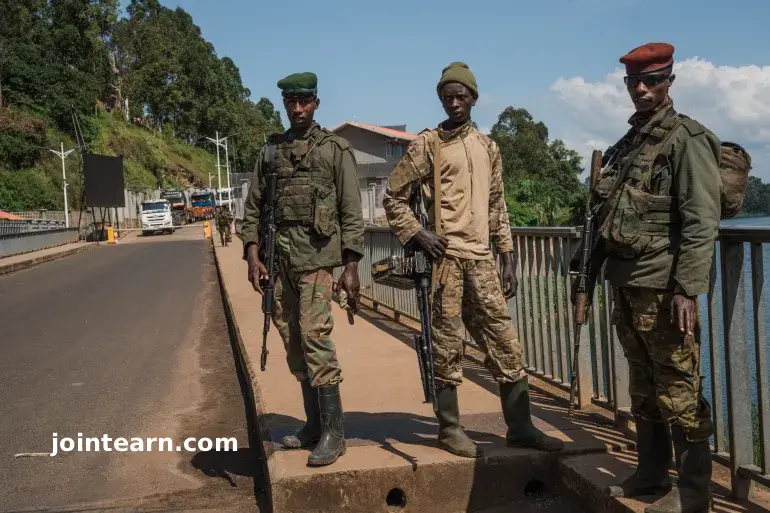
More than 400 civilians have been killed in eastern Democratic Republic of Congo (DRC) as fighting escalates between government forces and the Rwanda-backed M23 rebel group. The surge in violence comes despite a United States-mediated peace agreement signed last week in Washington, DC, by the Congolese and Rwandan presidents, which is now at serious risk of collapsing.
According to regional officials, the M23 offensive has already displaced around 200,000 people in South Kivu province, as the rebels consolidated control over the strategic town of Uvira, a key port on the northern tip of Lake Tanganyika, directly across from Burundi’s largest city, Bujumbura.
Civilians Bear the Brunt
The South Kivu provincial government reported that more than 413 civilians, including women, children, and youth, were killed by bullets, grenades, and bombs in areas between Uvira and Bukavu, the provincial capital. A government spokesperson accused Rwandan forces and foreign mercenaries of violating the recent ceasefire and agreements signed in Washington and Doha.
“The forces present in the city are composed of Rwandan special forces and some of their foreign mercenaries, operating in clear violation of the ceasefire as well as the Washington and Doha agreements, in total disregard of the commitments made,” the spokesperson said.
M23’s Strategic Gains
M23 forces reportedly captured Uvira on Wednesday after a rapid offensive that began earlier this month. The town had previously served as the base for the Kinshasa-appointed provincial government, following M23’s capture of Bukavu in February 2025. Despite sporadic gunfire, residents ventured out in search of food after spending the previous day sheltering or fleeing to the countryside.
Local teacher Godefroid Shengezi told Reuters, “The government told us that Uvira would never fall and that the situation was under their control. The reality today is quite the opposite.”
International Response
The United States and the United Nations have repeatedly accused Rwanda of backing M23, a group that had hundreds of members in 2021 but now reportedly fields around 6,500 fighters. While Rwanda denies direct involvement, it has acknowledged deploying troops and missile systems in eastern DRC, claiming it was for national security purposes. UN experts estimate up to 4,000 Rwandan soldiers are currently in the region.
Earlier this week, the US State Department called on Rwanda to prevent further escalation, urging both M23 and Rwandan troops to halt offensive operations and for Rwanda to withdraw its forces. Rwanda, however, blamed Congolese forces for violating the ceasefire, citing ongoing attempts by Kinshasa to recapture lost territories.
Humanitarian Crisis
Eastern DRC has become a flashpoint for one of the world’s most severe humanitarian crises. More than seven million people have been displaced as over 100 armed groups compete for control over mineral-rich territories along the border with Rwanda. Civilians continue to bear the brunt of violence, with reports of massacres, forced displacements, and infrastructure destruction.
The collapse of the US-brokered peace deal and continued M23 offensives underscore the fragile security situation in the DRC, raising urgent concerns for international humanitarian organizations and regional stability.


Leave a Reply