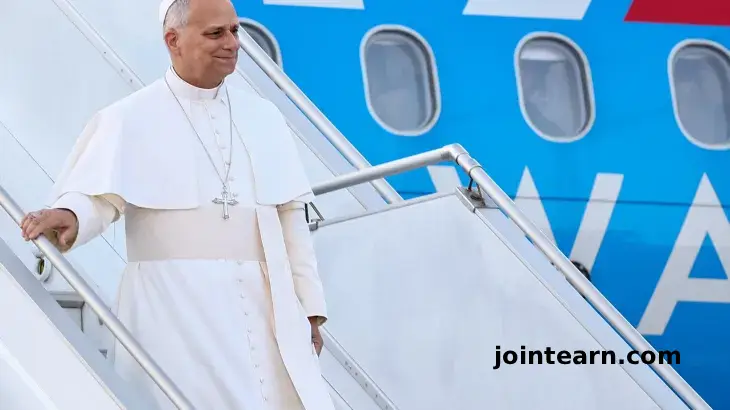
Beirut, Lebanon – November 30, 2025: Pope Leo XIV, the leader of the Roman Catholic Church, has once again emphasized the Vatican’s firm stance on a two-state solution as the only viable path to resolving the long-standing Israel-Palestine conflict. Speaking ahead of his meetings in Lebanon, the pontiff described the two-state approach as “the only solution” capable of delivering justice and lasting peace for both Israelis and Palestinians.
This statement comes as part of Pope Leo’s first international apostolic journey, following his previous visit to Turkiye. The pope’s visit to Lebanon marks the second and final leg of his maiden foreign trip as head of the Catholic Church, highlighting the Vatican’s commitment to international diplomacy and interfaith dialogue.
Pope Leo XIV Arrives in Lebanon
Pope Leo XIV arrived at Rafic Hariri International Airport in Beirut, greeted by local officials, clergy, and citizens waving Lebanese and Vatican flags. Security reinforcements, including the Lebanese army and internal security forces, were deployed along the papal route to ensure safe passage.
The pontiff is scheduled to meet Lebanon’s President Joseph Aoun, the Arab world’s only Christian head of state, and deliver a major address to authorities and diplomats at the presidential palace. In addition, he will lead an outdoor mass on the Beirut waterfront, visit local cities, and pray at the site of the 2020 Beirut port explosion that killed over 200 people.
Speaking to journalists en route to Lebanon, Pope Leo highlighted Lebanon’s religious diversity, noting that approximately 30% of the population is Christian, while the majority are Muslim, split evenly between Shia and Sunni branches. He stressed the importance of his visit as a beacon of hope and peace for the region.
Reiterating the Two-State Solution
During his flight from Turkiye to Lebanon, Pope Leo XIV confirmed that discussions with Turkish President Recep Tayyip Erdogan touched upon the ongoing conflicts in Gaza and Ukraine. He described Turkiye as having “an important role to play” in mediating these conflicts.
On the Israel-Palestine issue, Pope Leo reaffirmed the Vatican’s longstanding position advocating for a two-state solution. He explained that the establishment of a Palestinian state encompassing East Jerusalem, the West Bank, and Gaza is widely recognized internationally as the only sustainable approach to ending the decades-long conflict.
“We know that in this moment, Israel doesn’t accept this solution, but we see it as the only one that can offer a resolution to the conflict they are living in,” Pope Leo said.
“We are friends with Israel and the Palestinians alike. Our role is to serve as a mediating voice, bringing both sides closer to a solution that ensures justice for all.”
The pope has, however, refrained from directly addressing Israel’s ongoing military operations in Gaza during his Turkiye visit. Israeli Prime Minister Benjamin Netanyahu has historically opposed the creation of a Palestinian state, arguing that it could empower Hamas and pose security risks for Israel.
Welcomed as a Symbol of Hope in Lebanon
The Lebanese public and religious leaders have warmly received Pope Leo’s visit. Sheikh Sami Abi al-Muna, a leading Druze cleric, described the pontiff’s presence as “a glimmer of hope” for Lebanon’s diverse communities. Citizens in Beirut have expressed optimism that the pope’s visit will promote reconciliation and peace amid ongoing regional tensions.
While the pope will not travel to southern Lebanon—an area frequently targeted by Israeli airstrikes—he will pass through Hezbollah-controlled southern suburbs, where local Imam al-Mahdi Scouts will hold a welcoming ceremony. His schedule also includes visits to a psychiatric hospital and other key institutions, emphasizing humanitarian concerns alongside diplomatic efforts.
Farah Saadeh, a Beirut resident, described the visit as a blessing:
“The pope is coming to bless us and for the sake of peace. We hope his presence will help bring a lasting calm to our country.”
Before Pope Leo’s arrival, Hezbollah urged him to denounce what they perceive as “injustice and aggression” against Lebanon, referencing ongoing Israeli military actions. The pontiff’s balanced diplomatic approach aims to navigate these sensitive issues while maintaining his focus on dialogue and reconciliation.
The Role of Modern Papacy in International Diplomacy
Pope Leo XIV’s visit underscores the evolving role of the modern papacy in international diplomacy. Beyond leading the Catholic Church, the pope engages in global peacemaking efforts, meeting local communities, spreading interfaith dialogue, and addressing humanitarian crises. Travel abroad has become a vital tool for the Vatican to project moral authority, mediate conflicts, and encourage peaceful resolutions in troubled regions like the Middle East.
As the world watches Pope Leo XIV’s journey, his emphasis on a two-state solution for Israel and Palestine serves as a reminder of the Vatican’s commitment to justice, peace, and humanitarian principles, offering hope for a more stable and harmonious Middle East.


Leave a Reply