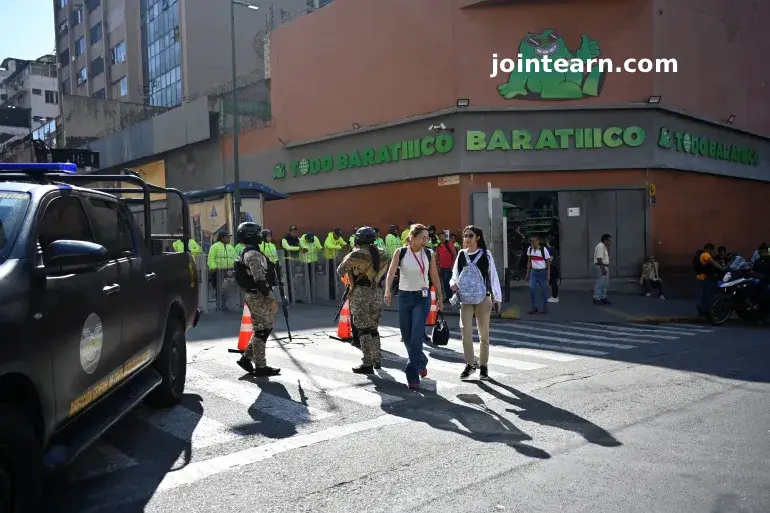
Caracas, Venezuela – Residents of Venezuela’s capital are experiencing a tense and unsettling atmosphere in the wake of the U.S. military operation that led to the abduction of President Nicolás Maduro. Markets are quieter than usual, essential goods are more expensive, and citizens are scrambling to secure basic supplies amid fears of further instability.
Shoppers Confront Scarcity and Price Spikes
In downtown Caracas, shoppers are navigating long lines and heightened security measures as they attempt to purchase food and household necessities. The normally bustling streets of the capital were eerily quiet on Monday, two days after the U.S. bombardment and the capture of Maduro.
At the central market of Quinta Crespo, many shopkeepers had closed their businesses due to fears of looting or unrest. Meanwhile, stores that remained open faced long queues under the midday sun, with officers from the Bolivarian National Police maintaining order.
Shoppers focused on non-perishable goods such as rice, corn flour, and canned foods, preparing for potential disruptions in supply chains.
“I’m looking for basic necessities, given the situation the country is going through,” said Carlos Godoy, a resident of western Caricuao. “We are waiting to see what happens. We are all in suspense, in uncertainty.”
Essential Goods See Dramatic Price Increases
The U.S. military operation has exacerbated Venezuela’s already fragile economy, leading to noticeable price spikes. Carlos Godoy noted that powdered milk was being sold at $16 per kilogram—an exorbitant price for local families.
Betzerpa Ramírez, another shopper, observed that hygiene items have become even more expensive than staple food products. Alexandra Arismendi, a mobile phone shop employee at the Sambil mall, criticized recent price surges, particularly for eggs, which now cost $10 per carton.
The lack of foot traffic in commercial areas has also hurt small business owners. Many employees, like Arismendi and her colleague María Gabriela, have been hesitant to attend work due to security concerns, relying on taxis instead of public transport to commute safely.
“There has been no usual activity. It has been one of the strangest days in recent months,” said Gabriela.
Venezuela’s Economic Struggles Persist
Venezuelans have faced chronic economic instability over the past decade, driven by government mismanagement, corruption, and international sanctions. The collapse of global oil prices under Maduro’s administration devastated the petroleum-dependent economy, triggering runaway inflation.
By 2018, Venezuela’s inflation rate exceeded 130,000 percent, according to the central bank, and the COVID-19 pandemic worsened shortages of essential goods and medical supplies. Since Maduro’s disputed 2024 election victory, official inflation statistics have not been released, leaving many residents uncertain about the country’s financial outlook.
Fallout from the U.S. Military Offensive
The U.S. military strike, launched early Saturday, targeted installations in Caracas, Aragua, Miranda, and La Guaira. The operation resulted in the deaths of at least 80 people, according to Venezuelan officials cited by The New York Times.
Although the offensive concluded within hours, President Donald Trump warned of a potential “second wave” of attacks if Venezuela failed to comply with U.S. demands. In response, the Venezuelan government declared a state of emergency, initiating the “national search and capture of everyone involved in the promotion or support for the armed attack by the United States.”
Despite the abduction, the Venezuelan administration insists that Maduro remains the country’s legitimate leader.
Public Sentiment and Daily Life
While some residents are calmly continuing daily routines, many Caracas citizens are exercising caution. The mood in the capital is tense, but not yet at the level of unrest seen during the 2024 elections, when massive protests erupted across the city.
“I feel that there was more tension around the elections,” said Arismendi. “Thank God we’re not at that level right now, but I feel like we’re not that far off either.”
As Venezuelans navigate the immediate aftermath of the U.S. military intervention, concerns over security, access to food, and inflation remain paramount. Analysts warn that without stabilization, the situation could worsen, further straining families already struggling with economic hardship.


Leave a Reply